


No doc business loans for property managers: complete 2026 guide

Property managers’ no doc business financing is funding marketed around reduced paperwork, with the aim of covering business expenses or financing property without a traditional income-document package. No doc business loans for property managers are not necessarily document-free, and a business working-capital loan is not interchangeable with an investment-property mortgage.
TL;DR
- No doc business loans for property managers require separating operating expenses from property financing before choosing a lender.
- Loanguys offers DSCR and bank-statement mortgage programs; do not assume these are unsecured business loans.
- Client rent collections and security deposits are not the same as earned management revenue.
- Choose financing by repayment source, collateral, and documentation—not the no doc label.
Why this matters
Your property management company and your rental investments have different financing needs. Payroll belongs to the operating business; a rental acquisition belongs to the property transaction. Mixing the two leads to applications for loans that cannot serve your purpose.
For a 2026 financing decision, first identify whether repayment comes from management fees, personal qualifying income, or an investment property’s rent. Then choose the documentation route that supports that source. The guide to bank-statement loans for property managers and leasing agents covers the mortgage side of this distinction.
Why reduced-documentation financing matters for property managers
Property managers handle money that belongs to different parties. Tenant payments, owner distributions, maintenance reimbursements, security deposits, and earned management fees do not all represent company income. A deposit total alone cannot explain repayment capacity.
Your role also matters. Managing properties for clients does not give your company ownership of those properties or the right to pledge them as collateral. If you also own rentals, those assets require a separate financing analysis.
Reduced-documentation financing changes the evidence a lender reviews; it does not eliminate underwriting. A bank-statement mortgage evaluates qualifying income through statements under the lender’s rules. A debt-service coverage ratio, or DSCR, loan focuses on an investment property’s income relative to its required debt payments, alongside other eligibility requirements.
For property managers in 2026, the useful question is not “Who asks for nothing?” It is “Which records prove the right repayment source?”
How to choose financing that matches your business
1. Define what the money must accomplish
Start with a spreadsheet, not an application. Divide your funding request into 3 categories: business operations, property acquisition, and property improvements. Assign each expense to the entity responsible for paying it.
Software, employee compensation, and business marketing are operating expenses. Buying a rental creates a property-financing need. Repairs to a client’s building require a separate review of your management agreement and the owner’s funding responsibilities.
Write a short purpose statement before contacting lenders. Explain the expense, the borrower, and the intended repayment source. If the request combines unrelated needs, separate them before comparing programs; one loan label does not make every use permissible.
- List each planned use of funds.
- Identify the business or property owner responsible.
- Separate recurring expenses from one-time projects.
- Name the income source expected to repay the debt.
2. Separate earned revenue from client money
Export bank transactions and reconcile them against your bookkeeping and owner statements. Identify earned management fees, leasing fees, and other company revenue separately from money collected for clients. Keep the supporting records together.
A property manager’s deposits can look larger than the business’s actual earnings when rent passes through an account before distribution. Internal transfers create another source of double counting. Explain those movements rather than presenting every deposit as revenue.
For your 2026 application, prepare a transaction summary that connects earned fees to management agreements and accounting entries. Ask your accountant to resolve unclear classifications. Do not treat client-held money as a reserve for your own loan obligations.
- Reconcile earned fees to your accounting records.
- Identify client rent collections and owner distributions.
- Flag transfers between your own accounts.
- Separate security deposits from company funds.
- Document reimbursements without automatically calling them income.
3. Match the financing route to the repayment source
Create a simple decision sheet yourself: business cash flow, qualifying borrower income, or property income. This narrows the lender conversation before you submit sensitive documents. Ask each provider which route the proposed loan actually uses.
For a mortgage request, Loanguys offers DSCR, bank-statement, bridge, fix-and-flip, and short-term rental loan programs. Loanguys is best for property managers comparing mortgage programs for real estate, rather than seeking unsecured operating-capital financing. Review the loan services against your intended transaction.
The benefit is access to different property-financing approaches through a mortgage broker. The limitation is equally important: a mortgage program is not a general business credit line, and eligibility still depends on underwriting.
- Match operating expenses with business-purpose funding.
- Discuss bank-statement mortgages when documented business income supports qualification.
- Discuss DSCR financing for an eligible investment-property transaction.
- Consider bridge financing only with a defined repayment or exit plan.
4. Ask exactly what “no doc” removes
Request a written document checklist before completing a full application. Ask whether “no doc” means no tax returns, no traditional employment verification, or simply a shorter application. These descriptions are not equivalent.
Bank-statement financing still involves statements. Property-based financing still requires evidence about the property and transaction. Depending on the program, lenders also review identity, credit, ownership, assets, liabilities, and collateral.
Keep 2 lists: documents required to assess the request and conditions required before funding. This separates an initial indication from a completed underwriting decision. A 2026 advertisement should never replace the lender’s written checklist or loan agreement.
- Ask which income documents are unnecessary.
- Request the full statement-history requirement.
- Confirm credit and identity review requirements.
- Ask which property and entity records apply.
- Identify conditions that remain after initial review.
5. Test repayment using money you control
Build a cash-flow forecast with your existing records. For the management business, use earned company revenue and company expenses—not gross tenant collections. For an owned rental, evaluate that property separately.
DSCR measures income relative to debt service, but residential investment and commercial programs do not always use identical calculations. Ask the lender which rent figure, expenses, and payment components enter its calculation. Do not import a ratio from an unrelated program and assume it applies.
Also ask about loan-to-value, or LTV: the loan amount relative to the property value used for underwriting. A workable repayment picture does not remove collateral requirements. Test weaker collections and higher expenses before deciding the payment fits.
- Forecast repayment from earned fees or owned-property income.
- Exclude client-held balances from your available cash.
- Ask for the lender’s DSCR calculation method.
- Confirm the property valuation used for LTV.
- Check repayment under a weaker-income scenario.
6. Compare obligations beyond the application
Put written proposals side by side in a spreadsheet. Compare the same borrowing purpose and transaction structure so that a short application does not distract from a difficult repayment obligation.
For operating-business financing, examine payment frequency and collection rights. For property financing, examine collateral, maturity, guarantees, prepayment restrictions, and any conditions attached to releasing funds. Ask whether the agreement creates a balloon payment—a remaining balance due at maturity.
Bridge financing needs particular attention to the exit. A planned refinance is not an approved refinance, and a planned sale is not a completed sale. Identify what happens if that exit fails before you accept the obligation.
- Confirm payment frequency and repayment structure.
- Identify collateral and personal guarantees.
- Review prepayment and default provisions.
- Check maturity and any balloon balance.
- Ask what happens if the planned exit fails.
7. Submit a consistent application package
Assemble your records in a secure folder before submitting them through the lender’s approved channel. Use consistent business names, ownership details, property addresses, and explanations across the application. Resolve discrepancies instead of leaving the underwriter to interpret them.
For a mortgage conversation with Loanguys, explain whether you manage client properties, own rentals, or do both. Include the transaction purpose and the income source you want evaluated. This gives the broker a clear basis for discussing programs without assuming approval.
Keep client information protected. Ask which records are necessary and how to submit them securely; do not alter statements or remove information without instructions. For your 2026 file, retain the written requirements and explanations you submitted.
- Match entity names to formation and ownership records.
- Explain transfers and unusual deposits consistently.
- Separate management-company records from rental-property records.
- Use the provider’s secure submission process.
- Keep copies of submitted documents and written conditions.
Compare financing options for property managers
Choose the financing category before choosing a provider. The table separates operating-business funding from property-backed financing; it does not imply that every provider offers every option.
Business working-capital loan or credit line
- Best for: Management companies funding eligible operating expenses
- Main advantage: Aligns borrowing with business cash-flow needs
- Key limitation: Documentation, guarantees, and repayment obligations depend on the provider
Bank-statement mortgage
- Best for: Self-employed property managers seeking a mortgage using qualifying income documented through statements
- Main advantage: Offers an alternative income-documentation route
- Key limitation: Deposits require analysis; client money is not automatically qualifying income
DSCR investment-property loan
- Best for: Property managers buying or refinancing eligible rentals they own
- Main advantage: Centers income analysis on the investment property
- Key limitation: Does not turn client-managed properties into the borrower’s collateral
Bridge loan
- Best for: Property owners addressing a temporary financing gap with a defined exit
- Main advantage: Connects a property transaction to a later sale or refinance
- Key limitation: Maturity creates repayment risk if the exit fails
Fix-and-flip loan
- Best for: Investors buying and renovating property for resale
- Main advantage: Aligns financing with a renovation-and-sale project
- Key limitation: Requires project underwriting and is not ordinary management-company working capital
The practical distinction is ownership and repayment. A management contract supports an explanation of service revenue; a deed establishes property ownership. Neither replaces the other.
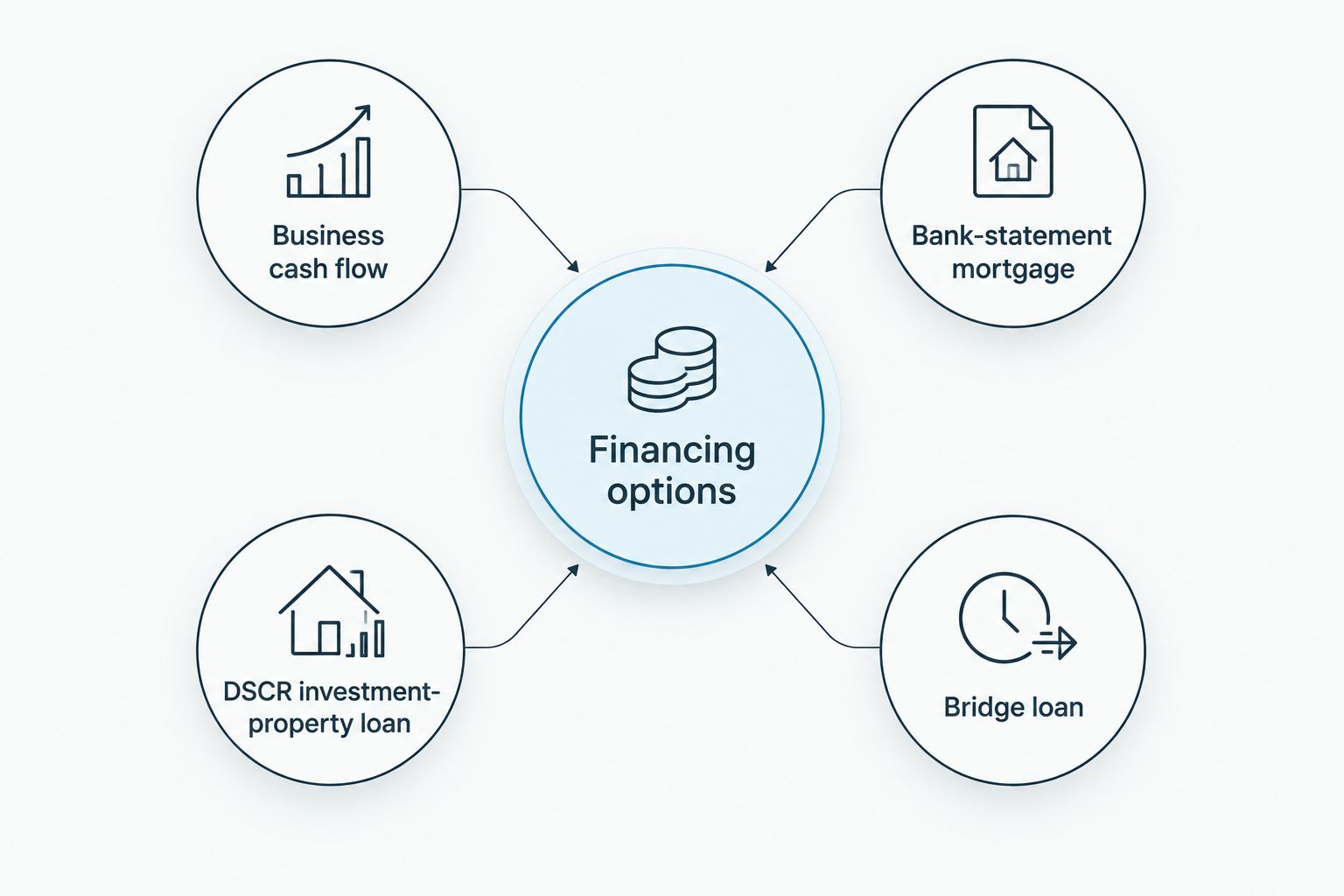
Choose the financing category before comparing providers.
Common mistakes property managers make
Counting all rent deposits as business income
Gross rent collected for owners is not the same as earned management revenue. Present a reconciliation that identifies your fees and explains pass-through funds. Otherwise, the deposit total misrepresents the income available to repay company debt.
Treating managed properties as owned collateral
A management agreement does not give your business authority to mortgage a client’s property. Confirm the legal owner and authorized borrower before discussing property-backed financing. Managing the building and owning the building are different roles.
Choosing a DSCR loan for payroll
A DSCR investment-property loan is not an unsecured payroll facility. If you are considering a property refinance to release equity, confirm permitted proceeds, ownership, and transaction requirements separately. Do not assume every property loan funds everyday business expenses.
Treating an initial response as final approval
An application acknowledgment or preliminary discussion does not establish that all underwriting conditions are satisfied. Get outstanding requirements in writing before making commitments that depend on financing. Ask who issues the lending decision and what remains unresolved.
Using client balances as your safety cushion
Money held for owners or tenants does not become company liquidity because it appears in an account you administer. Build your repayment plan around funds your business is entitled to use. Have your accountant or attorney address uncertain ownership or trust-account questions.
FAQ
Can property managers get a business loan without tax returns?
Some financing programs use alternative documentation rather than tax returns, but requirements depend on the lender and loan type. Ask whether the request is for business working capital or a mortgage, then obtain the applicable document checklist.
Does no doc mean the lender will not check anything?
No doc does not mean no underwriting. A provider can still require identity, credit, bank, entity, or collateral records even when traditional income documents are not required.
Can I count rent collected for clients as my business income?
Rent collected on behalf of property owners is not automatically your management company’s income. Separate earned fees from owner funds, security deposits, reimbursements, and account transfers before presenting revenue.
Is a DSCR loan better than a business credit line?
A DSCR loan and a business credit line serve different purposes. DSCR financing supports eligible investment-property transactions, while a business credit line addresses eligible operating-business needs under its agreement.
Can I use a client’s rental property as collateral?
You cannot pledge a client’s property merely because you manage it. Property-backed borrowing requires the legal owner’s participation and the authority and documentation required for the transaction.
Does Loanguys offer no doc business working-capital loans?
Loanguys is a mortgage broker offering DSCR, bank-statement, bridge, fix-and-flip, and short-term rental loan programs. Do not treat those mortgage programs as an offer of unsecured business working-capital financing.
What should I prepare before contacting a lender in 2026?
Prepare a clear funding purpose, borrower ownership details, and records supporting the intended repayment source. Property managers should also reconcile earned fees separately from money held or collected for clients.
One last thing
The cleanest deposit history is not necessarily the largest deposit history. For a property manager, a smaller total clearly reconciled to earned fees tells a more accurate story than gross collections that include owner money.
Before applying, write one sentence explaining who owns the money that will repay the loan. If the answer includes a client or tenant, correct the repayment plan first.


