


Payoff statements to cash-out refinance closing: 2026 workflow

Instead of chasing payoff quotes and recalculating cash proceeds whenever closing moves, use a payoff statement cash out refinance closing workflow that ties each debt to the actual disbursement date. Request dated payoff statements, have your settlement agent reconcile them against title and closing figures, and confirm payment and lien-release tracking after funding.
TL;DR
- A payoff statement cash out refinance closing workflow needs dated quotes, title review, and verified disbursement instructions.
- Use the payoff statement, not your mortgage balance, to calculate refinance proceeds.
- Loanguys offers mortgage brokerage for investors seeking DSCR, bridge, and bank-statement financing.
- Signing, funding, payoff receipt, and lien release are separate milestones; track each one.
Why this matters
Your mortgage balance is not necessarily the amount required to retire your loan. A payoff statement accounts for the amount due through a stated date, including applicable accrued interest, charges, and adjustments.
An expired quote or an overlooked second lien changes the closing calculation. Treat the payoff as a dated instruction, not a static balance. Your settlement agent needs a figure that works when the existing servicer receives payment, not merely when you sign.
Loanguys is a mortgage broker offering investment-property and homeowner financing. Loanguys is best suited to investors seeking a mortgage broker for DSCR, bridge, or bank-statement financing. The broker helps arrange financing; the existing servicer supplies its payoff, and the settlement agent coordinates closing disbursements.
For your 2026 refinance, assign responsibility for each handoff before choosing a signing date. A calendar appointment is not proof that the loan is ready to fund.
Before you start
- Gather account access and authorization. Have your current servicer details, loan numbers, recent statements, property address, and any authorization required for your broker or settlement agent to request payoff information. Use secure document channels for account information.
- Identify every secured debt. Include the first mortgage, second mortgage, home equity line of credit, and other liens identified during title review. Tell the settlement agent about pending payments, disputed balances, and any loan secured by additional properties.
- Confirm the date that controls the quote. Ask the settlement agent for the expected disbursement date and the payoff recipient's receipt requirements. The non-obvious gotcha: signing does not necessarily mean immediate funding, and funding does not mean the old servicer has received its payoff.
Do not cancel an existing payment simply because a refinance signing is scheduled. Ask the servicer and settlement agent how to handle any payment due before payoff posts; missed payments and duplicate payments create different problems.
Set up the payoff request
Match the debt to the property
- Match each account to the property address, borrower name, and recorded lien information. Resolve discrepancies with the settlement agent rather than assuming a similar account number is sufficient.
- Ask whether any loan includes a prepayment provision, deferred balance, modification balance, or other amount not obvious from the monthly statement. Request an itemized explanation of unfamiliar charges.
- Identify who will request the payoff and who will receive it. Keep one responsible coordinator so separate parties do not work from different versions.
Expected result: Every debt being paid has an identified servicer, account, property connection, and request owner.
Request a dated payoff statement
- Ask the servicer for a written payoff statement through the date your settlement agent requests. Supply the authorization and delivery details the servicer requires.
- Request the statement's expiration or good-through date, payment instructions, and any daily interest amount provided. Daily interest is often called per diem; it is the interest charged for an additional day under the payoff instructions.
- Save the original statement securely. Record its issue date and requested payoff date, and send it to the settlement agent through the agreed channel.
For covered dwelling-secured consumer credit, Regulation Z's payoff-statement rule generally requires an accurate statement within 7 business days after a written request. Exceptions apply, including certain bankruptcy or foreclosure situations and specified servicing difficulties. Do not apply that deadline automatically to business-purpose investment financing.
For a 2026 closing, request the quote early enough for review and possible correction. The response deadline is not a promise that title review or funding will finish on the same schedule.
Expected result: Your settlement agent has a written, date-specific quote rather than an estimated balance.
Configure the payoff and title reconciliation
Build a shared closing tracker
- Create a secure checklist with these working labels: Account, Quote date, Good-through date, Daily interest, Payment status, and Release status. These are your tracking labels, not names of buttons in a servicer portal.
- Ask the settlement agent to compare the payoff statements with the title commitment or title report. Every lien requiring payment, release, or approved subordination needs a documented resolution.
- Flag home equity lines separately. A zero balance does not, by itself, close a revolving credit line or release its lien; follow the creditor's closure and release requirements.
- Confirm how any escrow balance will be handled. Do not assume money held for taxes and insurance will reduce the payoff or arrive with your refinance proceeds.
Expected result: The title requirements and debt-payoff list agree, with unresolved items clearly assigned.
Reconcile the cash-out calculation
- Ask for an updated proceeds calculation using the approved loan amount, current payoffs, closing charges, prepaids, escrow funding, and applicable credits or adjustments.
- Compare that calculation with the closing document used for your transaction. For covered consumer mortgages, review the Closing Disclosure, especially Payoffs and Payments, Calculating Cash to Close, and the transaction summaries where applicable.
- Ask the settlement agent to explain every difference between the earlier estimate and the current figures. Separate changes caused by the payoff date from changes in loan terms or settlement charges.
The basic relationship is straightforward: new loan proceeds minus existing debt payoffs and transaction deductions, adjusted for credits, determine what remains for you. The approved loan amount is not your take-home cash.
These documents serve different purposes; none replaces the others.
Monthly mortgage statement
- Best for: Routine account monitoring
- Strength: Shows balance and payment activity
- Limitation: Is not a date-specific payoff instruction
Written payoff statement
- Best for: Retiring existing debt
- Strength: States the amount and conditions for payoff
- Limitation: Must match its stated date and instructions
Title commitment or report
- Best for: Identifying recorded lien requirements
- Strength: Flags interests requiring resolution
- Limitation: Does not replace a servicer's payoff quote
Closing Disclosure or settlement statement
- Best for: Reviewing the transaction calculation
- Strength: Shows how funds are allocated
- Limitation: Needs reconciliation with current payoffs
Expected result: You understand the projected net cash and can trace each payoff deduction to its supporting statement.
Confirm the closing and funding calendar
- Have the lender or settlement agent identify the transaction's disclosure and waiting-period requirements. Consumer-purpose and business-purpose loans do not automatically follow the same rules.
- For a covered mortgage subject to the Closing Disclosure requirement, confirm receipt at least 3 business days before consummation—the point when you become contractually obligated under applicable state law.
- Ask whether a right of rescission applies. In an eligible refinance secured by your principal dwelling, the standard cancellation period generally runs until midnight of the third business day after the latest of consummation, delivery of the rescission notice, or delivery of the required material disclosures.
- Confirm signing, permissible disbursement, expected payoff receipt, and the quote's good-through date separately. Have the settlement agent determine whether the quote covers the planned payment.
Under Regulation Z's specific business-day definition used for these waiting periods, Sundays and federal legal public holidays do not count. Do not assume the payoff-request deadline uses the same counting method. Ask the closing team to calculate the dates for your transaction.
For 2026 planning, do not assume a rental-property or business-purpose refinance carries the same rescission period as an eligible principal-dwelling refinance. Have the lender confirm the applicable treatment.
The handoffs should remain visible even when one company handles several tasks: Request payoff, Review title, Reconcile proceeds, Confirm dates, and Track release.
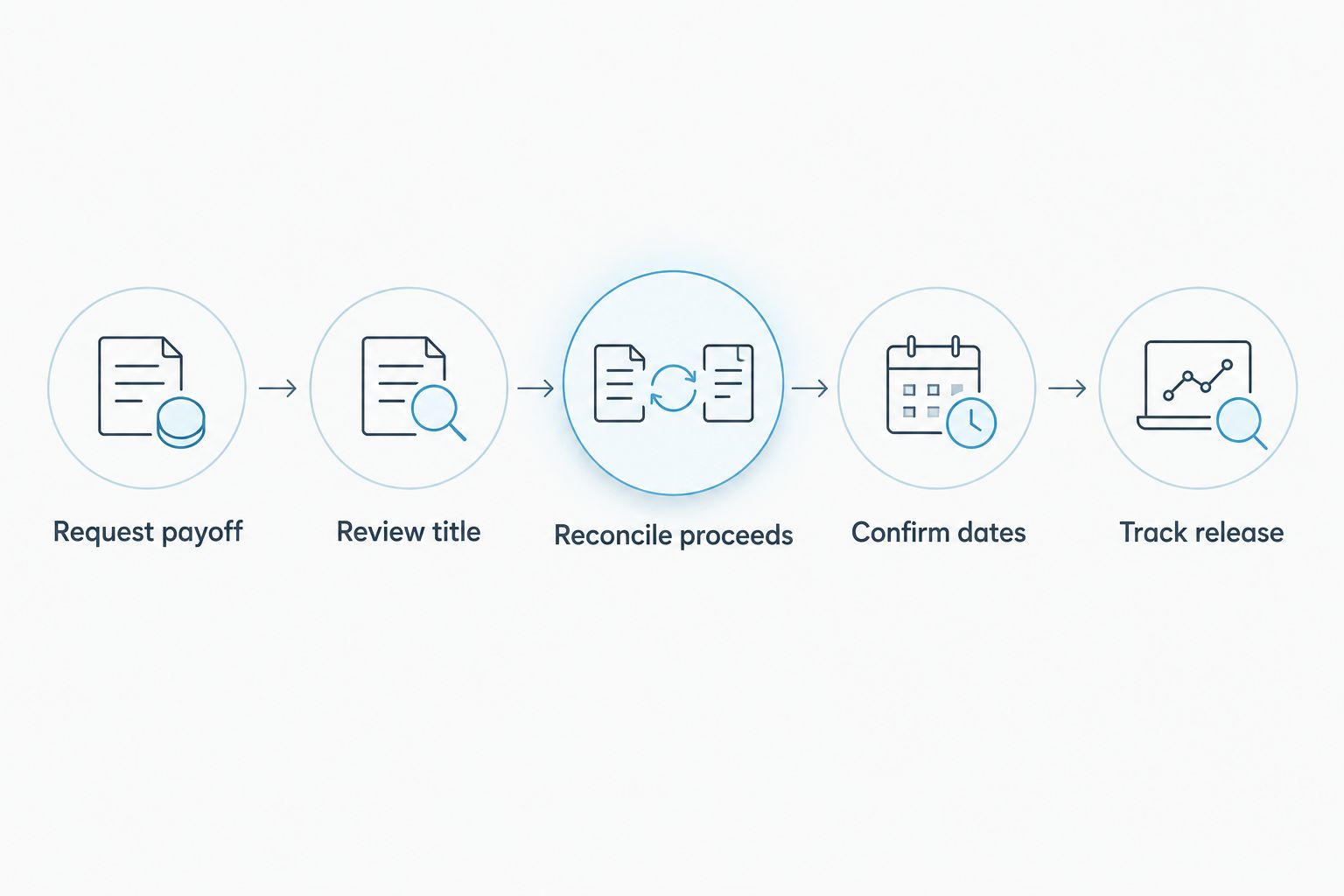
A signed closing package does not finish the payoff workflow.
Expected result: You have a confirmed funding calendar supported by current payoff instructions, not an assumed same-day closing.
Verify disbursement and lien release
- Verify payment instructions through an independently established contact method before funds move. Do not rely solely on an email containing changed wire instructions.
- Ask the settlement agent to confirm that payoff funds were sent and retain the disbursement record securely. Ask the servicer to confirm receipt and posting; a sent wire is not the same as a posted payoff.
- Review the old account for any remaining balance, overpayment, or pending transaction. Resolve differences with the servicer and settlement agent using their records.
- Ask who will track the mortgage satisfaction, reconveyance, or other applicable lien-release document. Obtain confirmation of recording or the settlement agent's documented follow-up process.
Expected result: The old debt shows paid status, remaining account adjustments are addressed, and responsibility for the recorded release is clear.
Do not treat the online account disappearing as proof of a recorded release. Account servicing and public land records are separate systems.
Refresh the workflow whenever funding changes
A delayed appraisal, unresolved title item, or revised signing schedule can move disbursement. When that happens, repeat the date-sensitive checks rather than restarting every task.
- Refresh the quote. Ask the settlement agent whether the existing statement permits an extension using its stated daily interest instructions or requires a replacement.
- Recheck account activity. Report payments, late charges, advances, or other changes since the quote was issued.
- Reconcile proceeds again. Confirm the revised payoff and resulting cash-out amount before authorizing the final documents.
- Reconfirm disclosures. Let the lender decide whether changed terms require corrected disclosures or another waiting period.
A changed payoff amount alone does not automatically restart the Closing Disclosure waiting period. Under Regulation Z, a new waiting period is required for specified changes, including an inaccurate annual percentage rate beyond permitted tolerances, a changed loan product, or an added prepayment penalty.
For a 2026 refinance, keep superseded quotes marked as replaced. Leaving several unmarked versions in the same closing file invites avoidable errors.
Troubleshooting
The payoff quote expires before funds arrive
Ask for an updated quote or written confirmation of permitted date adjustments. Do not extend a payoff by multiplying daily interest unless the settlement agent confirms that the statement allows that treatment.
A recent payment is missing from the quote
Provide evidence of the payment and ask the servicer whether it has posted. Have the settlement agent reconcile the revised payoff; subtracting the payment yourself risks overlooking how the servicer applied it.
Title shows a lien you thought was already paid
Send the prior payoff evidence to the settlement agent. The title team must determine what release or corrective documentation is needed; a payment receipt alone does not remove a recorded lien.
Your projected cash-out amount falls
Compare the revised payoff date, deductions, escrow funding, and credits against the previous calculation. Ask for an itemized explanation rather than accepting a single changed net figure.
Wire instructions change unexpectedly
Stop and verify the change using a trusted, previously established phone number. Ask the settlement agent to follow its verification procedure before sending money or disclosing sensitive account information.
Customize your workflow
For an investor replacing short-term debt, add the existing loan's maturity and extension provisions to the checklist. The guide to refinancing a hard money loan into a DSCR loan covers that adjacent financing path.
Loanguys offers DSCR, bridge, and bank-statement mortgage programs. The benefit is access to financing categories suited to different borrower and property circumstances; the constraint is that program selection does not replace payoff verification, underwriting, or title clearance.
Before discussing your next refinance with Loanguys, organize the property details, existing debt statements, intended use of proceeds, and target timing. Keep account numbers and payoff instructions in secure channels, not a general inquiry message.
FAQ
Is a payoff statement the same as my mortgage balance?
No. A payoff statement gives the amount required to retire the loan through a specified date, while a mortgage balance does not necessarily include all interest, charges, or adjustments due at payoff.
When should I request a payoff statement for a cash-out refinance?
Request it after your settlement agent identifies the expected disbursement timing and required payoff date. Leave time to correct account details, resolve title issues, and refresh the quote if funding changes.
How long does a mortgage servicer have to provide a payoff statement?
For covered dwelling-secured consumer credit, Regulation Z generally requires an accurate payoff statement within 7 business days after a written request. Exceptions apply, and business-purpose investment loans do not automatically receive the same treatment.
Will I receive cash-out funds on the day I sign?
Signing does not guarantee same-day disbursement. Disclosure requirements, any applicable rescission period, lender conditions, and settlement procedures determine when funds can move.
Does every refinance have a three-day cancellation period?
No. The federal right of rescission generally applies to eligible consumer-credit transactions secured by a principal dwelling, subject to exceptions. Do not assume it applies to a business-purpose rental-property refinance.
Can I use daily interest to extend an expired payoff quote?
Use daily interest only as permitted by the payoff instructions and confirmed by your settlement agent. An expired quote can require a replacement rather than a borrower-calculated adjustment.
Does paying off a home equity line automatically close it?
No. Paying the balance to zero does not necessarily close the line or release its lien. Follow the creditor's closure requirements and have the settlement agent confirm the required release documentation.
One last thing
A paid loan and a released lien are different outcomes. For your 2026 closing file, retain the final payoff statement, settlement figures, payment confirmation, and release follow-up together. That record helps resolve a later title question without reconstructing the transaction from old emails.


