


Quicken Loans alternatives for investment property loans

Quicken Loans, now operating as Rocket Mortgage, offers an online mortgage application process and conventional investment-property financing. A conventional mortgage is not the same financing structure as a rental-income-based loan or a renovation loan. The best Quicken Loans alternative in 2026 is Loanguys if you need DSCR, bank-statement, fix-and-flip, or bridge financing; a portfolio bank if you need a loan evaluated for that bank's own portfolio.
TL;DR
- Loanguys is the program-focused choice among quicken loans alternatives for investment property loans, including DSCR and bridge financing.
- Rocket Mortgage remains a conventional investment-property financing option for borrowers whose income and property meet underwriting requirements.
- Portfolio banks offer another route when you want a lender that retains loans rather than selling them.
- Seller financing depends on the owner's agreement and requires careful legal review.
Why this matters
Your financing problem determines the right alternative. A self-employed borrower with substantial business deductions faces a different qualification question from an investor buying a house that needs major repairs.
Changing lenders without changing the loan structure does not necessarily solve either problem. First identify whether the obstacle is your income documentation, the property's condition, rental-income treatment, or the planned borrowing entity.
For a 2026 purchase, compare programs against the actual transaction—not a lender's name recognition. A loan that works for a completed rental is not automatically suitable for buying, renovating, and selling a property.
Quicken Loans alternatives at a glance
The comparison below separates a named mortgage broker from other financing channels. Portfolio banks and seller financing are categories, not endorsements of a particular institution or seller.
Quicken Loans / Rocket Mortgage
- Best for: Conventional investment-property borrowers
- Standout feature: Online mortgage application process
- Difference from Quicken Loans / Rocket Mortgage: Baseline for comparing conventional financing
- Main limitation: Borrower and property must meet the selected program's requirements
Loanguys
- Best for: Investors seeking DSCR, bank-statement, renovation, or bridge programs
- Standout feature: Mortgage broker offering multiple investor loan types
- Difference from Quicken Loans / Rocket Mortgage: Explicit program selection includes DSCR, fix-and-flip, bridge, and bank-statement loans
- Main limitation: Each program still requires underwriting; broker status is not an approval guarantee
Portfolio bank
- Best for: Borrowers seeking a lender-held loan
- Standout feature: Bank retains the loan in its portfolio
- Difference from Quicken Loans / Rocket Mortgage: Ask about the bank's own credit policy rather than assuming conventional requirements apply
- Main limitation: Lending criteria and property eligibility depend on the institution
Seller financing
- Best for: Buyers negotiating directly with a willing property owner
- Standout feature: Seller carries an agreed portion of the purchase financing
- Difference from Quicken Loans / Rocket Mortgage: Financing terms are negotiated with the owner
- Main limitation: Requires seller agreement, sound documentation, and review of existing liens
Choose the underwriting method before choosing the provider. An online application, broker relationship, bank relationship, or owner negotiation is only the route into that financing decision.
1. Loanguys: best for matching investor loan types
Loanguys is an investment-property mortgage broker offering DSCR, fix-and-flip, bridge, bank-statement, and short-term rental loan programs. That program range makes it a relevant alternative when your transaction needs something other than a standard conventional mortgage. Start by describing the property, your income source, and whether you intend to hold or sell.
Where Loanguys shines
- Rental-income-based financing: DSCR programs focus on the relationship between qualifying property income and debt service.
- Self-employed income documentation: Bank-statement programs provide a different documentation route from conventional tax-return-based qualification.
- Renovation and transition plans: Fix-and-flip and bridge programs address different stages of an investment project.
- Short-term rental financing: An explicitly stated program category gives vacation-rental investors a relevant starting point.
Where it falls short
- A broker is not the same as the institution funding your loan. Ask who underwrites, funds, and services the transaction.
- Alternative documentation does not remove credit, collateral, or other underwriting requirements.
- The available program categories do not establish that your specific property, entity, or renovation plan qualifies.
Head-to-head: broker programs versus conventional financing
Income approach
- Investor-focused broker programs: Ask about DSCR or bank-statement qualification
- Quicken Loans / Rocket Mortgage conventional route: Review personal qualifying income and conventional rental-income treatment
Project purpose
- Investor-focused broker programs: Fix-and-flip and bridge programs are explicitly offered
- Quicken Loans / Rocket Mortgage conventional route: Confirm that the selected mortgage fits the property's condition and intended use
Application preparation
- Investor-focused broker programs: Match the transaction to a program before assembling documents
- Quicken Loans / Rocket Mortgage conventional route: Prepare documents for the chosen conventional mortgage
Best for: Investors who need a program-specific financing discussion rather than another conventional application.
Verdict: Hold until the program matches your property and exit plan; proceed only after reviewing written terms.
2. Portfolio bank: best for a lender-held financing discussion
A portfolio bank retains loans rather than originating every loan for sale into the secondary market. That distinction creates a useful question: will the institution evaluate your transaction under its own portfolio lending policy? It does not establish that the bank will accept a difficult property or borrower.
Where portfolio banks shine
- You can ask directly about the institution's own investment-property credit policy.
- A bank relationship gives you a place to discuss the property alongside your wider financial position.
- Portfolio lending provides a distinct channel to compare with conventional mortgage financing.
Where portfolio banks fall short
- Retaining a loan does not mean relaxed underwriting.
- A bank's lending territory, eligible properties, and borrower requirements differ by institution.
- A portfolio mortgage is not automatically a renovation loan, construction loan, or blanket mortgage.
Loan ownership
- Portfolio bank: Bank retains the loan in its portfolio
- Quicken Loans / Rocket Mortgage conventional route: Conventional loans are structured for applicable mortgage-market requirements
Main qualification question
- Portfolio bank: Does the transaction fit the bank's portfolio policy?
- Quicken Loans / Rocket Mortgage conventional route: Does the transaction fit the selected conventional program?
Property fit
- Portfolio bank: Confirm directly with the institution
- Quicken Loans / Rocket Mortgage conventional route: Confirm against the selected program's eligibility rules
Best for: Investors seeking a direct conversation with a bank about a lender-held loan.
Verdict: Hold until the bank confirms property eligibility and provides written terms.
3. Seller financing: best for a negotiated purchase structure
Seller financing lets a willing owner carry financing as part of a property sale. You negotiate the debt terms with the seller instead of relying entirely on a new institutional mortgage. The owner's willingness is essential.
Where seller financing shines
- The buyer and seller can negotiate the financing structure together.
- Financing becomes part of the purchase negotiation rather than a separate lender-only decision.
- It offers a distinct route when the seller is willing to receive payments over time.
Where seller financing falls short
- The seller can decline, regardless of how well the arrangement suits your plans.
- Existing mortgages and due-on-sale provisions require legal review.
- A balloon payment creates a future repayment obligation; refinancing is not guaranteed.
Decision-maker
- Seller financing: Property owner, subject to legal and existing-loan constraints
- Quicken Loans / Rocket Mortgage conventional route: Mortgage lender and applicable underwriting requirements
Documentation
- Seller financing: Negotiated purchase and financing documents
- Quicken Loans / Rocket Mortgage conventional route: Mortgage application and lender-required closing documents
Main dependency
- Seller financing: Seller consent and a legally sound structure
- Quicken Loans / Rocket Mortgage conventional route: Borrower and property eligibility
Best for: Buyers negotiating with an owner who is willing and legally able to carry financing.
Verdict: Hold until a real estate attorney reviews the financing documents and title position.
Match the loan to the actual obstacle
The useful distinction among Quicken Loans alternatives for investment property loans is not simply conventional versus unconventional. It is which evidence supports repayment and which loan structure fits the project.
Use these starting points when comparing financing in 2026:
- Rental income: Ask about DSCR financing when the property's income is central to the qualification discussion.
- Business income: Ask about bank-statement financing when you need an alternative way to document self-employment income.
- Renovation: Ask about fix-and-flip financing when repairs and a planned sale define the transaction.
- Temporary financing: Ask about a bridge loan when repayment depends on a later sale or refinance.
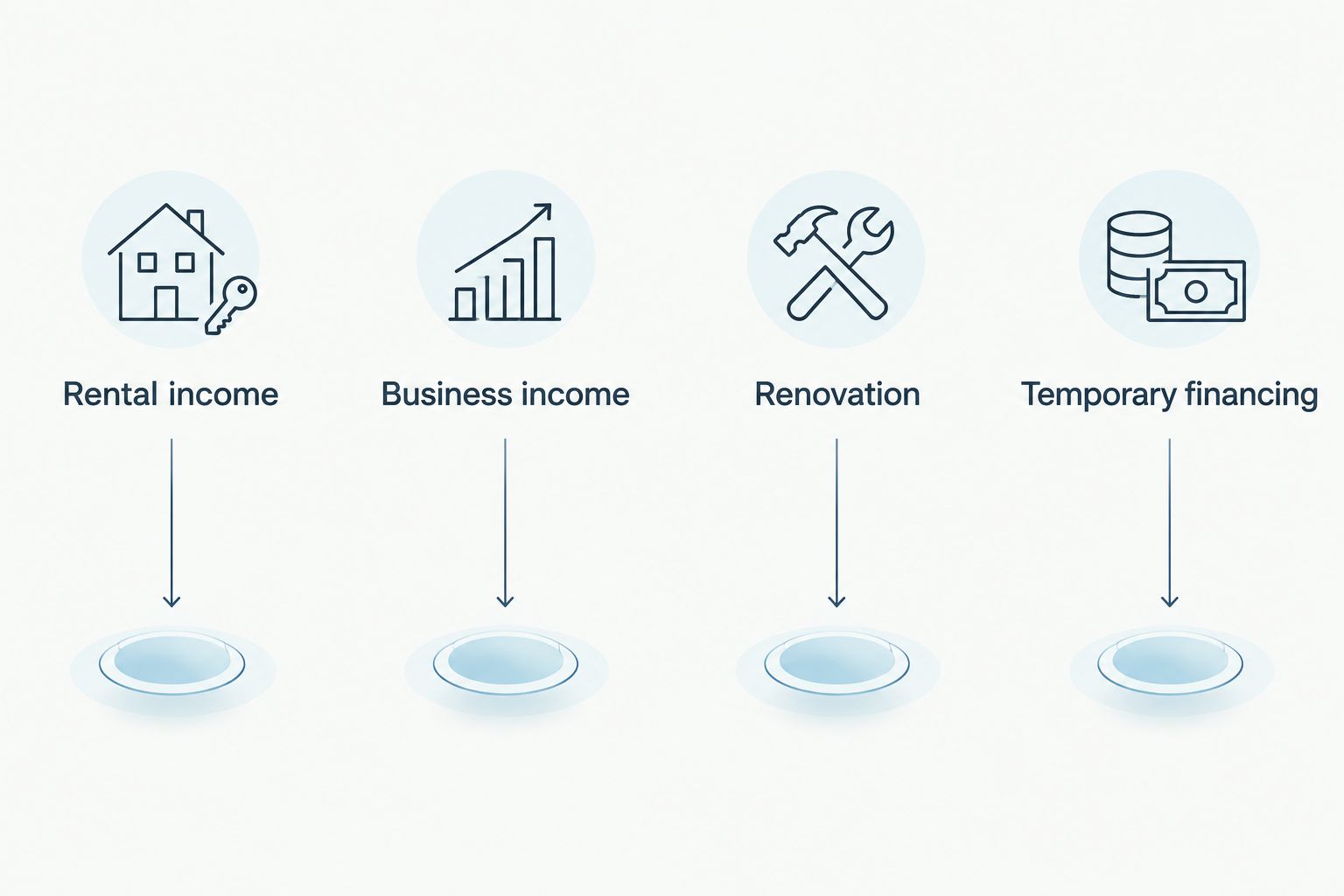
Identify the financing obstacle before choosing a lender.
Understand the ratios without assuming a lender minimum
DSCR means debt-service coverage ratio. It compares qualifying income with the debt payments used in the lender's calculation. A 1.00x ratio means the qualifying income equals those debt payments; it does not mean the property covers every operating expense or meets a lender's approval threshold.
LTV means loan-to-value ratio: the loan amount divided by the applicable property value. Ask which value the lender uses, especially when your project involves improvements. An as-is value and an after-repair value describe different property conditions.
Property classification matters too. Conventional residential mortgage frameworks generally cover 1–4-unit properties; a 5-unit building falls outside that standard residential category. Confirm the program before treating an apartment building like a single-family rental.
Why investors look beyond Quicken Loans
There are specific reasons to compare financing channels. None requires a claim that Rocket Mortgage has poor service, changed its policies, or cannot handle your application.
Your income documentation needs another route
Self-employed income requires careful documentation. Bank statements and tax returns provide different evidence, and deposits do not automatically equal qualifying income.
Ask how the program treats business expenses, transfers, and inconsistent deposits. The goal is a defensible income calculation—not avoiding scrutiny.
Your project includes substantial renovation
Buying a completed rental and financing a rehabilitation project are different transactions. A renovation plan introduces questions about scope, contractor arrangements, inspections, and the release of funds.
Ask the lender to confirm whether the financing covers acquisition, repairs, or both. Do not assume a standard purchase mortgage will fund the work.
Your ownership or rental plan needs confirmation
An LLC purchase raises questions about the borrowing entity, guarantees, and title. A short-term rental raises questions about permitted use and acceptable income evidence.
Get those answers before changing ownership or committing to a loan. The guide to qualifying for an investment-property loan using an LLC covers a related preparation topic.
What to request before choosing an alternative
Compare written proposals for the same transaction in 2026. If the property, borrowing entity, loan purpose, or income assumptions differ, the proposals are not directly comparable.
Request clear answers on:
- Qualification: Which income documents and property-income calculations support approval?
- Collateral: Which property types and conditions qualify?
- Repayment: Is the loan fully amortizing, interest-only, or subject to a balloon payment?
- Restrictions: What prepayment provisions, guarantees, or entity requirements apply?
- Execution: What must happen before funding, and who handles each remaining condition?
- Exit: If you plan to refinance, which future qualification assumptions does that plan depend on?
A broker conversation is most useful when you bring the address, intended use, purchase contract if available, income details, and renovation scope. Describe uncertainties rather than leaving them for underwriting to discover.
Discuss your investment financing
Ask Loanguys which loan program fits your property, income documentation, and hold-or-sell plan.
When staying with Rocket Mortgage makes sense
Stay with Rocket Mortgage if a conventional investment-property mortgage fits your income, property, ownership structure, and repayment plan. The existence of specialty programs is not a reason to use one unnecessarily.
You do not need to switch simply because you are self-employed or buying a rental. First establish whether conventional qualification works. Then compare an alternative against that actual option, not against an assumed rejection.
For a straightforward 2026 rental purchase, the right decision is the financing structure you understand and can support with documentation. Provider selection follows that decision.
FAQ
What's the best Quicken Loans alternative for investment property loans?
Loanguys is the program-focused alternative for investors seeking DSCR, bank-statement, fix-and-flip, bridge, or short-term rental financing. A portfolio bank or seller-financed purchase serves a different financing need; compare the structure before choosing the provider.
Are Quicken Loans and Rocket Mortgage different lenders?
Quicken Loans now operates under the Rocket Mortgage name. Treat Rocket Mortgage as the current benchmark when comparing conventional investment-property financing.
Is a DSCR loan better than a conventional rental-property mortgage?
A DSCR loan is not automatically better than a conventional mortgage. Compare whether property-income-based qualification or conventional borrower-income qualification fits your transaction, along with repayment terms and restrictions.
Can bank statements help a self-employed investor qualify?
Bank-statement loan programs use bank statements as an alternative income-documentation route. The lender still evaluates the deposits and applies its underwriting rules; total deposits are not automatically qualifying income.
Does a DSCR loan with a 1.00x ratio guarantee approval?
A 1.00x DSCR does not guarantee approval. It means qualifying income equals the debt payments used in that calculation, while credit, collateral, reserves, and program requirements remain separate considerations.
Can I buy an investment property through an LLC?
LLC eligibility depends on the selected loan program. Confirm the permitted borrowing entity, title requirements, and guarantees before signing documents or transferring ownership.
Should I use a bridge loan for a long-term rental?
A bridge loan is temporary financing, not a substitute for a confirmed long-term repayment plan. If your exit is a refinance, verify the future loan's requirements before committing to the bridge loan.
One last thing
A financing exit is an assumption until its requirements are checked. Buying with temporary financing and planning to refinance later creates separate qualification decisions.
Before signing, ask what happens if repairs take longer, rent is lower than expected, or the later loan does not qualify. That question reveals more about a loan's fit than a lender ranking does.


