


Zillow Home Loans alternatives for self-employed mortgage shoppers

Zillow Home Loans gives you a direct mortgage lender to evaluate for a home purchase or refinance. If its qualifying-income calculation does not support your application, the next step is a different documentation approach—not simply another application. The best Zillow Home Loans alternative in 2026 is Loanguys for self-employed mortgage shoppers seeking bank-statement financing; a portfolio lender is another route when you need an individually reviewed lending decision.
TL;DR
- For Zillow Home Loans alternatives for self employed mortgage shoppers, prioritize income documentation over lender rankings.
- Loanguys offers bank-statement mortgage programs for borrowers who need an alternative to tax-return-based qualification.
- Portfolio lenders deserve consideration when your application needs individual review, but underwriting still applies.
- DSCR financing concerns investment-property income; it is not a substitute for a primary-residence mortgage.
Why this matters
Self-employment does not automatically make you ineligible for a conventional mortgage. The problem is often how a lender calculates usable income after reviewing business expenses, income trends, and ownership interests. Your business deposits and your qualifying mortgage income are not necessarily the same figure.
That distinction matters before you change lenders. A new company using the same calculation can reach the same decision, while a bank-statement program evaluates income through a different documentation method. Neither approach removes the need to demonstrate repayment ability.
For your 2026 mortgage search, separate the problem into three questions: What property are you financing? Which records demonstrate your income? What underwriting condition is preventing approval?
Zillow Home Loans alternatives at a glance
The alternatives below compare lending approaches rather than promise that one lender approves every self-employed applicant. Confirm the actual program and documentation requirements before submitting a full application.
Zillow Home Loans
- Best for: Shoppers evaluating a direct mortgage lender
- Standout feature: Direct lender relationship
- Difference from Zillow Home Loans: The benchmark; ask how your business income will be calculated
Loanguys
- Best for: Self-employed borrowers exploring bank-statement mortgages
- Standout feature: Mortgage broker offering bank-statement and investor loan programs
- Difference from Zillow Home Loans: A broker relationship with an explicitly stated bank-statement offering
Portfolio lender
- Best for: Borrowers seeking individual review of an unusual file
- Standout feature: Loans retained by the lender rather than necessarily sold
- Difference from Zillow Home Loans: Evaluate the lender's own underwriting policy, not the company label alone
Credit union mortgage department
- Best for: Eligible members comparing a relationship-based option
- Standout feature: Member-based financial institution
- Difference from Zillow Home Loans: Membership eligibility adds a separate consideration
Another conventional mortgage lender
- Best for: Borrowers whose tax-return income supports qualification
- Standout feature: Another review of a conventional mortgage application
- Difference from Zillow Home Loans: Changes the lender, but does not necessarily change the qualifying method
Choose the documentation route before choosing the lender. A lender comparison becomes useful only when you know whether you need conventional income analysis, bank-statement qualification, or investment-property underwriting.
1. Loanguys: best for bank-statement mortgage guidance
Loanguys is a mortgage broker offering bank-statement, DSCR, fix-and-flip, bridge, and short-term rental loan programs. For a self-employed homebuyer, the relevant starting point is the bank-statement program—not an investor loan simply because the applicant owns a business.
Bank-statement qualification evaluates eligible deposits under the program's rules rather than treating gross deposits as spendable income. Business expenses, transfers between accounts, ownership share, and unusual deposits still need attention.
Where the broker approach shines
- An explicitly stated bank-statement offering gives you a relevant program to discuss.
- The program range separates homeowner financing from rental-property and renovation financing.
- A broker relationship provides a place to discuss which documentation route matches your circumstances.
Where the broker approach falls short
- A broker does not replace the funding lender's underwriting decision.
- Bank-statement financing still requires supporting documentation; it is not automatic approval.
- The existence of a program does not establish your eligibility or confirm that its terms fit your plans.
Best for: Business owners whose deposits demonstrate ongoing business activity but whose conventional qualifying-income calculation needs another approach.
Relationship
- Broker bank-statement discussion: Mortgage broker
- Zillow Home Loans discussion: Direct mortgage lender
Income documentation
- Broker bank-statement discussion: Ask about the stated bank-statement program
- Zillow Home Loans discussion: Ask which documentation methods apply to your file
Primary residence
- Broker bank-statement discussion: Confirm occupancy eligibility for the selected program
- Zillow Home Loans discussion: Confirm the appropriate home mortgage program
Approval authority
- Broker bank-statement discussion: Funding lender applies its requirements
- Zillow Home Loans discussion: Lender applies its requirements
Prepare questions about expense treatment before sending statements. The guide to qualifying for a bank-statement loan as a business owner addresses the next stage of that discussion.
Verdict: Hold until you receive a program-specific income assessment.
2. Portfolio lender: best for an individually reviewed file
A portfolio lender retains loans on its own books. That structure creates a different underwriting discussion, but it does not mean the institution accepts every unusual income profile or offers bank-statement mortgages.
Ask whether the lender reviews the exact issue affecting your application: seasonal revenue, multiple businesses, recent ownership changes, or declining income. Request a clear answer about required evidence before moving the file.
Where portfolio lending shines
- You can ask about the institution's own lending criteria.
- Individual review gives you a specific policy discussion rather than a general promise of flexibility.
- A detailed business explanation helps frame questions about an unusual application.
Where portfolio lending falls short
- Keeping loans does not guarantee flexible documentation.
- The lender can impose its own property, reserve, and borrower restrictions.
- A relationship with the institution does not establish mortgage eligibility.
Best for: Borrowers who can explain a specific underwriting exception and provide records supporting it.
Verdict: Hold until the lender confirms that its policy addresses your obstacle.
3. Credit union mortgage department: best for eligible members
A credit union is a member-owned financial institution, not a distinct mortgage qualification method. Treat membership and underwriting as separate questions: you need to meet membership requirements and qualify for the mortgage.
Ask whether the mortgage department offers conventional loans only, portfolio loans, or alternative-documentation programs. Do not assume a community relationship changes the income calculation.
Where credit unions shine
- Existing members have an institution to include in their comparison.
- A mortgage representative can explain the institution's documentation requirements.
- The option provides another lending relationship to evaluate alongside a broker or direct lender.
Where credit unions fall short
- Membership eligibility limits who can apply.
- Mortgage programs differ between institutions.
- Membership does not override credit, income, or property requirements.
Best for: Eligible members who want to compare their institution's mortgage process against other options.
Verdict: Hold until membership and program fit are confirmed.
4. Another conventional lender: best for documented taxable income
Another conventional lender deserves consideration when your tax returns and business records support the payment you need. Self-employment alone is not a reason to abandon conventional financing.
Request an explanation of qualifying income, including any allowable adjustments. Switching lenders without identifying a calculation difference is not a financing strategy.
Where conventional lending shines
- It remains a relevant route for qualified self-employed borrowers.
- You can compare the same loan structure across lenders.
- A documented income review identifies the actual qualification issue.
Where conventional lending falls short
- Gross business revenue is not equivalent to qualifying personal income.
- Another lender can reach the same conclusion from the same records.
- Changing lenders does not eliminate program requirements.
Best for: Applicants with supportable income, consistent business documentation, and an otherwise suitable conventional application.
Verdict: Hold until the income review confirms that the requested loan fits.
Match the mortgage to the property and income
Before choosing among Zillow Home Loans alternatives in 2026, identify the financing problem. An owner-occupied home, a rental purchase, and a renovation project need different underwriting conversations.
- Property use: State whether you will occupy the home or rent it to others.
- Income evidence: Identify whether tax returns or eligible bank deposits best document your business earnings.
- Qualification gap: Ask whether income, debts, credit, reserves, or property condition is the obstacle.
- Program fit: Request the program's requirements before ordering services or committing to a lender.
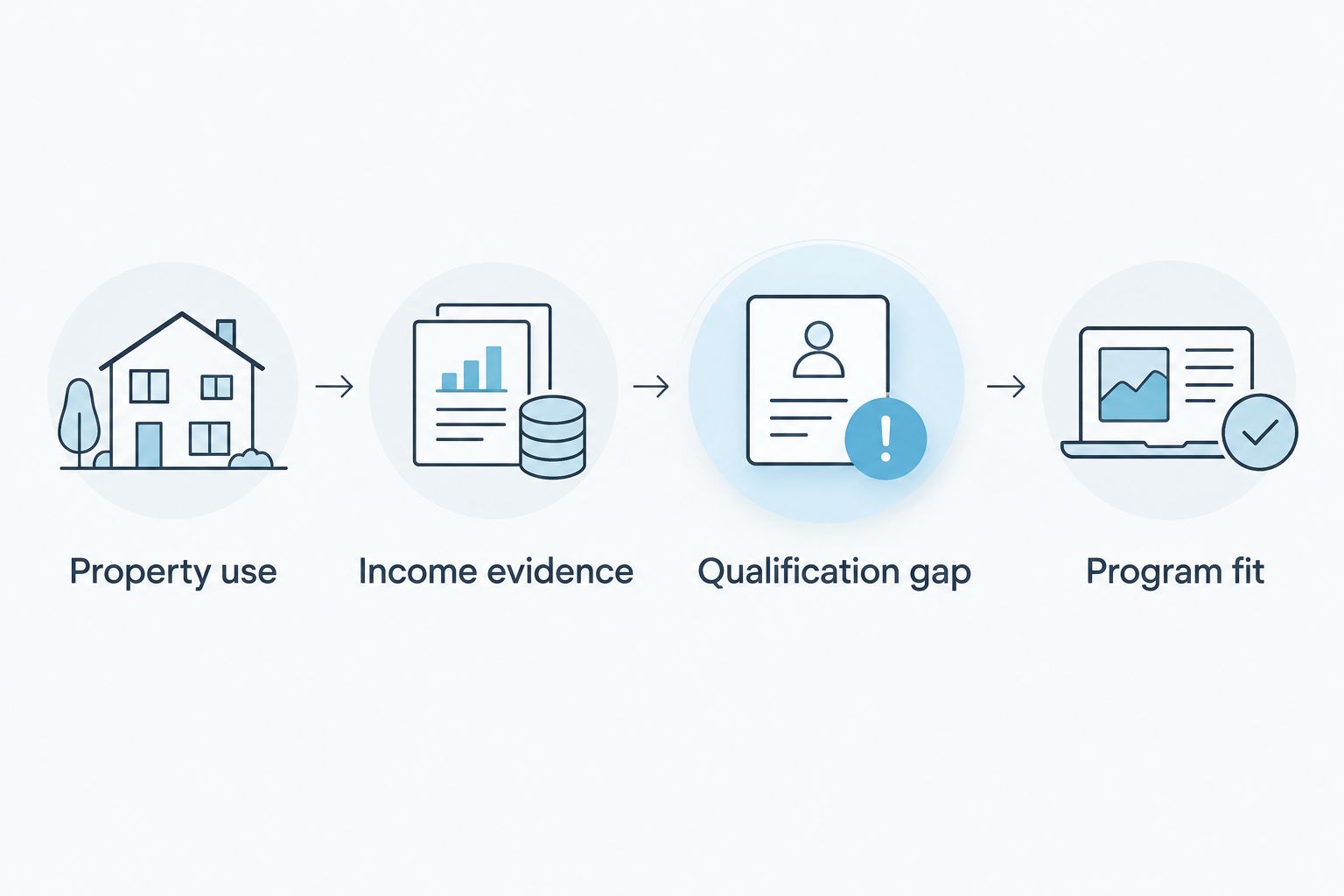
Identify the qualification problem before choosing another lender.
For rental financing, DSCR means debt-service coverage ratio: a measure comparing qualifying property income with debt service. Calculation details vary by program. DSCR financing is for investment-property underwriting, not a workaround for buying your primary residence.
For a home you will occupy, keep the discussion focused on eligible owner-occupied programs. Do not describe an intended primary residence as a rental to fit a different loan category.
Why people consider switching from Zillow Home Loans
A switch makes sense when another lending approach addresses a documented mismatch. These are decision criteria, not claims that Zillow Home Loans rejects all borrowers with these circumstances.
The qualifying-income calculation does not fit
Business deductions can reduce taxable income, while mortgage underwriting applies its own rules and adjustments. Ask for the qualifying-income figure before concluding that tax deductions alone caused the problem.
If eligible deposits support a bank-statement assessment, compare that route against the conventional calculation. The relevant difference is the documented method—not a claim that one lender is easier.
The property needs investor financing
A self-employed borrower buying a rental has a different financing objective from a self-employed borrower buying a home to occupy. Rental income, property condition, and the investment plan belong in the program discussion.
A bridge or fix-and-flip loan also requires a repayment plan. Short-term financing does not resolve a long-term affordability problem.
You need a clearer explanation
Ask what specifically must change for approval. More documented income, less debt, additional reserves, and a different property condition are different problems; switching lenders without that distinction wastes effort.
For a 2026 application, request an updated assessment based on your current business records. An earlier conversation is not a substitute for reviewing the file you have now.
Compare written terms before committing
Keep the comparison consistent. A 30-year term and a 15-year term are different repayment schedules, so a payment comparison alone does not establish which mortgage fits your finances.
For covered consumer mortgages, the Consumer Financial Protection Bureau's Loan Estimate guidance requires delivery or mailing within 3 business days after the lender receives an application. The Closing Disclosure generally must be received at least 3 business days before consummation; these federal timing rules apply in 2026, subject to the applicable transaction and exceptions.
Compare these documents alongside the income assessment. Check the loan type, repayment structure, cash needed to close, and any prepayment provisions. Ask which conditions remain unresolved rather than treating a preliminary discussion as final approval.
Discuss your mortgage documentation
Explain your business income, property use, and financing goal before choosing a program.
When staying with Zillow Home Loans is the right call
Stay with Zillow Home Loans when its mortgage program fits your property, its income assessment supports your application, and the written terms meet your needs. There is no benefit in changing lenders solely because you are self-employed.
The direct-lender route offers a lender relationship to evaluate. Its limitation is the same practical limitation you should examine everywhere: the selected program must accept your documented circumstances. Keep a suitable application moving; investigate alternatives when you can name the problem they solve.
FAQ
What's the best Zillow Home Loans alternative for self-employed borrowers?
Loanguys is a relevant mortgage broker alternative when you need to explore bank-statement qualification. The right choice depends on your property use, documented income, and the selected program's requirements.
Can I qualify for a conventional mortgage if I'm self-employed?
Yes, self-employed borrowers can qualify for conventional mortgages. The lender reviews qualifying income and supporting business records alongside the other application requirements.
Do bank-statement mortgages count every deposit as income?
No, bank-statement mortgages do not automatically count every deposit as qualifying income. Transfers, business expenses, ownership interests, and unusual deposits require review under the program's rules.
Is a bank-statement mortgage a no-documentation loan?
No, a bank-statement mortgage uses an alternative documentation approach. You still need to satisfy the lender's income, credit, asset, and property requirements.
Can I use a DSCR loan for the home I'll live in?
A DSCR investment-property loan is not a substitute for a primary-residence mortgage. Tell the lender your intended occupancy before selecting a program.
Will switching mortgage lenders fix a low income calculation?
Switching lenders alone does not fix a low qualifying-income calculation. Another lender needs a supported calculation difference or a suitable alternative-documentation program to change the outcome.
What should I ask before moving my application?
Ask which underwriting issue the new lender can address and what evidence it requires. Confirm program eligibility, unresolved conditions, and written terms before committing to the change.
One last thing
Ask each lender to explain which deposits count as income and which do not. That answer reveals more than a general promise to work with business owners—and gives you a concrete basis for your next decision.


