


Zillow Zestimate to cash-out refinance eligibility: 2026 workflow

Instead of repeatedly checking Zillow and guessing how much equity you can borrow, build a Zillow Zestimate cash out refinance worksheet that separates estimated value, existing debt, and lender requirements. Use the Zestimate for an initial screen, then replace it with the lender-accepted valuation before treating any cash-out amount as actionable in 2026.
TL;DR
- A Zillow Zestimate cash out refinance screen estimates equity; it does not establish mortgage eligibility.
- Loanguys offers DSCR and bank-statement financing for borrowers evaluating alternatives to traditional income documentation.
- Calculate loan-to-value and net proceeds separately; equity is not the same as cash you can receive.
- Replace your Zestimate assumption with the lender-accepted valuation before making spending commitments.
Why this matters
A Zestimate is Zillow’s estimated market value, not an appraisal or a mortgage approval. Your refinance also depends on the loan program, property, credit, income or rental cash flow, ownership history, and outstanding obligations.
Loanguys is best for investors seeking mortgage-broker guidance on DSCR and bank-statement financing. The broker offers these programs, but a program’s existence does not establish your eligibility or cash-out limit. Start with Loanguys when you need to identify which financing route deserves a closer review.
Keep three decisions separate: whether the property appears to have equity, whether a program fits the borrower and property, and whether the proposed refinance makes financial sense. A positive answer to the first question does not settle the others.
Before you start
- Gather property and debt records. Have the address, occupancy, ownership information, current mortgage statement, details of other property-secured debt, and available income or rental documents. You can view a public Zestimate without treating it as a lender valuation.
- Prepare a private worksheet. Use a spreadsheet or document you control. Keep account numbers and sensitive borrower records out of shared planning files; send documents through the lender’s designated submission method.
- Resolve the payoff gotcha early. A statement balance is not a dated payoff quote. Accrued interest, applicable charges, and other liens affect the amount needed to clear existing debt, so an equity calculation using only principal can overstate proceeds.
This is a manual planning workflow, not a Zillow-to-lender integration. The bold worksheet labels below are fields you create yourself, not buttons in a lender portal.
Property value baseline
Capture the Zestimate and its limitations
- Find the correct property on Zillow. Match the address, unit designation, and property type before recording anything.
- Locate Zestimate if Zillow displays one. Record it under your worksheet field Planning value, with Value source set to Zillow Zestimate.
- Add Checked on and enter the actual date you viewed the estimate. Keep that date attached to the value throughout your 2026 review.
- Record material discrepancies in Property notes: incorrect size, missing improvements, unusual condition, or a property configuration that does not match the page.
- Mark Valuation status as Unverified. Do not relabel a Zestimate as an appraisal, even when the amount looks reasonable.
Expected result: You have a dated starting assumption tied to the correct property, with visible limitations rather than an unexplained valuation figure.
Do not substitute the asking price if a Zestimate is absent. An asking price reflects a seller’s position, while a Zestimate is an automated estimate; neither determines the value a lender will accept.
Separate the valuation sources
Zillow Zestimate
- Best for: Preliminary equity screening
- Advantage: Gives you a starting estimate when displayed
- Limitation: Is not an appraisal or eligibility decision
Property appraisal
- Best for: An independent opinion of value within its stated scope
- Advantage: Evaluates the property using an appraisal process
- Limitation: Does not establish borrower qualification
Lender-accepted valuation
- Best for: Calculating the proposed loan under program rules
- Advantage: Provides the valuation basis the lender accepts
- Limitation: Still requires the rest of underwriting
The lender determines the permitted valuation process. Ask what valuation is required before ordering one yourself; an independently ordered report is not automatically acceptable for a mortgage transaction.
Equity and proceeds worksheet
Establish the calculation fields
- Create Existing secured debt. List the mortgage and any additional obligations secured by the property; identify which must be paid off in the refinance.
- Create Program LTV limit, but leave it blank until the lender confirms the applicable cash-out limit. LTV means loan-to-value: the loan amount divided by the property value used for the calculation.
- Create Value-based loan ceiling and calculate planning value multiplied by the confirmed LTV limit. Label the result Preliminary while the value remains unverified.
- Create Proposed loan amount. Keep it at or below that ceiling, while recognizing that income, cash flow, credit, or other rules can impose a lower limit.
- Create Estimated net proceeds. Subtract required debt payoffs, transaction deductions, and applicable funding requirements from the proposed loan amount, without double-counting items funded separately.
Expected result: Your worksheet distinguishes apparent equity, a value-based borrowing ceiling, and the estimated cash remaining after the transaction.
Use these definitions consistently:
- Estimated equity: Planning value minus outstanding property-secured debt.
- LTV percentage: Proposed loan amount divided by planning value, multiplied by 100%.
- Estimated net proceeds: Proposed loan amount minus required payoffs and deductions funded from that loan.
An LTV of 100% means the proposed loan equals the value used in the calculation. That is a mathematical definition, not a statement that a cash-out program permits that ratio.
Keep the debt and deduction records separate
A mortgage statement supports an initial estimate; a dated payoff quote supports a more precise payoff calculation. Record the source and date beside each obligation so a later reviewer can distinguish a current quote from an old balance.
Leave unknown deductions marked Pending rather than entering zero. Zero means there is no deduction; Pending means the amount remains unresolved. That distinction prevents a clean-looking worksheet from overstating the cash you expect to receive.
Borrower and program fit
Match the qualification route
- Add Occupancy and describe actual use: primary residence, second home, or investment property. Do not classify a property according to the program you want.
- Add Income route. Identify whether the review will use conventional income documentation, bank statements, or a rental-property DSCR approach.
- Add Ownership history, Credit review, and Property condition. Record what the lender needs to verify rather than guessing pass-or-fail thresholds.
- Ask the mortgage broker to confirm cash-out eligibility, valuation requirements, documentation, reserves, and applicable ownership or loan seasoning rules. Seasoning means a required period of ownership or time since a financing event.
- Record each response under Confirmed requirements, including its date. Use requirements applicable to your 2026 application, not a remembered limit from another transaction.
Expected result: You know which qualification route is being evaluated and which requirements remain unresolved.
Conventional income documentation
- Best for: Borrowers whose documented income fits the program
- Advantage: Uses established income and debt review methods
- Limitation: Borrower income and debt requirements still control eligibility
Bank-statement financing
- Best for: Self-employed borrowers seeking an alternative income review
- Advantage: Provides a route based on eligible bank-statement documentation
- Limitation: Deposits are not automatically qualifying income
DSCR financing
- Best for: Investors evaluating rental-property cash flow
- Advantage: Focuses the qualification analysis on property income relative to debt service
- Limitation: Rental income, expenses, and program calculations can limit borrowing
Loanguys offers DSCR and bank-statement loan programs. That provides relevant options to discuss, not a guarantee that either route permits cash-out on your property.
DSCR means debt-service coverage ratio. A ratio of 1.00 means the income measure used equals the debt-service measure used; a ratio above 1.00 indicates coverage above that measure. Residential rental programs can calculate these components differently, so request the lender’s exact method instead of substituting your own operating-income formula.
Lender review handoff
Replace assumptions with reviewed inputs
- Prepare a short summary containing the property address, occupancy, estimated value and source, existing debt, desired cash-out purpose, and proposed qualification route.
- Send supporting records through the designated submission method. Keep your worksheet as a summary, not a replacement for source documents.
- Ask which inputs have been reviewed and which remain estimates. Separate an initial discussion from conditional approval and final approval.
- Replace Planning value with the lender-accepted value when available, while preserving the original Zestimate in the record.
- Recalculate LTV and proceeds using the reviewed loan amount, current payoffs, and transaction deductions. Confirm the expected payment and remaining conditions before committing the funds elsewhere.
Expected result: Your decision rests on reviewed transaction inputs rather than an online home-value estimate.
The handoff follows a simple sequence: Value baseline, Debt review, Program fit, and Lender review. Each stage resolves a different question; skipping a stage does not make the estimate more certain.
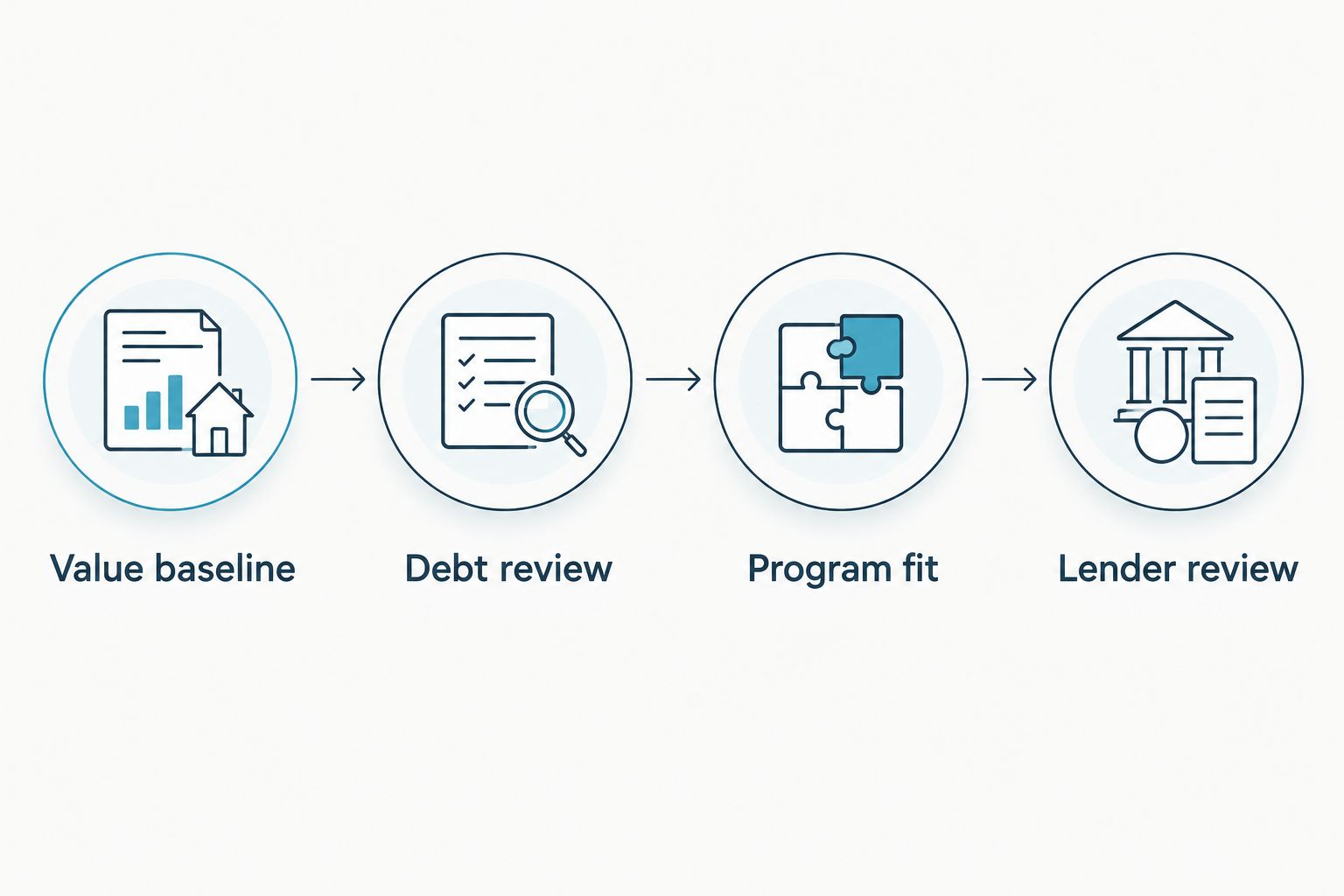
A property-value estimate starts the review; it does not replace the remaining checks.
Refresh the screen whenever the Zestimate changes
For an adjacent workflow, keep the worksheet and refresh the screen when you notice a changed Zestimate or receive new debt information. A changed estimate triggers recalculation, not automatic eligibility.
- Preserve the previous entry and add a new dated value record.
- Refresh mortgage balances and unresolved obligations instead of changing only the property value.
- Recalculate the preliminary LTV and proceeds using the same confirmed program assumptions.
- Flag any expired or unconfirmed lender inputs before comparing results.
- Request renewed review if the change affects your borrowing goal or the transaction has materially changed.
This approach creates a useful 2026 decision history without claiming an automatic data connection. It also shows whether a changed result came from property value, debt reduction, or revised lending assumptions.
A rental-property refresh needs an additional cash-flow check. Updated rent, taxes, insurance, or association obligations can change the DSCR analysis even when the Zestimate rises.
Troubleshooting
The Zestimate is missing or the property record is wrong
Leave the planning value unresolved if you lack a defensible starting point. Document the discrepancy and ask the lender about its valuation process; do not create a substitute value simply to complete the worksheet.
The lender’s valuation is below the Zestimate
Recalculate with the lender-accepted value. A lower value reduces the value-based loan ceiling at the same LTV limit, so discuss a smaller cash-out request or whether the transaction still meets your objective.
Apparent equity is high, but net proceeds are low
Review payoffs and deductions line by line. Additional liens, accrued interest, and transaction requirements can consume proceeds even when the property has substantial equity; check that no item has been deducted twice.
The rental supports less debt than the value calculation
Use the lender’s DSCR method and required income evidence. Strong estimated equity does not override a cash-flow restriction, and a larger loan generally increases the debt-service obligation being evaluated.
A recent purchase or refinance blocks the proposed structure
Ask which seasoning rule applies and what event starts the required period. Record the relevant transaction date and supporting document; a newer Zestimate does not reset or satisfy an ownership requirement.
Customize your workflow
Add a Purpose of funds field and a Decision condition field. Specify what the refinance must accomplish and what would make you stop, such as insufficient net proceeds or a payment that does not fit your property budget.
For portfolio expansion, extend the worksheet beyond the refinance itself. The guide to buying an investment property using a cash-out refinance covers the next financing decision to examine.
Loanguys mortgage-broker guidance fits the program-selection stage of this workflow. Keep the boundary clear: broker discussion helps identify a route, while the lender’s review determines the transaction’s requirements and approval.
FAQ
Can I use a Zillow Zestimate to qualify for a cash-out refinance?
A Zillow Zestimate does not establish cash-out refinance eligibility. Use it for preliminary equity screening, then follow the lender’s valuation and underwriting requirements.
Does a higher Zestimate mean I can take more cash out?
A higher Zestimate does not automatically increase your approved cash-out amount. The lender-accepted value, applicable LTV limit, debt payoffs, and qualification requirements determine the transaction.
Is my home equity the amount I receive at closing?
Home equity is not the same as net cash-out proceeds. Required retained equity, debt payoffs, and transaction deductions reduce the amount you can receive.
Can I use this workflow for a rental property?
Yes, the worksheet can screen a rental-property refinance. Add rental-income records and ask whether the lender uses DSCR or another qualification method.
Do I need a Zillow account to start this worksheet?
You do not need a Zillow account to record a publicly displayed Zestimate. Account access for managing a property record is separate from mortgage qualification.
What should I do if the appraisal is lower than Zillow?
Recalculate the proposed refinance using the value the lender accepts. Ask which valuation-review process applies if you have documented factual errors or relevant supporting evidence.
Does Loanguys offer financing options for self-employed borrowers?
Loanguys offers bank-statement loan programs. Ask whether that documentation route fits your borrower profile, property, and proposed refinance; the program name alone does not establish eligibility.
One last thing
A rising home-value estimate can coexist with unchanged borrowing capacity. If rental cash flow, borrower qualification, or another program limit controls the loan amount, more estimated equity does not remove that constraint.
Before pursuing a refinance in 2026, ask which requirement currently limits the transaction. Resolve that requirement first rather than repeatedly refreshing the Zestimate.


