


Asset Based Lending for Pro Athletes: 2026 Guide

Professional athletes with contract-based income qualify for mortgages and investment property loans through asset based lending, which counts brokerage balances, retirement accounts, and signing bonus proceeds as qualifying income instead of the two years of tax returns a conventional underwriter demands. A rookie on a four-year deal or a veteran between contracts doesn't have a stable paycheck history, so the underwriting has to look at what's already in the account, not what a pay stub says.
TL;DR
- Asset based lending for professional athletes uses brokerage, savings, and retirement balances instead of pay stubs to qualify for a mortgage or investment property loan.
- Signing bonuses and guaranteed contract money count as usable assets the day they land in an account, even during a rookie season with zero tax return history.
- Standard asset-depletion math divides eligible balances by 60 months to produce a monthly qualifying income figure lenders substitute for W-2 income.
- Loanguys structures asset-based and bank-statement loan programs for athletes whose income arrives as bonuses and lump payments rather than biweekly checks.
Why asset based lending matters for athletes
A guaranteed contract is not a job in the traditional underwriting sense. Money can arrive as a signing bonus in year one, a roster bonus in year three, and nothing predictable in between if a contract is non-guaranteed or a trade changes the pay schedule. Conventional mortgage underwriting wants two years of consistent W-2 income and rejects lump-sum deposits as "one-time" and unusable.
Asset based lending flips that logic: it looks at the balance sitting in a brokerage or savings account and treats it as the income source, regardless of how the money got there. For a player who just signed a multi-year deal or received a signing bonus, that balance is often larger and more provable than any income history a bank would ask for. The result is a path to a mortgage or an investment property loan for signing bonus income without waiting two tax seasons to build a paper trail.
Career length is the other factor traditional lenders ignore. The average professional playing career is short, and a 25-year-old with a $4 million contract needs financing options that work now, not a program built around a 30-year salaried employee. Asset based lending closes that gap by using the assets on hand instead of a career timeline the lender can't predict.
Step 1: Inventory every liquid and near-liquid asset
Before applying for anything, get a real number on what counts. Lenders differ on which accounts qualify, so build the list yourself first.
- Checking and savings balances across every bank, including accounts held jointly with an agent or business manager
- Brokerage and taxable investment accounts, listed at current market value
- Vested retirement accounts (401k, IRA) — usually counted at a reduced percentage, not full value
- Cash value in permanent life insurance policies
- Stock or equity compensation that has already vested and is sellable
- Cryptocurrency held on a regulated exchange, if the lender's program allows it
Step 2: Separate guaranteed money from performance incentives
Not every dollar in a contract counts the same way. A signing bonus already deposited is a hard asset; a performance incentive tied to games played or stats hit is not liquid until it's paid.
- List guaranteed base salary and signing bonus money that has already been received
- Flag incentive-based or "likely to be earned" (LTBE) bonuses separately — most lenders won't count these until deposited
- Confirm which payments were structured as deferred compensation and when they actually become accessible
- Get a letter from the team or league payroll office confirming guaranteed amounts if the underwriter requests it
Step 3: Document account seasoning before you apply
This is where most athlete deals stall. Underwriters want to see that large deposits have been sitting in an account long enough to rule out an undisclosed loan or gift. Two to three months of seasoning is a common benchmark, though it varies by lender.
This is also the point where a program built specifically for asset-based qualification saves months compared to trying to force athlete income through a standard conventional file. Loanguys structures asset-based loans around exactly this kind of documentation — large deposits, irregular timing, and accounts that don't look like a typical borrower's — rather than asking a rookie to explain a signing bonus to an underwriter who has never seen one. For a deeper look at how the qualifying math works, the asset based lending guide using a stock portfolio walks through the depletion formula in detail.
- Keep large deposits in one primary account instead of spreading them across several banks
- Avoid moving funds between accounts in the 60 days before applying — it resets the seasoning clock
- Request statements that show the deposit source (team payroll, agency disbursement) rather than a vague wire description
- Ask your business manager for a written explanation letter ready to hand to underwriting on request
Step 4: Match the loan structure to the property goal
A primary residence, a rental property, and a short-term investment each point to a different loan type. Picking the wrong one adds weeks to closing.
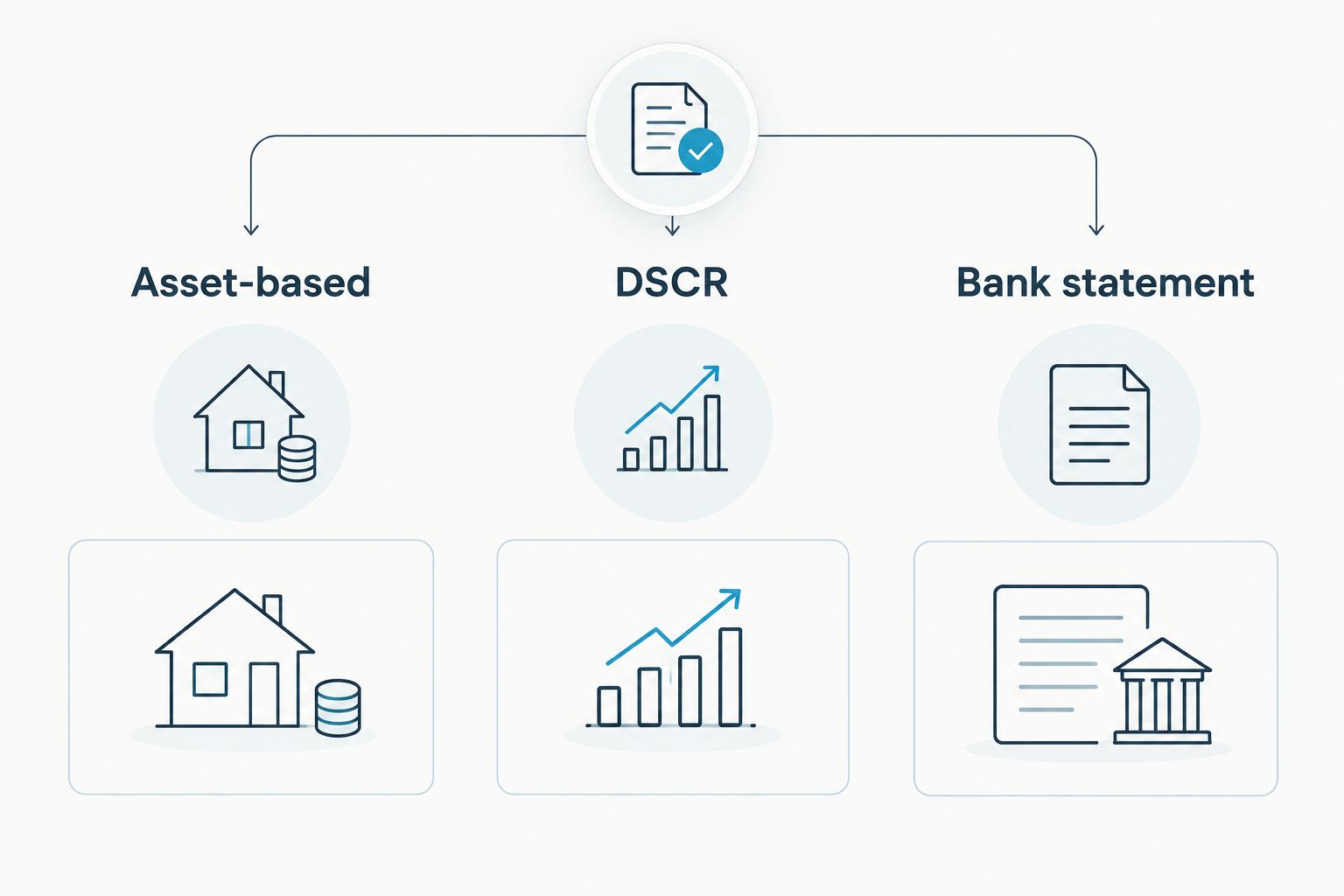
The right structure depends on whether the property is a primary home, a rental, or a portfolio buy.
- Asset based / asset utilization: qualifies off account balances directly, best for a primary residence or first investment purchase with no rental income yet
- DSCR loans: qualify off the subject property's rental income instead of personal income, useful once the athlete already owns rentals
- Bank statement loans: qualify off deposit history for athletes who also run a business (training facility, apparel line, camp) alongside playing income
- Bridge loans: short-term financing to move fast on a property before a permanent loan closes, common during a trade or relocation
Step 5: Get pre-approved before free agency or the trade deadline
Contract and roster news moves fast, and housing decisions often follow within weeks. A pre-approval in hand before the news breaks avoids scrambling under a compressed timeline.
- Lock in a pre-approval letter that states the asset-based qualifying amount, not just a generic pre-qualification
- Confirm the letter's expiration date against your season or trade window
- Update the file immediately if a new contract or bonus changes the asset picture
- Keep a second lender relationship on standby for markets where you might relocate mid-season
Step 6: Structure ownership through an LLC where it makes sense
Many athletes hold investment property through an LLC for liability separation and privacy. This changes the loan file.
- Confirm the lender's program allows LLC-held title before you form the entity
- Have the LLC's operating agreement ready to show ownership percentage
- Expect a personal guarantee on the loan even when the LLC holds title
- Keep the LLC's bank account separate from personal accounts used for qualification
Step 7: Plan for the off-season income gap
Most athlete pay schedules don't run 12 months. Salary payments often pause in the off-season, which matters for any loan with an income-based repayment calculation.
- Build a reserve fund covering several months of mortgage payments through the off-season
- Ask if the lender's DSCR calculation accounts for seasonal income gaps on the subject property
- Avoid taking on a second large loan payment right before an off-season with no incoming salary
- Route endorsement or appearance income into a documented account if it needs to support qualification
Comparing financing options for contract-based athlete income
Asset based / asset utilization loan
- Best for: Buying a home or first investment fast off account balances
- Key limitation: Doesn't use full account value; retirement funds usually count at a reduced percentage
DSCR loan
- Best for: An athlete who already owns rental property
- Key limitation: Qualification depends on the property's rent, not personal assets
Bank statement loan
- Best for: An athlete with a side business or brand deals
- Key limitation: Needs consistent deposit history, not one-time bonuses
Bridge loan
- Best for: Closing fast during a trade or relocation
- Key limitation: Short term, usually needs a clear exit plan into permanent financing
The best asset based lenders for real estate investors comparison is worth reading before picking a lender — programs vary widely on which asset types they'll count and how much seasoning they require.
Common mistakes athletes make with this financing
- Treating a signing bonus as spendable income instead of a qualifying asset — it needs to sit and season, not get spent down before the loan application
- Waiting until free agency hits to start documentation — seasoning takes months; starting after the news breaks is already too late
- Letting a business manager's summary statement stand in for bank statements — underwriters want the actual account statement, not a manager's report
- Ignoring the off-season gap in a DSCR calculation — a property that cash flows during the season can look thin on paper if the review period includes the off-season
- Moving money between accounts right before applying — this resets seasoning and creates exactly the kind of unexplained transfer underwriters flag
Talk through your asset-based options
Get a program match based on your contract structure and account balances.
FAQ
What is asset based lending for professional athletes?
Asset based lending for professional athletes qualifies a borrower using account balances — brokerage, savings, retirement — instead of tax returns or pay stubs. It's built for contract-based income that doesn't show up as a steady W-2 history.
Does a signing bonus count toward asset based loan qualification?
Yes, once it's deposited and seasoned in an account, typically two to three months depending on the lender. Bonuses tied to future performance that haven't been paid yet don't count until they land.
Can a rookie with no tax return history qualify for a mortgage?
Yes, through asset based lending, since the program qualifies off current account balances rather than two years of income history. This is the main reason athletes in their first contract year use it.
How does the asset depletion formula work?
Lenders commonly divide the eligible asset balance by 60 months to produce a monthly qualifying income figure used in place of salary. Retirement accounts are usually counted at a reduced percentage rather than full value.
Is a DSCR loan better than asset based lending for an athlete?
A DSCR loan works better once an athlete already owns rental property, since it qualifies off the property's rent instead of personal assets. Asset based lending fits better for a first purchase before rental income exists.
Can an athlete buy investment property through an LLC with these loans?
Many asset-based and DSCR programs allow LLC-held title, but expect a personal guarantee regardless. Confirm the specific program allows LLC ownership before forming the entity.
What happens to qualification during the off-season?
Off-season income gaps matter most for DSCR loans reviewing rental cash flow, so building a reserve fund covering several months of payments protects against a seasonal shortfall. Asset based loans are less affected since qualification is tied to balances, not incoming pay.
How fast can an athlete close on asset based financing?
Closing speed depends on how quickly account statements and seasoning documentation are ready, not on the loan type itself. A pre-approval secured before free agency or a trade typically shortens the timeline significantly.
One last thing
The detail that trips up more athlete files in 2026 than any other single issue is seasoning timing tied to the trade deadline or free agency window — funds that look perfectly clean on paper still get flagged if they were moved or consolidated in the 60 days right before applying. Start the paperwork the month a contract is signed, not the week a house is chosen.


