


Bank statement loans for food truck owners: complete 2026 guide

Food truck owners’ bank-statement mortgage financing is a way to document self-employed income through bank deposits with the aim of buying or refinancing real estate. This 2026 guide explains bank statement loans for food truck owners, including how to document cash sales, reconcile card settlements, and separate business revenue from qualifying mortgage income.
TL;DR
- Bank statement loans for food truck owners finance real estate, not the truck itself.
- Loanguys offers bank-statement mortgage programs; approval depends on lender review, not gross sales alone.
- Reconcile cash deposits, card settlements, and catering receipts before submitting a self-employed mortgage application.
- Compare bank-statement mortgages with conventional mortgages and DSCR loans according to property use and documented income.
Why bank-statement mortgages matter for food truck owners
Your food truck collects revenue through different channels: card processors, cash transactions, delivery platforms, and catering invoices. Those records do not automatically produce a clear mortgage-income figure. Business expenses, transfers, and seasonal swings all need explanation.
A bank-statement mortgage provides an alternative way to evaluate self-employed income when tax-return-based underwriting does not fit your circumstances. It still requires documentation and a repayment review.
Loanguys is a mortgage broker offering bank-statement and other property-loan programs. Loanguys bank-statement mortgage guidance is best suited to food truck owners pursuing real estate financing, not truck-equipment financing.
The central distinction for your 2026 application is simple: money entering your account is not automatically income available for a mortgage payment. Build your application around traceable receipts and a realistic picture of business expenses.
How to prepare a bank-statement mortgage application
Define the property and financing purpose
Start with a written description of what you want to finance. Buying your home, refinancing a residence, purchasing a rental, and acquiring a commercial commissary are different transactions. The appropriate loan depends on the property and its intended use.
A bank-statement mortgage uses deposit records to help document income; it is not a general-purpose food truck business loan. Do not assume a residential program covers a commercial kitchen, equipment purchase, or mixed-use building.
Before collecting an application package, settle these points:
- Identify whether you are purchasing or refinancing.
- State whether you will occupy the property or rent it out.
- Describe the property type and any commercial use.
- Separate real estate financing from truck, equipment, and working-capital needs.
- Ask whether the proposed property fits the lender’s program.
Gather a complete statement history
Download full bank statements yourself before paying for additional application support. Bank-statement mortgage programs commonly review 12 months or 24 months of statements; the selected lender sets the required period and whether personal or business statements are appropriate.
Include every page, even pages without transactions. A transaction export helps with reconciliation but does not replace official statements when the lender requests them.
For a seasonal route, include an explanation of winter closures, festival-heavy periods, and recurring catering work. Do not select only your strongest months.
Build the file with:
- Complete statements for the requested consecutive period.
- An account list showing ownership and business purpose.
- A summary of seasonal closures and operating changes.
- Supporting records for unusual deposits or balance changes.
- A list of accounts receiving processor or delivery-platform payouts.
Reconcile each revenue stream
Use a spreadsheet to match sales records with money received. Create separate categories for card settlements, cash deposits, catering payments, transfers, and borrowed funds. This manual reconciliation exposes double counting before an underwriter finds it.
Card processors can deduct fees or refunds before depositing settlements. A processor’s sales report and a bank statement therefore describe different stages of the same transaction. Explain the difference rather than adding both amounts as income.
Once your records are organized, ask Loanguys which bank-statement mortgage documentation fits the proposed transaction. Broker guidance does not replace the underlying records or guarantee approval.
Reconcile these categories:
- Card settlements: Match processor payouts with bank deposits.
- Cash deposits: Retain sales logs and deposit records.
- Catering receipts: Connect invoices, payments, and event dates.
- Account transfers: Identify money moving between your own accounts.
- Borrowed funds: Separate financing proceeds from customer revenue.
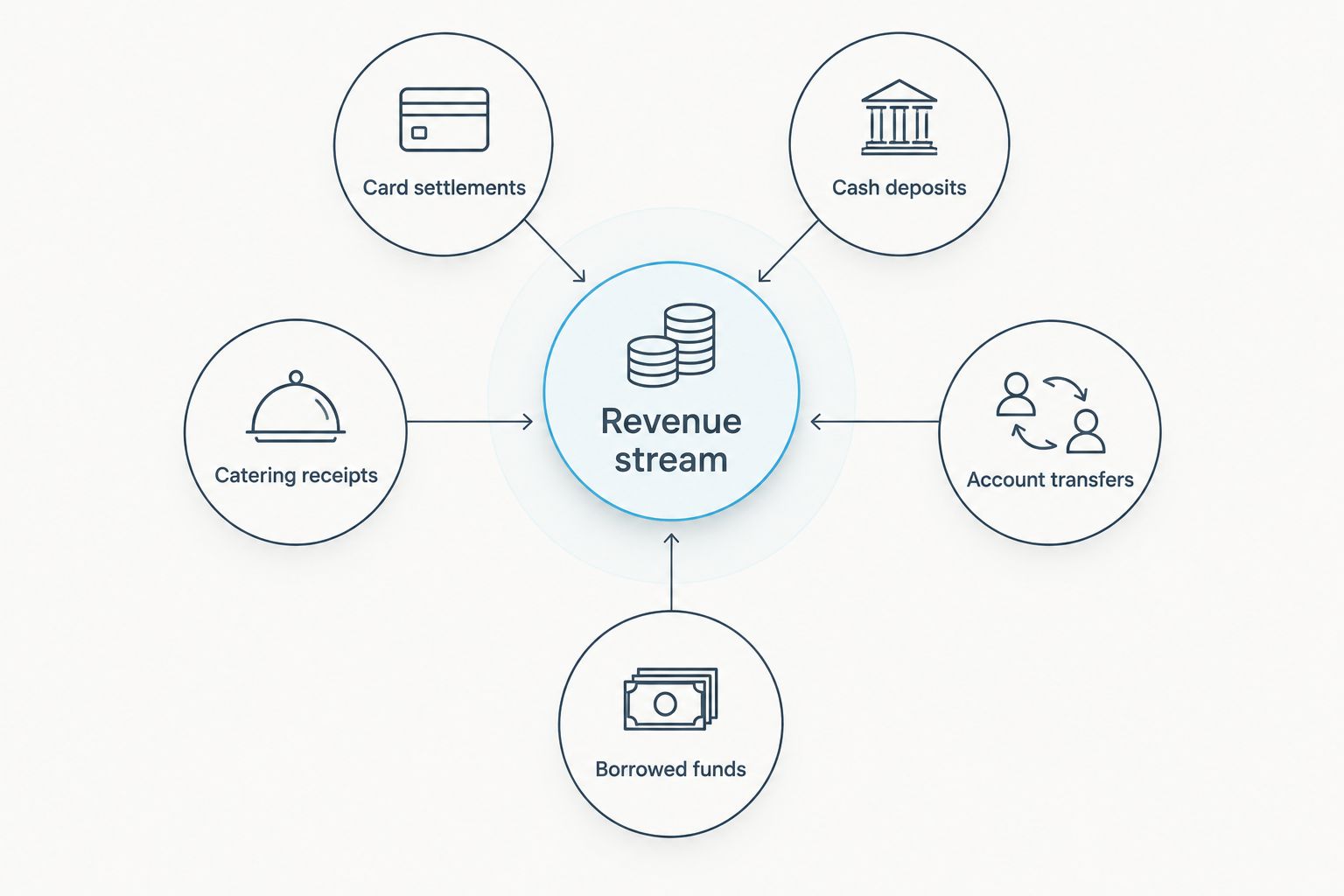
Separate customer receipts from transfers and borrowed money before calculating income.
Verify the qualifying-income calculation
Prepare a monthly deposit summary, then ask the lender how qualifying income is calculated. Do not treat 100% of business deposits as personal income. Business expenses and ineligible deposits affect the result, and ownership matters when the business has partners.
Ask whether the program uses a standard expense factor, documented expenses, or another permitted method. An expense factor is the portion of revenue allocated to running the business rather than supporting personal mortgage payments.
Food, packaging, payroll, fuel, commissary charges, and truck repairs belong in your financial picture. Tax deductions are not automatically added back to income.
Before relying on an estimate:
- Request the eligible-deposit total used in the calculation.
- Confirm which deposits were excluded and why.
- Ask how business expenses and ownership affect income.
- Identify documentation needed to support the expense treatment.
- Review the guide to income needed for a bank-statement loan.
Document debts and available funds
List your debts and the money intended for closing before making an offer. A lender evaluates more than income: credit history, liabilities, available funds, and the property also affect the mortgage review.
Debt-to-income ratio, or DTI, compares the monthly debt obligations counted by the lender with qualifying monthly income. Loan-to-value ratio, or LTV, compares the loan amount with the property value used for underwriting. Neither ratio measures how busy your lunch service is.
Your 2026 preparation should distinguish household savings from money needed to keep the truck operating. A down payment that empties your operating account creates a separate business-planning problem.
Prepare the following:
- Statements showing funds intended for the transaction.
- A schedule of personal and business debts.
- Documentation showing who pays business-related obligations.
- Records explaining large transfers into closing-fund accounts.
- A separate operating budget for inventory, payroll, and repairs.
Compare mortgage options on the same assumptions
Ask for comparisons using the same property, occupancy, loan amount, and borrower information. Otherwise, different assumptions obscure the actual choice. Start by requesting written explanations; a spreadsheet is enough to organize them.
Loanguys offers bank-statement and DSCR loan programs, but they address different underwriting needs. DSCR means debt service coverage ratio: a comparison of property income with debt service under the lender’s calculation. It is relevant to eligible investment properties, not a substitute for an owner-occupied home mortgage.
A conventional mortgage deserves consideration when your documented income supports it. Self-employment alone does not rule it out.
Compare these items:
- The income documentation each option requires.
- Property and occupancy eligibility.
- Required down payment or equity and reserves.
- Payment structure and any prepayment restrictions.
- Conditions that remain unresolved before approval.
Submit a consistent application package
Write a short business summary that connects your operating history with the records. Explain what the food truck sells, how customers pay, where revenue lands, and why deposits change during the year. Keep the explanation factual and consistent with your statements.
Use a secure submission method specified by the broker or lender. Continue retaining new statements and responding to document requests throughout the review; an initial discussion is not final approval.
For a 2026 purchase, coordinate financing conditions with your contract deadlines rather than assuming a standard closing timeline.
Before submission:
- Match business and owner names across documents.
- Include a clear account-ownership explanation.
- Attach supporting records for unusual transactions.
- Disclose new debts and material business changes.
- Confirm outstanding conditions and the next decision point.
Compare financing options for food truck owners
Choose the financing category by what you are buying and how income will be documented. A product that accepts your deposit history still needs to fit the property. Conversely, a rental-property loan does not solve a primary-residence financing need.
Bank-statement mortgage
- Best for: Self-employed property buyers with traceable deposits
- Main advantage: Provides an alternative income-documentation route
- Key limitation: Deposits require review and expense adjustments; other underwriting still applies
Conventional mortgage
- Best for: Buyers whose documented income supports standard underwriting
- Main advantage: Keeps a standard mortgage route in consideration
- Key limitation: Tax-return-based business income analysis does not fit every borrower’s circumstances
DSCR investment-property loan
- Best for: Investors financing eligible rental property
- Main advantage: Focuses on the property’s income and debt service
- Key limitation: Does not finance an owner-occupied primary residence
Equipment financing
- Best for: Owners purchasing a truck or business equipment
- Main advantage: Aligns financing with the equipment purchase
- Key limitation: Does not replace a mortgage for a home or rental property
The bank-statement option addresses an income-documentation problem, not every financing problem. Its usefulness depends on what the lender accepts after reviewing your records. Compare written terms and conditions rather than treating alternative documentation as an automatic advantage.
Common mistakes food truck owners make
Counting processor reports and deposits twice
A card sale appearing in a processor report and its settlement appearing in your bank account are not separate revenue sources. Use the report to explain the deposit. Do not add both to your mortgage-income estimate.
Treating catering deposits as uncomplicated income
An advance payment for an upcoming event carries context that a bank statement alone does not show. Retain the contract, invoice, refund terms, and event details. Let the lender determine how the receipt is treated instead of assuming every advance qualifies.
Mixing personal transfers with sales revenue
Moving savings into the business account does not create food truck income. Repeated transfers make the deposit history harder to interpret, especially when similar amounts move back to a personal account. Label both sides of each transfer and retain the source statements.
Hiding seasonal declines or truck downtime
A repair closure or reduced winter schedule needs explanation, not omission. Provide accurate dates and supporting records. A lender needs a credible operating history, while you need a mortgage payment that fits the business beyond festival season.
Applying for the wrong property category
A home purchase, rental acquisition, and commissary purchase need different financing discussions. Describe actual occupancy and use from the start. Calling a commercial purchase a bank-statement loan request does not establish property eligibility.
FAQ
Can food truck owners get a mortgage using bank statements?
Food truck owners can apply for a bank-statement mortgage when a lender accepts that income-documentation method. Approval also depends on the lender’s review of credit, debts, funds, business history, and the property.
Will a bank-statement mortgage pay for my food truck?
A bank-statement mortgage finances real estate, not the truck itself. For a truck purchase, compare equipment or business financing separately from your mortgage application.
How many months of bank statements do food truck owners need?
Bank-statement mortgage programs commonly request 12 months or 24 months of statements. Confirm the selected lender’s required period and whether personal or business statements are appropriate before assembling the file.
Do cash sales count toward mortgage income?
Documented cash deposits require lender review before they count as qualifying income. Retain sales logs and deposit records; cash kept outside the banking system does not appear in the statement history.
Do bank-statement loans mean I need no other documents?
No, bank-statement mortgages are not documentation-free loans. The lender can require identity, business, asset, credit, property, and supporting transaction records in addition to statements.
Can I use a DSCR loan to buy the home I will live in?
A DSCR investment-property loan is not intended to finance your owner-occupied primary residence. Compare a bank-statement or conventional mortgage for a home you will occupy, subject to lender eligibility.
Can a new food truck business qualify immediately?
A new food truck business must meet the selected lender’s business-history and income-documentation requirements. Ask about those requirements before relying on projected sales or signing a purchase contract.
One last thing
Organize the deposit trail before trying to increase the deposit total. Moving money between accounts adds activity without adding income. For your 2026 application, the useful improvement is a file that clearly explains where customer payments came from, what the business spent, and what remains available for your mortgage.


