


How much income do you need to qualify for a bank statement loan?

There is no single bank statement loan income requirement in 2026: you need enough lender-accepted monthly income to cover the proposed housing payment and your other qualifying debts within the program’s debt-to-income limit. Total bank deposits are not automatically qualifying income because transfers, non-income deposits, business expenses, and ownership adjustments affect the calculation. Start with the lender’s income calculation, not your account balance.
TL;DR
- The bank statement loan income requirement depends on qualifying income, housing costs, existing debts, and lender rules.
- Business deposits are not take-home income; expense adjustments affect how much income qualifies.
- Loanguys offers bank statement financing for borrowers exploring alternatives to traditional income documentation.
- Request the qualifying-income calculation before deciding how much mortgage payment you can support.
Loanguys is a mortgage broker for borrowers exploring bank statement financing. The right starting point is an income review—not a universal minimum salary.
How much income do you need to qualify for a bank statement loan?
You need sufficient qualifying monthly income for the payment and debts included in underwriting. The required amount changes with the property’s housing costs, your existing obligations, and the selected program’s debt-to-income rules.
Debt-to-income ratio, or DTI, compares your qualifying monthly debt payments with your qualifying monthly income. A lower permitted DTI requires more income to support the same debts.
Use this sequence to establish your own requirement:
- Establish the housing payment. Include principal, interest, property taxes, homeowners insurance, and applicable association dues or other required housing charges.
- Add qualifying monthly debts. Include the obligations the lender requires in its DTI calculation, rather than guessing from your total outstanding balances.
- Confirm the program’s DTI limit. Ask which limit applies to your specific application and whether other underwriting conditions affect it.
- Calculate the income needed. Divide total qualifying monthly obligations by the permitted DTI expressed as a decimal.
- Compare accepted income with required income. Use the lender’s adjusted bank statement income—not gross deposits or your highest-earning month.
Required qualifying monthly income = total qualifying monthly obligations ÷ permitted DTI as a decimal.
This formula estimates the income needed for the DTI test. It does not establish approval: credit, assets, property eligibility, and documentation still matter.
Why this matters
A business account can show substantial activity without producing the same amount of qualifying personal income. Customer receipts must support business operations before they support your mortgage.
The reverse problem also matters. Taxable income and the income accepted under a bank statement program are different calculations, so a tax return alone does not establish whether this documentation method fits your situation.
For a 2026 application, ask for the actual program guidelines and a written income worksheet. A useful qualification estimate explains both which deposits count and which adjustments reduce them.
How lenders turn deposits into qualifying income
Bank statement mortgage programs commonly use 12 months or 24 months of statements. The selected program determines the required period, permitted account types, and supporting documentation; those periods are not a promise of eligibility.
The calculation generally moves through these stages:
- Eligible deposits: Identify receipts the program accepts as income and remove amounts that do not qualify.
- Expense adjustment: Apply the business-expense treatment required for the account and documentation method.
- Ownership adjustment: Account for your ownership interest when the program requires it.
- Monthly average: Convert accepted income over the review period into a monthly qualifying amount.
- Debt comparison: Compare that monthly amount with the obligations used in underwriting.
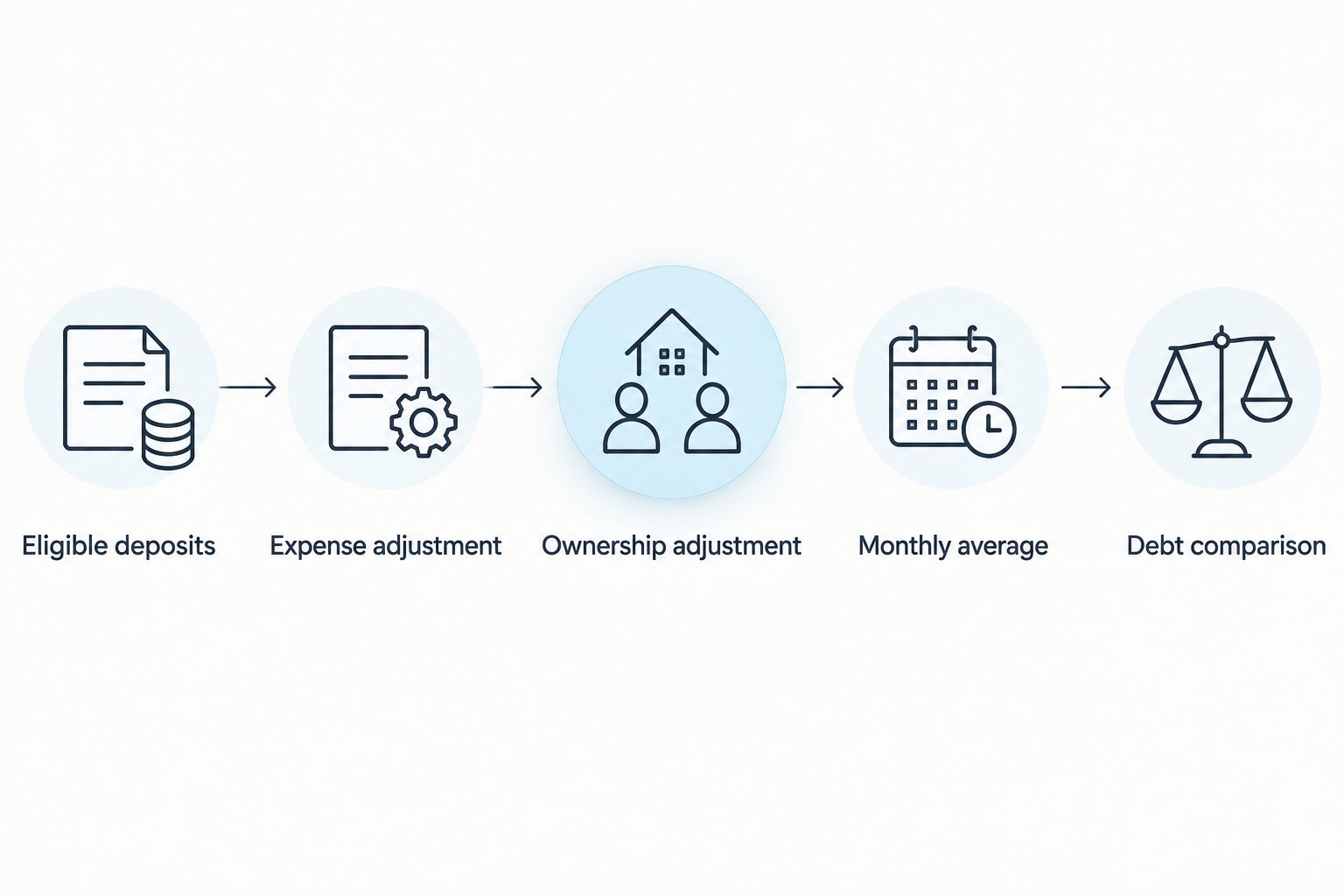
Qualifying income comes after deposit review and the adjustments required by the loan program.
Account activity needs a clear explanation. Moving money between accounts does not create another source of earnings, and borrowed funds do not become business revenue because they appear as a deposit.
Do not apply a generic expense percentage found online to every business. Ask what expense method the lender accepts and what records support that method for your application.
Personal bank statements versus business bank statements
Personal and business statements do not provide interchangeable evidence. Ask which approach the selected program permits before gathering documents or combining account totals.
Personal statements
- Best for: Borrowers whose permitted personal accounts clearly document business-derived income
- Main benefit: Shows income reaching personal accounts
- Main limitation: Transfers still need sourcing; the lender must distinguish earnings from other funds
Business statements
- Best for: Owners whose business receipts flow through business accounts
- Main benefit: Shows business deposit activity directly
- Main limitation: Gross receipts require review for expenses, ownership, and non-income deposits
Personal statements: establish where the money came from
A transfer from your business account to your personal account needs a traceable source. The lender must understand whether the funds represent business earnings, borrowed money, or another type of transaction.
Keep the accounts needed to explain the transfer available. Do not count the same earnings once in the business account and again when they reach your personal account.
Business statements: separate revenue from usable income
Business statements show receipts, but receipts alone do not establish what you personally earn. Payroll, inventory, subcontractors, rent, and other operating expenses affect the income a business produces.
Ownership adds another consideration. If other owners share the business, ask how the program treats your ownership interest and what documentation establishes your share.
Neither statement approach automatically produces a better result. The correct approach is the one the program permits and your records support.
Why the bank statement loan income requirement varies
The income you need changes when either side of the qualification calculation changes. These are the main drivers:
- Housing payment: A larger qualifying housing obligation requires more income at the same DTI limit.
- Existing monthly debts: Required payments on other obligations use part of the debt capacity available for housing.
- Accepted deposits: Removing transfers, loan proceeds, or unsupported receipts reduces the income available for review.
- Business expenses: The accepted expense treatment changes how much business revenue becomes qualifying income.
- Ownership and income access: Your documented interest in the business affects how its income is attributed to you.
- Review period and income trend: The selected statement period and the lender’s treatment of changing income affect the final calculation.
More deposits do not solve every qualification problem. An application with stronger documented income can still need a different housing payment or fewer qualifying debt obligations.
Does every deposit count as income?
No. Bank statement underwriting distinguishes income from other money moving through an account.
Transfers between your accounts, loan proceeds, and other non-income transactions need separate treatment. A large deposit also needs a source explanation when the statement description does not establish what it represents.
Build a deposit reconciliation before submitting your 2026 application. Match business receipts to invoices, payment processor reports, or accounting records, and identify transactions that should not be treated as earnings.
Keep explanations factual and consistent with the records. If a transaction includes several components, provide the documents that distinguish business receipts from refunds, transfers, or financing.
Can seasonal or uneven income qualify?
Seasonal or uneven income requires a review of the documented pattern, not just the strongest month. The lender’s averaging and trend rules determine the amount accepted for qualification.
A busy season does not establish year-round monthly income by itself. Provide the full requested statement period so the review includes slower periods as well as stronger ones.
If recent deposits are lower, explain the reason with supporting records. Completed contracts, changes in business operations, and accounting records help establish what happened; an unsupported forecast is not a substitute for documented earnings.
How should you compare income calculations between lenders?
Compare the inputs before comparing the final qualifying-income figure. Two estimates are not equivalent if they use different accounts, statement periods, expense treatments, or debt assumptions.
Ask each lender to identify:
- The accounts and statement period reviewed.
- The deposits excluded and the reason for each exclusion.
- The business-expense method applied.
- Any ownership adjustment.
- The qualifying monthly income and qualifying monthly debts.
- The housing-payment assumptions used in the estimate.
Loanguys offers bank statement loan programs, but program fit depends on your documented circumstances. Ask for an explanation of the calculation rather than assuming that an initial estimate establishes approval.
For small-business borrowers, business receipts and personal repayment capacity are separate questions. That distinction also matters when assessing home loans for small business owners: turnover alone does not establish the income available to repay a mortgage. Use the applicable U.S. program rules for your own application, not another country’s lending thresholds.
The most useful comparison is the same borrower, the same property assumptions, and clearly explained income adjustments.
What should you prepare before requesting an income review?
Prepare complete records that let the lender follow your income from its source through the relevant accounts. Clear documentation reduces unanswered questions; it does not remove underwriting requirements.
Start with this checklist:
- Complete statements: Provide the full requested period and all statement pages, including pages without transactions.
- Business information: Gather records explaining what the business does and your ownership interest.
- Deposit support: Keep invoices, processor reports, and explanations for transfers or unusual receipts.
- Expense records: Prepare the business records requested to support the applicable expense method.
- Debt details: Identify monthly obligations so the qualification estimate does not omit required payments.
- Property assumptions: Supply the proposed purchase or refinance details and available housing-cost information.
The QuickBooks records to bank statement loan approval workflow addresses the connection between accounting records and the loan application process.
For your 2026 review, keep qualification funds and business working capital distinct in your planning. Money needed to operate the business should not be treated as freely available simply because it appears in an account.
Request a bank statement income review
Discuss your income documentation and proposed property financing with Loanguys.
What if your qualifying income falls short?
First identify the cause. A documentation gap, an expense adjustment, a high housing payment, and existing debt obligations are different problems with different responses.
Correct missing records or duplicate transactions before changing your financing plans. If the calculation is accurate, discuss whether a smaller loan amount or reduced qualifying monthly debt would change the result.
A larger down payment can reduce the amount borrowed, but it also uses cash. Review the effect on your remaining assets and business liquidity rather than treating a larger contribution as an automatic solution.
Do not move money around to make deposits look larger. Transfers do not create earnings, and unclear account activity makes the income review harder to explain.
FAQ
What is the minimum income for a bank statement loan in 2026?
There is no single minimum income that applies to every bank statement loan. Your required qualifying income depends on the housing payment, other qualifying debts, and the selected program’s DTI rules.
Do bank statement loans use gross deposits as my income?
Gross deposits are not automatically qualifying income. The lender reviews eligible receipts and applies the expense, ownership, and other adjustments required by the program.
How many months of bank statements do I need?
Bank statement mortgage programs commonly review 12 months or 24 months of statements. Confirm the exact period and account requirements for the program being considered.
Can I qualify if my tax returns show low income?
Low taxable income alone does not determine eligibility for a bank statement loan. The lender must still establish sufficient qualifying income under its bank statement calculation and complete the remaining underwriting review.
Can I count transfers from my business account as personal income?
A business-to-personal transfer needs a documented source and the treatment permitted by the selected program. The same earnings cannot be counted twice merely because they appear in separate accounts.
Does a larger down payment replace the income requirement?
A larger down payment does not automatically replace the income requirement. It can reduce the amount borrowed, but the application must still satisfy the program’s repayment and other eligibility rules.
What should I ask before applying for a bank statement mortgage?
Ask for the statement period, accepted account types, expense method, DTI rules, and supporting-document requirements. Request a qualifying-income calculation based on your actual records before relying on a borrowing estimate.
One last thing
Your ending bank balance and your qualifying monthly income answer different questions. A balance shows money held at a point in time; the income calculation assesses accepted earnings over the review period.
Before committing to a property in 2026, get both figures clear: the monthly income accepted for repayment and the documented funds required for the transaction. Neither substitutes for the other.


