


Bankrate alternatives for DSCR loan comparisons

Bankrate is useful for mortgage education and broad rate research, but that research does not establish whether a specific rental property qualifies for a DSCR loan. You need a financing provider to assess the property's income, debt payments, ownership structure, and loan purpose. The best Bankrate alternative in 2026 is Loanguys if you need a mortgage broker offering DSCR financing; a direct DSCR lender is the better comparison route if you want to evaluate one lender's program directly.
TL;DR
- For bankrate alternatives for dscr loan comparisons, Loanguys offers a mortgage-broker route to DSCR financing.
- Compare direct DSCR lenders when you want answers about a specific lender's underwriting requirements.
- Keep Bankrate for mortgage research; request property-specific terms before choosing rental property financing.
- Compare income calculations, payment structure, reserves, and prepayment conditions—not just the headline rate.
Why this matters
A DSCR loan comparison starts with the property, not a mortgage-rate headline. DSCR means debt service coverage ratio: a measure of income relative to the debt payments used in the lender's calculation.
For rental-property financing, ask exactly which income and payment figures the lender uses. A comparison becomes misleading when one proposal assumes different rent, insurance, taxes, or payment terms from another.
Your next move is to compare written proposals using the same property information. Treat educational websites, brokers, direct lenders, and banks as different routes—not interchangeable sources of approval.
Bankrate alternatives at a glance
These are financing and research routes, not a ranking based on quoted rates or approval results. The right choice in 2026 depends on whether you need education, a broker-led discussion, or an answer from a particular lender.
Bankrate
- Best for: Mortgage education and broad research
- Standout function: Mortgage guides, calculators, and comparison content
- Difference from Bankrate: Research benchmark
- Main limitation: Research does not establish property-specific eligibility
Loanguys
- Best for: Investors seeking a DSCR mortgage-broker route
- Standout function: Offers DSCR and other real estate loan programs
- Difference from Bankrate: A financing business rather than an editorial comparison resource
- Main limitation: A broker conversation is not final lender approval
Direct DSCR lender
- Best for: Evaluating a particular lender's rental-property program
- Standout function: Answers about its own underwriting requirements
- Difference from Bankrate: Direct discussion of a specific program
- Main limitation: One lender's answer does not represent the wider market
Local bank or credit union
- Best for: Testing a relationship-based financing route
- Standout function: Discussion with a banking institution
- Difference from Bankrate: A potential financing relationship rather than a research resource
- Main limitation: Confirm investment-property and DSCR program fit first
1. Loanguys: best for a DSCR mortgage-broker route
Loanguys is a mortgage broker offering DSCR, fix-and-flip, bridge, bank-statement, and short-term rental loan programs across the United States. That makes it a relevant alternative when you have moved beyond research and need to discuss financing for an actual property.
The distinction is the business model. You are approaching a broker about loan programs, not asking an editorial website to determine whether your rental qualifies.
Where Loanguys shines
- DSCR financing is an explicitly offered program. You can start with the financing category relevant to your rental-property search.
- Other financing categories are also offered. A property requiring rehabilitation raises different questions from a stabilized rental.
- The service is directed at investors and homeowners. Your discussion can begin with the transaction rather than general mortgage terminology.
Where Loanguys falls short
- It is a broker, not an independent comparison publication. Treat the conversation as a financing discussion and compare written proposals independently.
- A program offering is not an approval. Your property's eligibility and final terms still require review.
- It does not replace your investment analysis. Financing eligibility and an attractive rental investment are separate decisions.
Primary purpose
- Mortgage-broker route: Discuss financing programs
- Bankrate: Research mortgages and borrowing concepts
DSCR relevance
- Mortgage-broker route: DSCR programs explicitly offered
- Bankrate: Educational research is not an underwriting decision
Useful next step
- Mortgage-broker route: Provide transaction and property details
- Bankrate: Build your questions and understand terminology
Decision boundary
- Mortgage-broker route: Obtain written terms and approval conditions
- Bankrate: Verify information with the financing provider
Review the available loan services before describing your purchase, refinance, or rehabilitation plan. Ask which program fits the property's current condition—not just its intended use after improvements.
Best for: Investors who want a mortgage-broker discussion about DSCR financing and related real estate loan programs.
Verdict: Hold any commitment until you have property-specific written terms.
2. Direct DSCR lender: best for checking one program directly
A direct DSCR lender is the alternative when you want to discuss a particular lender's requirements without beginning through a broker. Start by confirming that the lender handles your property type, transaction purpose, and intended rental use.
This route narrows the conversation. It does not establish whether that lender offers the best fit across the market.
Where a direct DSCR lender shines
- You can ask how that lender calculates qualifying rental income and debt service.
- You can request its documentation checklist and approval conditions.
- You can compare its written proposal against a broker-sourced proposal using the same assumptions.
Where a direct DSCR lender falls short
- Its answer reflects its own programs, not every financing route.
- You must repeat the comparison process with other providers to assess alternatives.
- A preliminary conversation still requires follow-through on property review and underwriting.
Main question
- Direct DSCR lender: Does this transaction fit this lender's program?
- Bankrate: What should a borrower understand?
Income calculation
- Direct DSCR lender: Request the lender's actual method
- Bankrate: Use research to learn which questions matter
Documentation
- Direct DSCR lender: Request a transaction-specific checklist
- Bankrate: Educational content is not a file requirement
Comparison limit
- Direct DSCR lender: Represents one lender's offering
- Bankrate: Does not substitute for a lender's decision
Best for: Investors who already have a property and want to test a specific lender's program.
Verdict: Hold until the lender confirms the assumptions behind its proposal.
3. Local bank or credit union: best for testing a banking relationship
A local bank or credit union is another route to investigate, particularly if you already have a business-banking relationship. Ask whether it finances non-owner-occupied rentals and whether it offers a DSCR-based program or another investment-property loan structure.
Do not assume that offering mortgages means offering the DSCR loan you need. Establish program fit before submitting a full file.
Where a local bank or credit union shines
- You can discuss investment-property financing with an existing banking contact.
- You can test whether a different loan structure fits your transaction.
Where a local bank or credit union falls short
- A banking relationship does not establish rental-property eligibility.
- A conventional or portfolio proposal is not automatically comparable to a DSCR proposal; identify the qualification method first.
Best for: Investors who want to check an existing banking relationship alongside specialist financing routes.
Verdict: Skip this route if the institution confirms that your property or transaction falls outside its programs.
Why people switch from Bankrate
For DSCR shopping, the reason to move from research to a financing provider is the need for a property-specific answer. This is not a claim about Bankrate users' behavior; it is the practical boundary between learning about financing and applying for it.
You need the income calculation explained
Ask whether the proposal uses an existing lease, appraiser-supported market rent, or another accepted income source. For short-term rentals, ask what evidence the lender accepts rather than assuming projected booking income qualifies.
You need the ownership structure checked
Tell the provider whether you intend to borrow personally or through an entity. Ask about borrower eligibility, entity documents, and any personal guarantee before arranging the transaction around an assumed structure.
You need the exit conditions understood
If you plan to sell or refinance, review prepayment conditions and the payment schedule before selecting financing. A loan that fits your current payment target still needs to fit your intended holding period.
In 2026, use a comparison website to prepare your questions and a financing provider to answer them for your transaction. Neither step replaces the other.
How to make DSCR proposals genuinely comparable
Use the same inputs for every provider. Otherwise, differences in the proposals can reflect different assumptions rather than a meaningful difference in financing.
Confirm property fit
State the property type, location, condition, occupancy, and intended rental use. Identify whether the transaction is a purchase, refinance, or cash-out refinance, meaning a refinance that releases equity as cash.
Match income assumptions
Give each provider the same lease or rental-income evidence. Ask which income figure appears in its calculation and what documentation supports that figure.
Match payment assumptions
Confirm whether the payment amortizes the loan balance or is interest-only for a period. Also identify the taxes, insurance, and association dues included in the qualification calculation.
Review exit terms
Ask about prepayment conditions, maturity, and any payment change built into the structure. Match those terms to your intended sale or refinance plan.
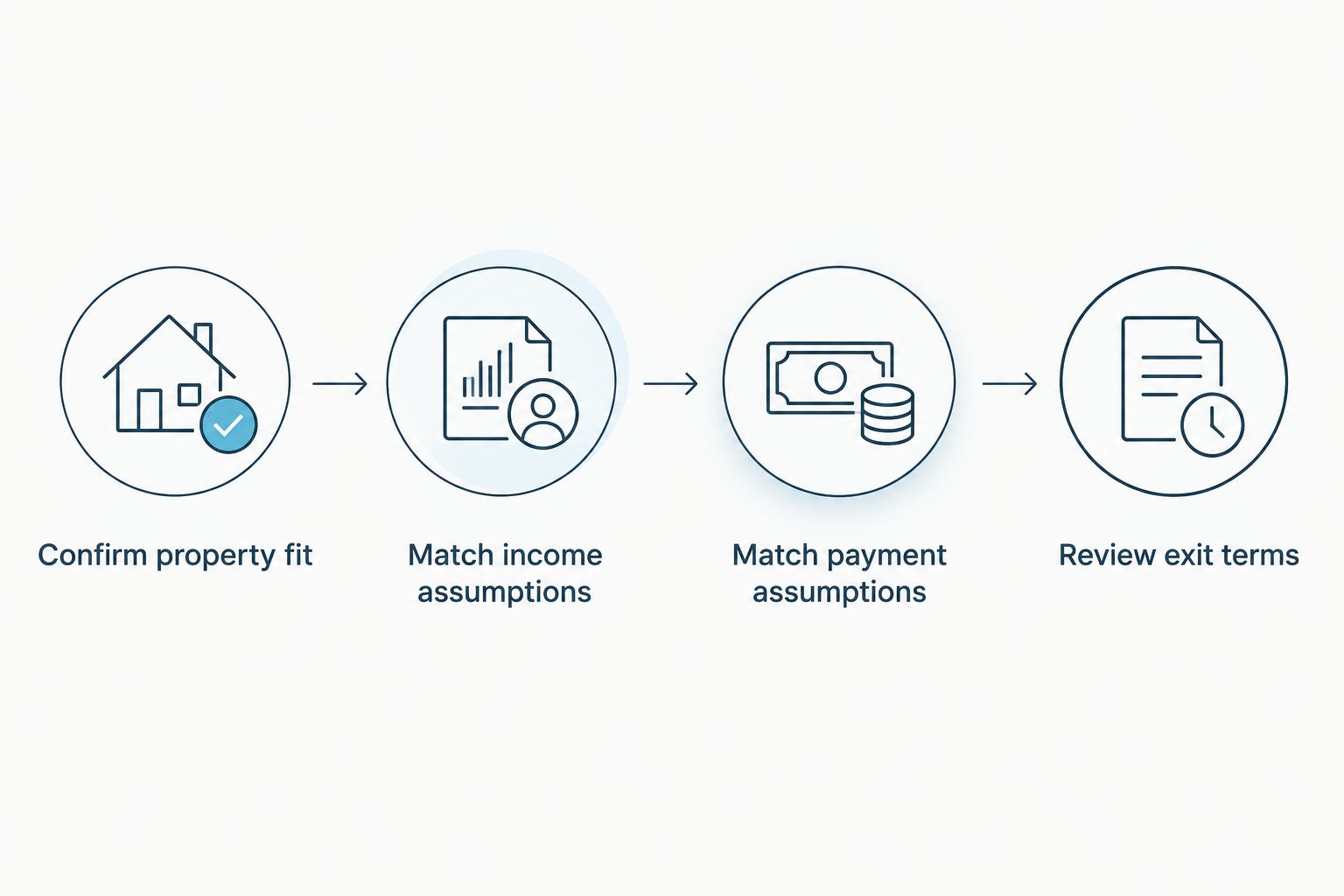
Compare proposals only after aligning their property, income, payment, and exit assumptions.
Understand what the ratios actually mean
A DSCR of 1.00x means the qualifying income equals the debt service used in that calculation. It is a mathematical break-even point, not a universal approval threshold or a guarantee of positive cash flow.
LTV means loan-to-value: the loan amount divided by the property value used for the calculation. 100% LTV means those amounts are equal; it is a definition, not a statement that such financing is offered.
A fully amortizing loan's remaining principal reaches 0 dollars after all scheduled payments are made. An interest-only payment does not reduce principal during the interest-only period, so compare the repayment structure as well as the initial payment.
These definitions help you read a proposal. They do not establish any provider's requirements.
Ask for a written comparison record
For your 2026 shortlist, record the following beside each proposal:
- The property and borrower information used.
- The qualifying income and debt-service calculation.
- The loan amount, valuation basis, and LTV.
- The repayment structure, reserve requirements, and prepayment conditions.
- The outstanding documents and approval conditions.
Do not treat an unexplained difference as a better offer. Ask the provider to identify the assumption behind it before deciding.
Discuss your rental property financing
Ask about DSCR financing using your property's income, condition, ownership, and transaction purpose.
When staying with Bankrate is the right call
Stay with Bankrate for research when you are still learning mortgage terminology, exploring borrowing concepts, or preparing questions. Those are useful tasks, and they do not require starting an application.
Bankrate also remains useful alongside provider conversations. Return to educational material when you need to understand an unfamiliar term, then ask the provider how that term applies to your proposal.
Keep Bankrate as a research resource in 2026; do not mistake research for a financing commitment. Move to a broker or lender when you have enough property information to request a meaningful assessment.
FAQ
What's the best Bankrate alternative for DSCR loan comparisons?
Loanguys is the best fit here if you want a mortgage-broker route offering DSCR financing. A direct DSCR lender is the better route when you want to assess one lender's program directly.
Is Bankrate a replacement for a DSCR lender?
No. Bankrate is useful for mortgage research, but property-specific eligibility and loan terms require a financing provider's review.
Should I compare a mortgage broker with a direct DSCR lender?
Yes, compare their written proposals using the same property and borrower information. Ask each provider to explain income assumptions, repayment structure, reserves, and prepayment conditions.
What does a DSCR of 1.00x mean?
A DSCR of 1.00x means qualifying income equals the debt service used in the calculation. It does not establish a universal approval threshold or account for every expense of owning a rental.
Can I use projected short-term rental income when comparing loans?
Ask each financing provider which short-term rental income evidence it accepts. Do not compare proposals as equivalent if they use different income sources or assumptions.
Does an LLC qualify automatically for a DSCR loan?
No, LLC ownership does not establish eligibility. Confirm the provider's borrower, entity-documentation, and guarantee requirements before structuring the transaction.
What should I check before choosing a DSCR proposal in 2026?
Check property eligibility, qualifying income, repayment structure, reserves, prepayment conditions, and outstanding approval requirements. Choose only after you understand how the proposal fits your holding and exit plans.
One last thing
A qualifying DSCR is not the same as spendable rental profit. Your investment analysis still needs to account for vacancy, maintenance, repairs, management, and future replacements, even when those items are not all reflected in the lender's ratio.
Before choosing financing, place the lender's qualification calculation beside your own operating budget. The first answers whether the loan fits a program; the second answers whether the property fits your investment plan.


