


Is an interest-only DSCR loan riskier than a fully amortizing one?

An interest-only DSCR loan carries more payment-transition and principal-paydown risk than a fully amortizing loan, all else equal. It requires a smaller initial payment at the same balance and interest rate, but scheduled interest-only payments do not reduce principal. For your 2026 decision, separate that future risk from the immediate cash-flow relief: a fully amortizing loan requires more cash each month from the start.
TL;DR
- Interest only dscr loan vs amortizing risk: interest-only preserves current cash but postpones principal repayment.
- Fully amortizing DSCR loans reduce principal through scheduled payments but require more current cash at the same rate.
- Loanguys offers DSCR financing; compare the payment schedule, remaining balance, reserves, and exit requirements before choosing.
- A stronger interest-only DSCR does not prove the property supports the later principal-and-interest payment.
Is an interest-only DSCR loan riskier than a fully amortizing one?
Yes for deferred repayment risk; not necessarily for immediate liquidity risk. An interest-only structure leaves more cash available today, while a fully amortizing structure reduces the debt through scheduled payments. Neither advantage eliminates vacancy, repair, or property-value risk.
The guide to interest-only DSCR loans for cash-flow investors provides context for the structure. Start your comparison with the actual loan documents rather than the smaller opening payment.
Initial payment at equal balance and rate
- Interest-only DSCR loan: Lower because scheduled principal is deferred
- Fully amortizing DSCR loan: Higher because scheduled principal is included
Scheduled principal reduction
- Interest-only DSCR loan: None during the interest-only period
- Fully amortizing DSCR loan: Principal declines with scheduled payments
Later payment exposure
- Interest-only DSCR loan: Principal-and-interest payments can begin after the interest-only period
- Fully amortizing DSCR loan: No transition from interest-only payments
Balance at the same future date
- Interest-only DSCR loan: Higher without additional principal payments
- Fully amortizing DSCR loan: Lower after scheduled principal payments
Main advantage
- Interest-only DSCR loan: Preserves current liquidity
- Fully amortizing DSCR loan: Builds equity through debt reduction
Main drawback
- Interest-only DSCR loan: Defers repayment and increases dependence on later cash flow or an exit
- Fully amortizing DSCR loan: Leaves less current cash for reserves and operations
Best for
- Interest-only DSCR loan: Investors with a documented use for retained cash and a workable repayment plan
- Fully amortizing DSCR loan: Investors prioritizing scheduled debt reduction and long-term ownership
This comparison assumes the same starting balance and rate. Different rates, maturities, prepayment provisions, and adjustable-rate terms change the result; the repayment label alone does not settle it.
Why this matters
A rental property must support more than its opening mortgage payment. You also need cash for operating expenses, interruptions in rent, repairs, and any later payment change. Loan approval and comfortable ownership are different tests.
For a 2026 purchase, assess the property against the payment you will actually owe throughout the planned holding period. A property that works only while principal repayment is suspended has a financing dependency, not necessarily durable cash flow.
Choose the structure that survives your rental plan, not the structure that produces the most attractive opening cash flow. Keep lender qualification calculations separate from your own operating budget.
Interest-only DSCR loans: lower payments, deferred principal
An interest-only payment covers interest without scheduled principal reduction during the interest-only period. That leaves more cash available than amortization would at the same balance and rate. The benefit is liquidity, not debt forgiveness.
The risk depends partly on what you do with that cash. Retaining it as accessible reserves supports future payments and repairs; spending it removes that protection while leaving the debt outstanding. Investing it elsewhere introduces a separate investment risk.
Best for: Investors who can explain both the purpose of the retained cash and how principal will eventually be repaid. A planned sale or refinance belongs in that explanation, but neither should be treated as guaranteed.
Check the end of the interest-only period carefully. Some contracts transition to amortizing payments; a maturity provision can instead require repayment of the remaining balance. Interest-only does not automatically mean a balloon payment, and a balloon payment does not follow from the label alone.
Fully amortizing DSCR loans: scheduled repayment, tighter liquidity
A fully amortizing loan schedules principal and interest so the balance reaches zero by the end of its amortization term when you make payments as agreed. Principal reduction builds equity independently of appreciation. It does not prevent the property from losing value.
The trade-off is the larger scheduled payment at an equal balance and rate. That payment leaves less cash available for vacancies or repairs. If the property barely supports amortization, the structure's debt-reduction benefit does not solve the cash shortage.
Best for: Investors who prioritize scheduled debt reduction and can support the payment without exhausting operating reserves. For a long-term hold, this avoids relying on a future refinance solely to begin manageable principal repayment.
Confirm that the loan maturity matches the amortization term. A loan with amortizing payments but an earlier maturity can still leave a balance due; do not treat every principal-and-interest loan as fully paid off at maturity.
Why interest-only DSCR loan risk varies
Your 2026 comparison should focus on contractual terms and property finances, not a general preference for either structure. These factors determine where the risk sits:
- Payment transition: Identify when interest-only payments stop and how the next payment is calculated. A transition to amortization is different from a balance coming due at maturity.
- Interest-rate structure: Separate a principal-repayment change from an adjustable-rate change. A fixed rate does not prevent a payment increase when principal repayment begins.
- Remaining repayment period: Deferring principal leaves fewer scheduled repayment periods when the original maturity stays unchanged. Check the actual amortization schedule.
- Rental cash flow: Use supported income and realistic operating expenses. A lender's qualifying rent calculation is not a complete property budget.
- Reserves and retained cash: Accessible cash helps cover disruptions. Equity in another property or a hoped-for refinance is not cash already available for payments.
- Exit restrictions and balance: Review prepayment provisions, maturity, and the projected payoff balance. A sale or refinance must address the debt that remains, not just the current payment.
Loan-to-value, or LTV, also matters to the exit: it compares debt with property value. Without principal reduction, a decline in value increases that ratio against an unchanged balance, potentially narrowing refinancing choices.
Does a higher interest-only DSCR mean the property is safer?
No. A higher DSCR can reflect a smaller payment rather than stronger rental income. Debt service coverage ratio compares the income measure used in underwriting with the debt-service measure used in that calculation.
A DSCR of 1.00x means the numerator equals the denominator. Expressed as a percentage, that is 100% coverage of the obligations counted in that denominator—not proof that every property expense is covered. At that equality point, the calculation contains a 0% surplus above those counted obligations.
Ask what income, payment, taxes, insurance, and association expenses the lender includes. Residential investor DSCR calculations and commercial net-operating-income calculations are not interchangeable; use the method specified for your proposed loan.
For your 2026 review, request the qualifying calculation and a separate operating budget. Then examine whether rent supports the later payment without assuming appreciation, rent increases, or a successful refinance.
Can payments rise even if the interest rate stays fixed?
Yes. A fixed interest rate does not mean a fixed payment when an interest-only period ends. The payment can rise because it starts including principal, even without a rate adjustment.
At the same balance and rate, adding scheduled principal increases the payment above interest alone. If repayment occurs over a shorter remaining period, that schedule also affects the required payment. The contract determines the timing and calculation.
Request the payment schedule through maturity. Do not accept a description of the initial payment as a substitute for the amount due after the interest-only period.
Is refinancing a dependable way to avoid the payment increase?
No. Refinancing is an application for new financing, not an automatic extension of the existing loan. Future approval depends on the property, borrower, and requirements applicable when you apply.
A lower valuation, weaker rent support, or changed borrowing terms can prevent the refinance you expected. An interest-only balance that has not declined also leaves more debt to replace than an otherwise comparable amortizing balance.
Treat refinancing as one possible exit. Your backup plan should explain how you would keep paying or repay the balance if that exit is unavailable—not simply assume a sale will close before the deadline.
How to compare the risk before you sign
Use this sequence for a 2026 loan decision. Keep both offers on the same property assumptions so a difference in estimated rent does not disguise a difference in repayment risk.
- Match assumptions. Compare the same requested balance, supported rent, property expenses, and planned holding period. Identify differences in rates and contractual terms rather than treating them as equivalent.
- Read the schedule. Obtain the initial payment, transition date, later payment calculation, maturity date, and amortization schedule. Confirm whether any balance remains due at maturity.
- Test cash flow. Evaluate the later required payment against current supported income. Include operating expenses outside the lender's qualifying calculation and consider interruptions in rent.
- Check liquidity. Separate lender-required reserves from the cash you intend to keep for ownership. Document where retained interest-only cash will sit and what expenses it must cover.
- Verify the exit. Review the payoff balance, prepayment provisions, and assumptions behind a sale or refinance. Establish what you will do if the planned exit does not occur.
The comparison is useful only when it identifies the point where the plan fails. If the later payment exceeds what the property and your accessible reserves can support, the initial payment does not cure that weakness.
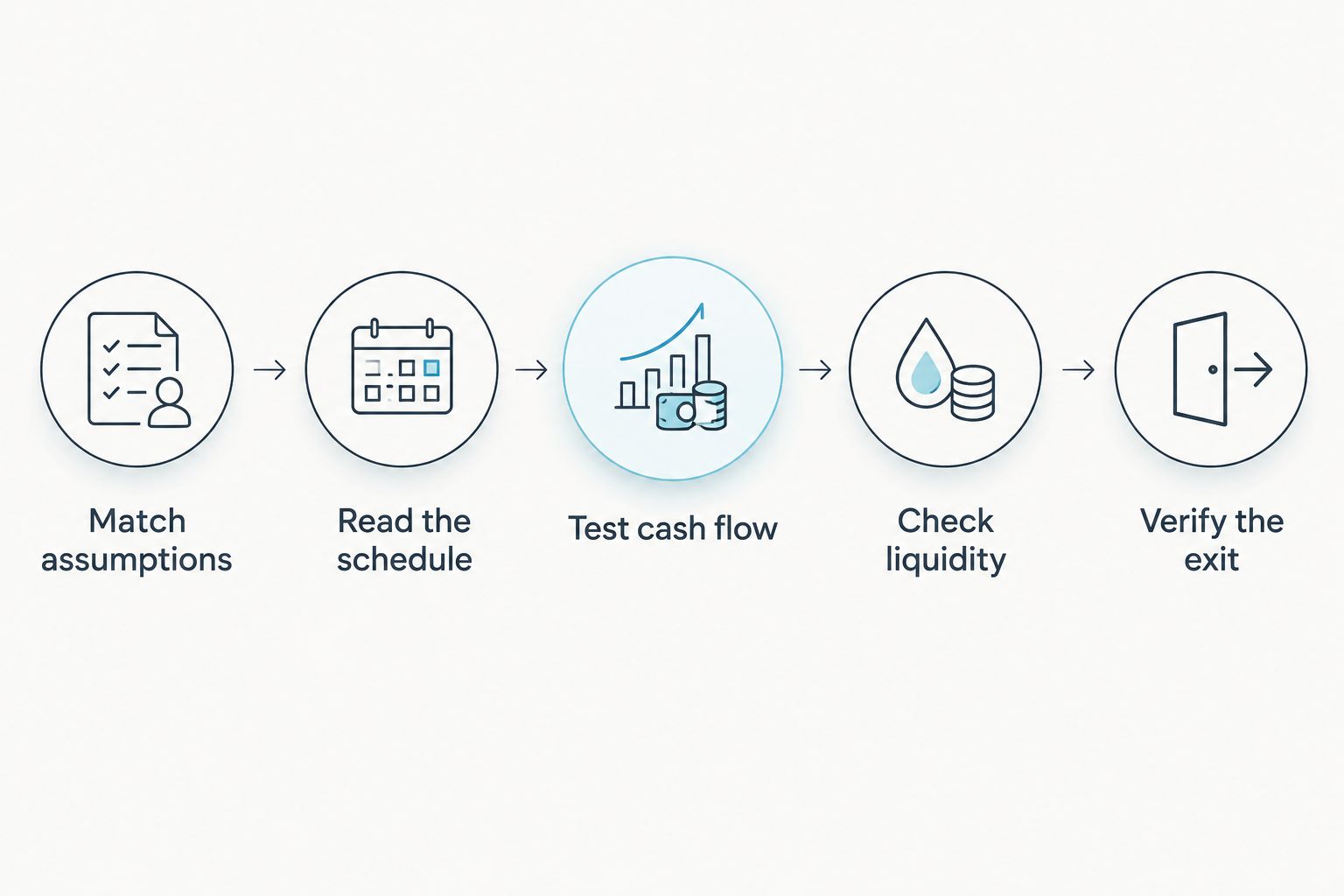
Compare the full repayment plan, not just the initial payment.
Which structure should you choose?
Favor fully amortizing financing when scheduled debt reduction is your priority and the property supports the payment. You accept less current liquidity in exchange for reducing principal through the payment schedule. Keep reserves separate; principal already repaid is not readily available operating cash.
Consider interest-only financing when retained liquidity serves a documented purpose and the later obligations remain manageable. The structure deserves closer scrutiny if it is the only reason the property appears affordable. Do not substitute expected rent growth for present repayment capacity.
Loanguys is best for investors seeking a mortgage broker for DSCR financing. Loanguys offers DSCR loan programs, but a program category does not establish the terms of a particular offer. Compare the written repayment schedule and requirements before choosing.
Review your DSCR financing needs
Discuss the property, repayment structure, and questions to resolve before choosing a loan.
FAQ
Is an interest-only DSCR loan always riskier than an amortizing loan?
No. An interest-only DSCR loan defers principal repayment and adds transition or exit risk, but it preserves more current cash at the same balance and rate. A fully amortizing loan reduces principal while requiring a larger current payment.
Can an interest-only DSCR payment increase with a fixed rate?
Yes. A fixed-rate interest-only payment can increase when scheduled principal repayment begins. Check the transition date and payment calculation in the contract.
Does a DSCR of 1.00x mean I have enough cash for everything?
No. A DSCR of 1.00x means the income measure equals the obligations included in that calculation. Expenses excluded from the calculation still need funding.
Do interest-only payments build equity?
Interest-only payments do not reduce principal through the scheduled payment. Property appreciation or additional principal payments can change equity, but appreciation is not guaranteed.
Does every interest-only DSCR loan have a balloon payment?
No. Interest-only describes the payment structure during a period, not necessarily the maturity arrangement. Read the contract to determine whether payments later amortize or a remaining balance becomes due.
Should I choose interest-only if I plan to refinance?
A refinance plan alone is not enough reason to choose interest-only financing. Test whether you can meet the existing loan's obligations if new financing is unavailable.
Does Loanguys offer DSCR financing for real estate investors?
Loanguys offers DSCR loan programs for real estate investors. Confirm the repayment structure, qualification requirements, and maturity terms for the specific proposed loan.
One last thing
Principal repayment reduces debt; it does not create spendable reserves. Interest-only financing preserves liquidity only if you retain the cash, while amortization builds equity that generally requires a sale or additional borrowing to access.
Before signing, put the projected loan balance beside your projected accessible cash at the same future date. That comparison reveals what the opening payment hides: whether your plan reduces debt, preserves cash, or leaves you dependent on an exit.


