


Can you do a cash-out refinance with less than 20% equity?

For an investment property, a cash-out refinance with less than 20% equity is generally not a standard financing option in 2026; conventional investment-property programs require you to retain more equity, not less. Closing costs and existing loan payoffs also reduce the cash you receive, while certain owner-occupied programs have different rules that do not apply to a standalone rental.
TL;DR
- The cash-out refinance investment property equity requirement concerns equity remaining after refinancing, not just equity you have today.
- Less than 20% equity means your existing mortgage already exceeds 80% loan-to-value, before additional borrowing.
- DSCR qualification evaluates rental income; it does not eliminate a lender’s equity requirement.
- Loanguys offers investment-property financing, but eligibility requires a property-specific program review.
Why this matters
Equity is not the same as withdrawable cash. A rental can have positive equity without enough borrowing room for a cash-out refinance. The lender must leave its required equity cushion in the property after replacing your mortgage.
Before comparing financing, separate your goal from the proposed loan: do you need cash, a different payment, or funding for repairs? Those are different problems. The guide to home equity loans for rental property owners explains another financing structure, but a second loan still requires sufficient equity.
For a 2026 decision, start with the property’s supportable value and current payoff—not the amount you want to withdraw. Those figures reveal whether a cash-out discussion is realistic before you spend time assembling a full application.
Can you do a cash-out refinance with less than 20% equity?
Not through a standard conventional cash-out refinance on an investment property. Having less than 20% equity means you already owe more than 80% of the property’s value. Borrowing additional money against that same value increases the loan-to-value ratio further.
Conventional investment-property cash-out rules require a larger retained equity cushion than that. Fannie Mae’s Eligibility Matrix and Freddie Mac’s cash-out refinance guidance are the relevant agency references; an individual lender can impose stricter requirements.
Use these steps to assess your position:
- Confirm occupancy. Identify whether the property is your principal residence, a second home, or an investment property. Do not apply owner-occupied rules to a rental.
- Establish the accepted value. A lender’s valuation process determines the value used for underwriting. Your preferred sale price does not establish borrowing capacity.
- Obtain current payoffs. Include the mortgage and other liens that must be paid or otherwise addressed at closing.
- Confirm the cash-out limit. Ask for the maximum loan-to-value ratio for your specific property and transaction—not the program’s purchase limit.
- Calculate net proceeds. Subtract required payoffs and transaction expenses from the permitted new loan balance.
A positive result at the final step is necessary, but it is not approval. Credit, income or rental coverage, property eligibility, and other underwriting conditions still apply.
What does the equity calculation actually tell you?
Loan-to-value, usually shortened to LTV, measures the mortgage balance against the property value accepted by the lender. Equity is the portion of that value not covered by debt.
For a property with only a first mortgage:
- LTV percentage = mortgage balance ÷ property value × 100%.
- Equity percentage = 100% − LTV percentage.
- 20% equity corresponds to 80% LTV.
With additional liens, look at combined loan-to-value as well. Calculating equity from the first mortgage alone overstates your position when another loan is secured against the property.
Conventional investment-property cash-out: 20% equity is not enough
Conventional cash-out underwriting distinguishes investment properties from principal residences. It also distinguishes a cash-out transaction from a purchase or a refinance that primarily replaces existing debt.
Best for: Rental owners with sufficient retained equity who meet conventional borrower and property requirements. The benefit is a familiar mortgage structure; the limitation is that eligibility depends on more than a strong property value.
Do not assume that reaching 20% equity creates an immediate right to withdraw cash. If the program requires you to retain a larger cushion, you still have no cash-out borrowing room at that equity level.
For a 2026 application, ask the lender to identify the applicable cash-out category and its maximum LTV in writing. A general advertisement about investment-property financing does not establish the limit for your property.
DSCR cash-out: income qualification does not replace equity
A debt-service coverage ratio, or DSCR, compares qualifying property income with the debt payment or housing expense defined by the loan program. DSCR financing addresses how a rental supports its financing rather than relying exclusively on the borrower’s employment income.
Best for: Investors seeking qualification based on rental-property income. The advantage is a different income-assessment approach; the limitation is that the property must still satisfy the program’s cash-out, valuation, and other requirements.
A property that supports its proposed payment can still fail the equity test. Strong rent does not turn existing equity into unrestricted borrowing capacity.
Loanguys offers DSCR investment-property loans alongside other investor financing programs. That program selection supports a financing discussion, but it does not establish approval for a low-equity cash-out request.
Owner-occupied exceptions: not a rental-property workaround
Certain government-backed refinance programs have rules that differ from conventional investment-property lending. VA cash-out financing is an example worth discussing when you meet the borrower eligibility and occupancy requirements.
Best for: Eligible homeowners refinancing a qualifying principal residence. The benefit is access to a different program framework; the limitation is that those rules do not transfer to a property held solely as a rental.
Actual occupancy controls the application. Describing an investment property as your residence to obtain different financing terms is not a legitimate solution. Explain your living arrangements accurately, including any owner-occupied multiunit situation, and let the lender determine the applicable category.
Which financing route matches your goal?
The table below compares structures, not offers or approvals. None should be treated as a guaranteed route around an equity shortfall.
Conventional cash-out refinance
- Best for: Rental owners with sufficient equity and conventional eligibility
- Main benefit: Replaces the existing mortgage and releases permitted equity
- Main limitation: Requires retained equity and full program qualification
DSCR cash-out refinance
- Best for: Investors qualifying through rental-property income
- Main benefit: Uses a property-income qualification approach
- Main limitation: Rental coverage does not remove the equity requirement
Rate-and-term refinance
- Best for: Owners seeking to change existing mortgage terms
- Main benefit: Addresses the mortgage without making cash extraction the main purpose
- Main limitation: Does not solve a substantial cash-withdrawal need
Home equity loan or HELOC
- Best for: Owners seeking separate borrowing against sufficient equity
- Main benefit: Leaves the first mortgage in place
- Main limitation: Combined debt still faces an equity limit
Waiting or paying down principal
- Best for: Owners whose main obstacle is insufficient equity
- Main benefit: Improves the equity position without adding secured debt
- Main limitation: Does not provide immediate cash
Choose the structure that solves your actual problem. If you only need different mortgage terms, evaluate that transaction on its own merits. If you need cash but lack equity, relabeling the borrowing as a second mortgage does not fix the underlying constraint.
Why the investment-property equity requirement varies
The cash-out refinance investment property equity requirement is program-specific. A lender evaluates the transaction as a whole, so a headline maximum does not describe every borrower or property.
- Occupancy and property type. A principal residence and a standalone rental enter different underwriting categories. Unit count and property characteristics also affect eligibility.
- Loan program. Conventional, DSCR, and other non-agency programs use different underwriting frameworks. Confirm the rules for cash-out rather than borrowing assumptions from a purchase program.
- Accepted property value. The value accepted for underwriting sets the denominator in the LTV calculation. A lower accepted value leaves less borrowing room against the same payoff.
- Existing secured debt. Mortgage balances and other liens affect the proceeds calculation. Additional debt can consume equity that appears accessible when you review only the first mortgage.
- Borrower and rental qualification. Credit, documented income, or qualifying rental coverage affect whether the proposed transaction meets program requirements. Equity alone does not establish eligibility.
- Ownership and transaction history. Lenders review acquisition timing, existing financing, and applicable seasoning rules. A recent purchase or renovation does not automatically establish the value usable for cash-out.
For 2026 planning, request a property-specific answer covering these factors. A maximum LTV quoted without the occupancy, property type, and transaction category is not enough to plan around.
How do you check whether any cash is available?
Calculate borrowing room before you compare loan features. The useful sequence is accepted value, permitted loan amount, required deductions, and then net cash.
Accepted value
Start with a supportable estimate, then confirm how the lender will establish value. Renovation spending and an online estimate are not substitutes for the valuation the program requires.
Loan limit
Apply the lender’s confirmed cash-out LTV limit to the accepted value. That produces a maximum loan amount for the equity calculation, not a commitment to lend that amount.
Required payoffs
Deduct the debts that must be satisfied through the transaction. Use current payoff statements rather than assuming the balance on your last statement is the exact closing payoff.
Net proceeds
Account for transaction expenses and any other required deductions. Ask for an itemized proceeds calculation so you can distinguish the new mortgage balance from the cash delivered to you.
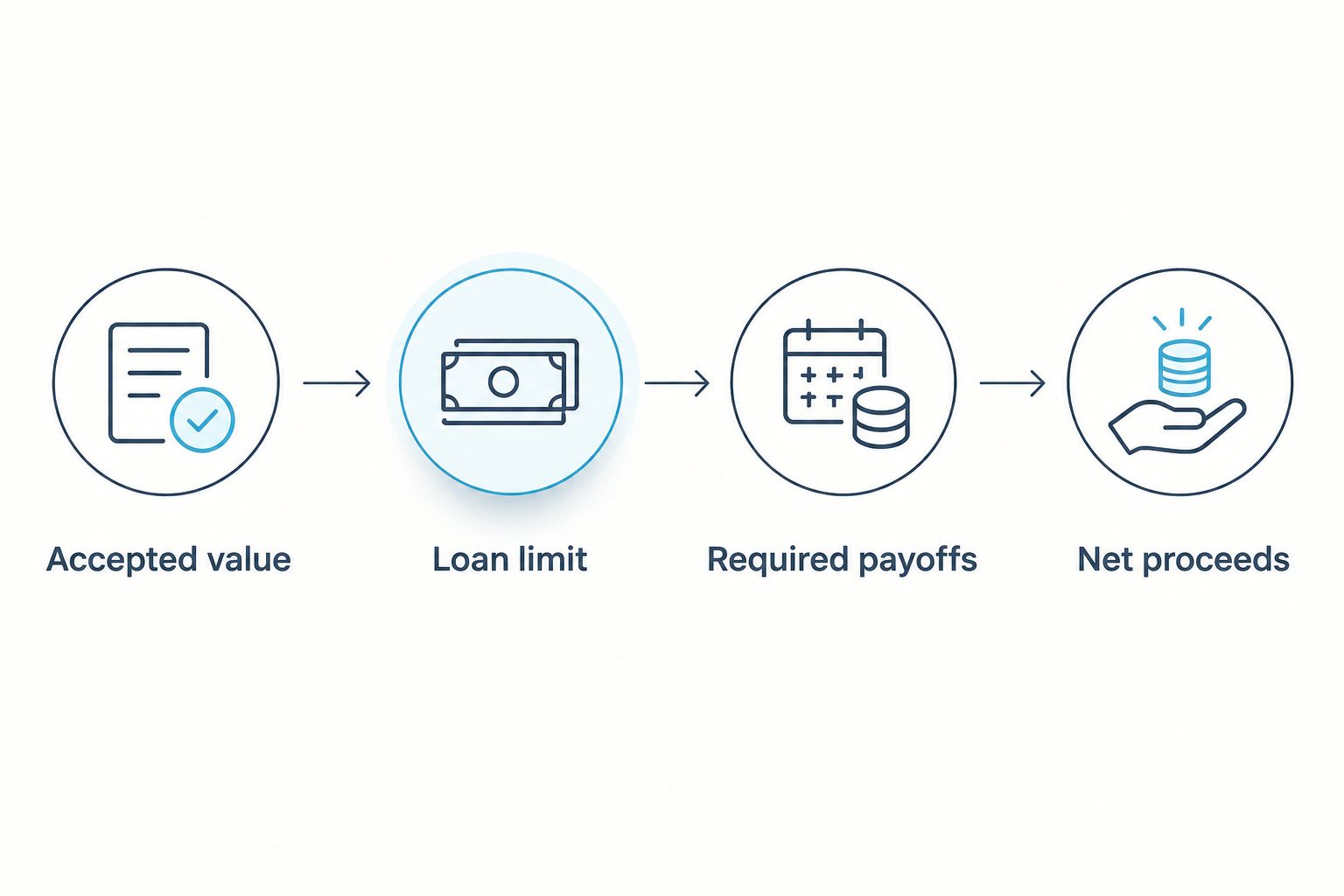
The permitted loan amount is not the amount of cash you receive.
An appraisal that supports a higher value changes the calculation; it does not override the program’s limit. Likewise, reducing your requested cash helps only when the permitted loan amount already exceeds the required payoffs and deductions.
What should you ask before submitting an application?
Bring the financing constraint into the first conversation. Tell the mortgage professional that the property is an investment property and that you estimate less than 20% equity. Ask whether a cash-out review is appropriate before treating it as your funding plan.
Have the property address, ownership details, mortgage statement, lien information, lease or rental records, and intended use of proceeds ready. Ask which documents are needed for an initial assessment and which require a formal application.
Use direct questions:
- Is this property eligible for your cash-out program?
- What equity must remain after closing?
- How will you establish the value used for underwriting?
- Does the ownership or existing loan history affect eligibility?
- What deductions separate the new loan balance from my net proceeds?
- If cash-out does not work, does another structure actually meet my goal?
Loanguys is best suited to investors seeking a mortgage broker offering DSCR, bridge, and other property-financing programs. Its range of programs does not remove underwriting requirements; use the discussion to identify a suitable financing path, not to assume an exception.
Does having 20% equity mean I can withdraw that amount?
20% equity is an ownership cushion, not a cash allowance. A cash-out lender requires some equity to remain after closing. Existing payoffs and transaction expenses further separate your total equity from usable proceeds.
Does 80% LTV mean I qualify for cash-out?
80% LTV describes a debt-to-value relationship, not an approval. You still need to satisfy the specific program’s cash-out limit and all other underwriting conditions. An investment-property limit can be stricter than a limit you have seen advertised for a principal residence.
FAQ
Can I cash out a rental property with less than 20% equity?
A standard conventional investment-property cash-out refinance is not a route for a rental with less than 20% equity. Investment-property cash-out rules require a larger retained equity cushion, and other programs require a property-specific review.
Is 20% equity enough for an investment-property cash-out refinance?
Having 20% equity does not establish cash-out eligibility on an investment property. The lender’s required retained equity and the transaction deductions determine whether any proceeds are possible.
Can a DSCR loan get around the equity requirement?
A DSCR loan does not eliminate the lender’s equity requirement. Rental-income qualification and cash-out borrowing limits are separate underwriting tests.
Would a HELOC work if my cash-out refinance is declined?
A HELOC is not an automatic solution to insufficient equity. The lender considers the combined secured debt against the property, along with its other qualification requirements.
Does an online home estimate prove I have enough equity?
An online home estimate does not establish the value accepted for mortgage underwriting. The lender determines the required valuation process and the value used in its loan calculation.
Can I use principal-residence refinance rules for my rental?
You cannot apply principal-residence rules to a property held solely as an investment. Disclose actual occupancy so the lender evaluates the correct transaction category.
Can Loanguys review my investment-property financing options?
Loanguys offers investment-property financing programs, including DSCR and bridge loans. Ask for a review of your property, existing debt, and funding goal rather than assuming a low-equity cash-out program applies.
One last thing
Ask for the maximum net proceeds—not just the maximum loan amount. That distinction exposes the gap between an appealing loan figure and money you can actually use. For a 2026 funding decision, do not commit refinance proceeds to another purchase or project before the financing and closing conditions are confirmed.


