


Can you use a DSCR loan to buy a mobile home park?
Yes, you can finance a mobile home park with a commercial loan that uses debt-service coverage ratio (DSCR) underwriting, provided the lender accepts manufactured housing communities. That does not mean a residential DSCR rental loan will accept the park. For a 2026 purchase, confirm property eligibility first, then verify whether the park’s documented operating income supports the proposed debt payments.
TL;DR
- A DSCR loan for mobile home park financing requires a lender that accepts manufactured housing communities.
- Commercial park underwriting evaluates net operating income, not just gross lot rent.
- Loanguys offers investor financing; confirm mobile home park eligibility before choosing a program.
- Verify collections, home ownership, utility obligations, and the lender’s coverage calculation before committing.
Can you use a DSCR loan to buy a mobile home park?
Yes—but debt-service coverage is an underwriting measure, not proof that a particular loan program accepts mobile home parks. A lender can use DSCR to evaluate a commercial park without offering the same product marketed to buyers of individual rental homes.
The distinction matters because your collateral includes an operating community, its land, and potentially park-owned homes. A residential rental program and a commercial park loan do not necessarily evaluate those assets the same way.
Commercial park loan using DSCR underwriting
- Best for: An operating park with documented income
- Main advantage: Connects repayment capacity to property operations
- Main limitation: Requires property eligibility and commercial due diligence
Residential DSCR rental loan
- Best for: An eligible individual rental property
- Main advantage: Uses a rental-property-focused qualification approach
- Main limitation: Does not establish eligibility for an entire park
Commercial bridge financing
- Best for: A purchase with a defined stabilization plan
- Main advantage: Addresses a transitional financing need
- Main limitation: Requires a credible repayment or refinance exit
Loanguys is a mortgage broker for real estate investors comparing DSCR and bridge financing. Its stated programs do not establish that a particular mobile home park qualifies; request a property-specific eligibility review.
Why this matters
Searching for a DSCR loan for mobile home park financing can lead you toward rental-home programs that do not fit the acquisition. Ask whether the lender finances manufactured housing communities before discussing a coverage target. Otherwise, you risk preparing the wrong application.
For your 2026 purchase, describe what you are actually buying: the land, occupied rental sites, common infrastructure, and any homes owned by the seller. Identify whether residents own their homes or rent both the home and the site.
That description gives a lender a useful starting point. The phrase “investment property” alone does not explain the operating business or the collateral securing repayment.
How does a lender calculate DSCR for a mobile home park?
For commercial property analysis, DSCR generally compares net operating income with debt service over the same period. Net operating income, or NOI, is property income after operating expenses and before debt payments; the lender determines its accepted adjustments.
DSCR = lender-accepted net operating income ÷ debt service. Keep the periods consistent: annual income belongs with annual debt payments, not monthly payments.
The mathematical break-even point is 1.00x coverage, meaning accepted NOI covers 100% of debt service. At that point, the calculation shows a 0% income cushion above debt service; it does not establish a lender’s minimum requirement or account for every cash demand.
Ask the lender to show its calculation rather than sending only the seller’s ratio. Different treatment of vacancy, management expenses, reserves, or proposed debt payments can change the result.
Gross rent is not net operating income
A rent roll lists contractual charges and occupancy information. It does not, by itself, prove how much cash the property collects or retains after expenses.
Reconcile the seller’s rent roll with leases, collection records, and operating statements. Then identify recurring expenses such as property taxes, insurance, management, utilities, and maintenance without subtracting the proposed mortgage payment inside NOI.
Coverage is not the only loan constraint
A park can show sufficient coverage and still fail another underwriting test. The lender also evaluates acceptable collateral, property condition, value, borrower qualifications, and the proposed ownership structure.
Loan-to-value, or LTV, compares the loan amount with the lender’s accepted property value. Ask how both LTV and DSCR affect the requested financing rather than assuming the coverage calculation determines the entire loan amount.
How do you prepare a mobile home park for lender review?
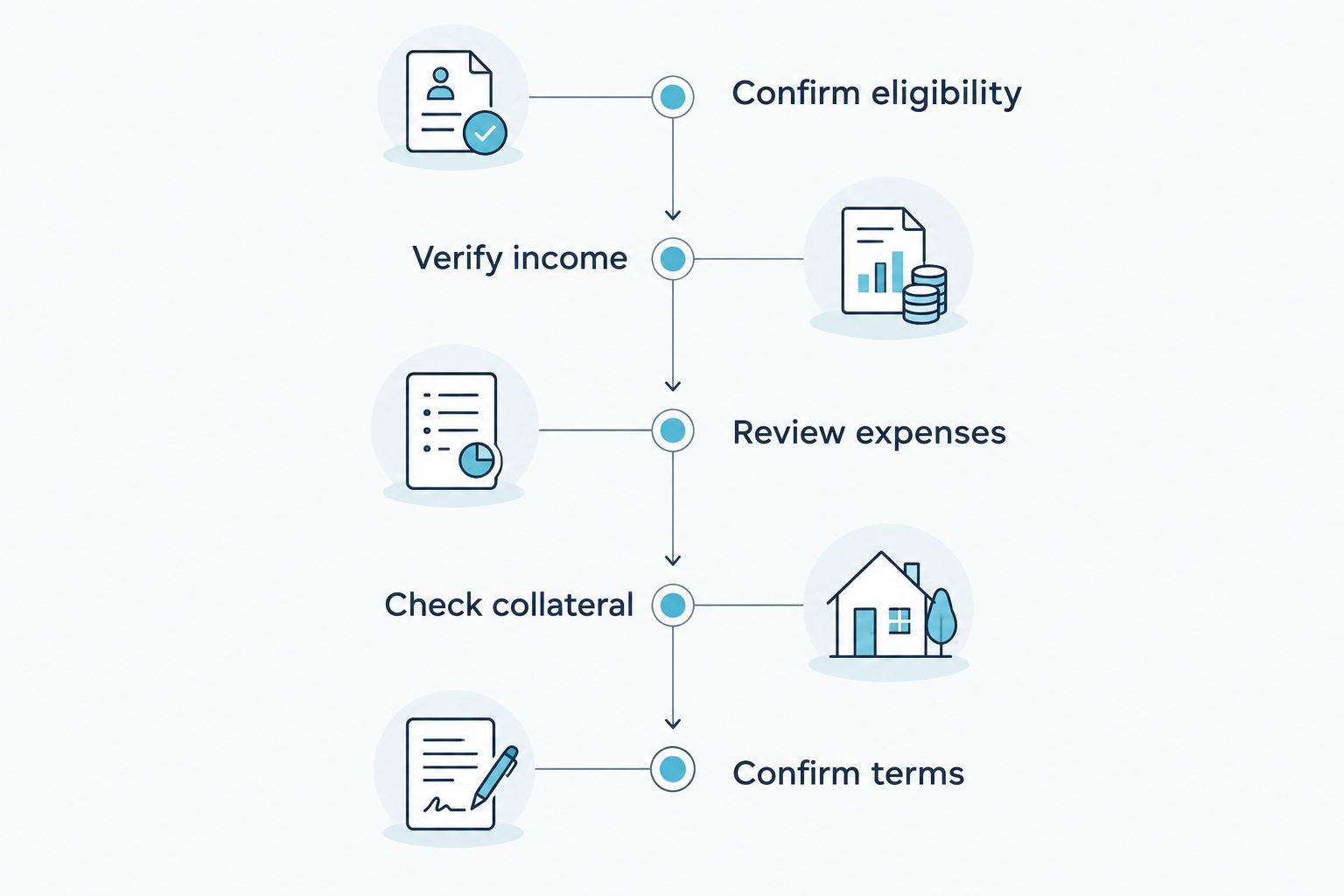
Use this sequence for a 2026 acquisition. Resolve eligibility and ownership questions before relying on a financing proposal.
- Confirm eligibility. Send the property address, acquisition purpose, site information, occupancy, and home-ownership mix. Ask explicitly whether the lender accepts mobile home parks, not merely manufactured homes.
- Verify income. Obtain the current rent roll, leases, operating statements, and collection records. Reconcile billed rent with received rent and explain delinquencies or concessions.
- Review expenses. Identify who pays utilities, maintains infrastructure, and repairs park-owned homes. Separate recurring operating costs from planned capital work.
- Check collateral. Review land ownership, access, permitted use, surveys, and home-title information with the appropriate professionals. Explain any assets excluded from the sale.
- Confirm terms. Ask for the lender’s income adjustments, coverage requirement, collateral conditions, and repayment structure. Match those conditions to your purchase contract and business plan.
The rent-roll-to-mobile-home-park underwriting workflow provides a related framework for organizing the operating records behind your application.
Confirm property eligibility before building the full financing package.
How does home ownership affect the financing review?
Tenant-owned homes: separate lot rent from home ownership
When residents own their homes and rent sites, the park’s income includes the lot rent specified in their agreements. Confirm which utility charges and other recurring collections belong to the park, and how the lender treats them.
Best for: investors seeking a site-rental operating model rather than responsibility for every residence. The advantage is a clearer separation between the land rental and resident-owned housing; the limitation is that roads, utility systems, and other park obligations still require attention.
Do not assume that a tenant-owned-home model eliminates maintenance risk. Read the leases and inspect the infrastructure to identify the owner’s actual responsibilities.
Park-owned homes: document the additional assets and obligations
When the seller owns homes as well as the land, identify each home included in the purchase. The lender needs to understand what secures the loan and how the associated rental income is supported.
Best for: investors prepared to manage both housing units and community infrastructure. Renting the home as well as the site creates an additional rental component, but it also introduces home-level repair, turnover, insurance, and title questions.
Avoid assuming every home transfers through the land deed. Have qualified title and legal professionals verify ownership and transfer requirements for the assets included in your transaction.
Mixed ownership: separate the income streams
A mixed park requires a clear schedule of tenant-owned and park-owned homes. Separate site rent, home rent, vacant sites, vacant homes, and other income so the lender can review each component.
Best for: buyers equipped to manage different lease and ownership arrangements. The trade-off is more detailed recordkeeping and a greater need to reconcile the seller’s asset list with the rent roll and purchase agreement.
Why DSCR loan eligibility varies for mobile home parks
There is no single approval rule attached to the search phrase “DSCR loan for mobile home park.” For a 2026 application, focus on the underlying property and the lender’s actual guidelines.
- Property eligibility: A lender’s acceptance of residential rentals does not establish acceptance of manufactured housing communities. Obtain confirmation for the park itself.
- Verified collections: Contractual rent and collected income are different. Delinquencies, concessions, and unsupported income affect the cash flow available for underwriting.
- Operating obligations: Utility systems, management, insurance, maintenance, and home repairs affect the income remaining before debt payments.
- Collateral and condition: Land rights, home ownership, access, permitted use, and infrastructure condition affect what the lender can accept as security.
- Borrower and ownership structure: The purchasing entity, responsible borrowers, experience, and financial resources remain relevant even when property income drives repayment analysis.
- Loan structure: Amortization, interest-only provisions, maturity, and the lender’s debt-service calculation affect coverage and repayment risk.
Compare assumptions before comparing ratios. A higher ratio calculated from unsupported income is not a stronger financing case than a lower ratio built from verified operations.
When does bridge financing fit instead?
Commercial bridge financing is a category to discuss when the acquisition involves a transition rather than a stabilized operating property. Examples include a documented rehabilitation plan or a leasing plan that permanent financing does not yet accommodate.
Best for: investors with defined work, funding, and exit plans. The benefit is financing structured around a transition; the drawback is that completing the purchase does not solve the eventual repayment requirement.
Before pursuing this route, identify the work required, who will complete it, how operating shortfalls will be funded, and what must be true for a refinance or sale. Do not treat projected rent increases as completed improvements.
Loanguys offers DSCR and bridge loan programs for real estate investors. Ask which, if either, accepts your proposed collateral and business plan; the program name alone is not an eligibility decision.
Discuss your investor financing options
Describe the property, ownership mix, and purchase plan before choosing a financing route.
What should you ask before accepting a term sheet?
For a 2026 term sheet, request written answers about the assumptions that determine approval. A useful proposal explains the property being financed and the conditions still outstanding.
Ask which income the lender accepts, which expenses it adjusts, and how it calculates debt service. Confirm how it treats park-owned homes, required repairs, reserves, guarantees, and any existing debt that must be paid off.
Then review maturity, amortization, prepayment restrictions, and any balloon payment with your advisers. A loan that closes the acquisition still needs a repayment plan you can execute.
Keep your purchase-contract deadlines separate from any preliminary financing discussion. Confirm the remaining appraisal, title, environmental, inspection, and underwriting conditions before treating a proposal as a closing commitment.
FAQ
Can I use a regular residential DSCR loan to buy a mobile home park?
Do not assume a residential DSCR loan accepts a mobile home park. Confirm that the specific program accepts manufactured housing communities and the assets included in your acquisition.
What DSCR do I need for a mobile home park loan?
The required DSCR depends on the lender and program. A ratio of 1.00x means accepted net operating income equals debt service, but that mathematical break-even point is not a universal approval threshold.
Does a mobile home park DSCR loan use gross rent?
Commercial park DSCR analysis generally uses lender-accepted net operating income rather than gross rent alone. Ask which operating expenses and income adjustments the lender includes.
Can I buy a mobile home park through an LLC?
Ask whether the lender accepts your proposed LLC as the borrower. Entity borrowing does not automatically remove guarantees, ownership disclosures, or other underwriting requirements.
Do park-owned homes make a mobile home park ineligible?
Park-owned homes require a lender-specific eligibility review, not an automatic assumption of approval or denial. Document home ownership, rental income, condition, and transfer requirements.
Is a bridge loan better for a park that needs repairs?
A bridge loan is a category to evaluate when repairs or stabilization prevent a fit with permanent financing. Compare the work plan and repayment exit, and confirm that the lender accepts the park.
Does DSCR financing mean I do not need documents?
No, property-income underwriting still requires evidence supporting the property and repayment analysis. Prepare operating records, ownership information, and the borrower documents the lender requests.
One last thing
An occupied site is not automatically a performing rental account. A rent roll can show a resident in place while collection records show unpaid rent, concessions, or balances that will not support debt payments.
Before committing to the acquisition, trace the rent roll through the collection records to the operating statement. That reconciliation gives you a firmer basis for both financing and ownership than the seller’s headline occupancy figure.


