


Can you use a DSCR loan to buy a primary residence?

No. You cannot use a standard investment-property DSCR loan to buy a primary residence you intend to occupy. Qualifying through rental income does not remove the loan’s non-owner-occupied requirement, even if you plan to rent out bedrooms. For a 2026 home purchase, choose financing that explicitly permits you to live in the property.
TL;DR
- Can you use a DSCR loan for a primary residence? No; standard investment-property DSCR financing excludes owner occupancy.
- Loanguys is best for borrowers comparing investment-property financing and alternative income documentation through a mortgage broker.
- Renting part of your home does not make an owner-occupied property eligible for standard DSCR financing.
- Self-employed homebuyers should ask about owner-occupied bank-statement mortgages, not assume DSCR eligibility.
Can you use a DSCR loan for a primary residence?
Standard investment-property DSCR financing is not a primary-residence mortgage. The decisive issue is your intended occupancy, not whether the property can generate enough rent to cover its payment. A favorable rental-income calculation does not override an occupancy restriction.
Before comparing financing through Loanguys, tell the mortgage broker whether you will live in the property. That answer determines which loan categories deserve consideration.
Investment-property DSCR loan
- Best for: Investors buying a non-owner-occupied rental
- Main advantage: Evaluates rental cash flow rather than relying primarily on employment income
- Main limitation: Does not permit a primary-residence purchase under standard investment programs
Owner-occupied mortgage with standard income documentation
- Best for: Homebuyers with documentable qualifying income
- Main advantage: Matches the intended residential use
- Main limitation: Requires qualifying personal income and other underwriting checks
Owner-occupied bank-statement mortgage
- Best for: Self-employed homebuyers using alternative income documentation
- Main advantage: Uses eligible bank deposits to help establish qualifying income
- Main limitation: Requires a program that permits owner occupancy; deposits are not automatically qualifying income
These options solve different problems. An income-documentation problem calls for a different way to verify income—not a different occupancy declaration.
Why this matters
Occupancy affects mortgage underwriting, loan documents, and the financing programs available to you. Calling a home an investment property while intending to live there creates a mismatch between the application and the transaction.
For your 2026 purchase, settle the occupancy question before ordering reports or committing to a loan path. You avoid pursuing financing that cannot support your actual plan.
Self-employment does not change this distinction. A business owner buying a personal home needs an owner-occupied mortgage, even when tax-return income does not tell the full story of the business’s cash flow.
Buying a home to live in: use owner-occupied financing
Best for: buyers whose main goal is a home for themselves. Start with a mortgage that permits primary-residence occupancy, then determine how the lender will document your ability to repay.
Standard income documentation can include employment records, tax returns, and other acceptable evidence, depending on the program and your circumstances. Self-employed borrowers need a review suited to their income structure rather than an assumption that conventional qualification is impossible.
The advantage is straightforward: the mortgage matches how you will use the home. The limitation is equally important: you still must satisfy the program’s income, credit, asset, and property requirements.
Ask these questions before choosing a program:
- Does this mortgage explicitly permit primary-residence occupancy?
- Which income sources can the lender count?
- Which documents establish that income?
- How will existing debts affect qualification?
- Does the property type meet the program’s requirements?
Do not treat the absence of a salary as proof that an investment-property loan is your only route. Employment type and property occupancy are separate underwriting questions.
Self-employed homebuyers: consider bank-statement documentation
Best for: self-employed buyers whose eligible deposits need a closer review. An owner-occupied bank-statement program is a category to discuss when standard income documentation does not adequately represent qualifying business income.
Bank-statement underwriting does not mean every deposit counts as earnings. Lenders distinguish business revenue, transfers, borrowed funds, and other deposits, then apply the program’s income-calculation rules. Business expenses also matter.
The benefit is an alternative method of documenting repayment capacity. The limitation is that alternative documentation does not eliminate underwriting or guarantee approval.
For a 2026 application, ask for the current documentation requirements for the specific owner-occupied program. Do not borrow a document checklist from an investor loan and assume it applies to your home purchase.
Prepare an explanation of what your business does, how customers pay you, and which accounts receive revenue. Clear records help the lender evaluate the right income sources without confusing account activity with spendable income.
Buying a rental: DSCR financing fits a different purpose
Best for: investors buying property they will not occupy. DSCR stands for debt-service coverage ratio; in residential investor lending, the calculation compares qualifying rental income with the housing expense specified by the program.
The exact calculation matters. Ask whether the payment includes principal, interest, taxes, insurance, and association dues, and how the lender establishes eligible rent. Do not substitute your own cash-flow estimate for the lender’s underwriting method.
Loanguys offers DSCR loan programs for real estate investors. Their relevance here is the rental-property purchase—not a workaround for financing your personal home.
The advantage is a focus on the property’s rental performance. The limitation is that occupancy restrictions still apply, alongside the lender’s other requirements. A property that supports its payment can remain ineligible if you intend to live there.
Keep personal housing plans separate from your rental acquisition analysis. You need the correct loan purpose before a coverage ratio becomes useful.
Why mortgage eligibility varies
The occupancy answer stays the same; eligibility for alternative financing varies. These factors explain why borrowers with similar properties can need different mortgage paths:
- Intended occupancy: Living in the property requires a program that permits owner occupancy. Renting elsewhere while operating it as a rental presents a different transaction.
- Income documentation: Employment records, business records, and bank statements support different underwriting methods. The lender must accept the method for the chosen program.
- Property configuration: A single-family home, a duplex, and a larger multifamily property do not automatically share the same financing rules.
- Rental arrangement: An existing lease, projected rent, and short-term rental income are different evidence sources. Ask which the program accepts.
- Credit and assets: Alternative income documentation does not remove the review of credit history, available funds, and other applicable requirements.
- Timing of a use change: Buying a rental and later experiencing a genuine change in circumstances differs from planning owner occupancy before an investment-loan closing.
Use these factors to narrow your options, not to search for an exception to a clearly stated non-owner-occupied requirement.
Can I live in a duplex and use rent to qualify?
Living in 1 unit makes the transaction owner-occupied, even when another unit produces rent. For a 2-unit duplex, ask about owner-occupied financing that accepts eligible income from the other unit; standard investment-property DSCR financing is not the correct route.
The same occupancy distinction applies to a 3-unit triplex or a 4-unit fourplex when you intend to live in a unit. Whether rental income can support qualification depends on the selected owner-occupied program and its documentation rules.
This strategy is often called house hacking. Its benefit is combining your housing and rental plans, but its limitation is that you must satisfy owner-occupied underwriting rather than rely solely on an investor-style rental calculation.
Do not assume projected rent will count exactly as advertised in a property listing. Ask how leases, appraised market rent, and your circumstances affect the amount the lender accepts.
Can I rent out bedrooms and qualify for a DSCR loan?
Renting bedrooms does not turn your primary residence into a non-owner-occupied investment property. If you intend to live in the home, disclose that plan and ask whether an owner-occupied program accepts the proposed rental income.
A roommate’s contribution can help your household budget without qualifying as mortgage income. Program rules—not the existence of a rent payment—determine whether that income can support approval.
Can I move into a DSCR-financed rental later?
There is no universal waiting period that makes moving into a DSCR-financed rental automatically permissible. Review the signed loan documents and ask the lender or servicer how a proposed occupancy change must be handled before moving.
A genuine later change in circumstances is different from an undisclosed plan to occupy the home at closing. Do not assume that waiting, changing your mailing address, or placing ownership in an LLC resolves an occupancy restriction.
If refinancing becomes part of the plan, review refinancing from a DSCR loan into a conventional mortgage. A replacement mortgage requires its own approval; it is not an automatic conversion of the existing loan.
How to choose the right mortgage before applying
For a 2026 application, choose the occupancy category before the income-documentation method. This sequence keeps the mortgage aligned with both your property use and your financial records.
- Confirm occupancy. State whether you will live in the property, use it personally on occasion, or operate it exclusively as a rental. Disclose any planned change already under consideration.
- Document income. Identify employment earnings, business income, existing rental income, and other sources you want evaluated. Separate current income from rent you expect after purchase.
- Match the program. Ask which mortgage category accepts both your intended occupancy and your available documentation. Eliminate programs that fail either requirement.
- Review the documents. Check that the application, occupancy statements, and final loan documents describe the transaction accurately. Resolve conflicting language before signing.
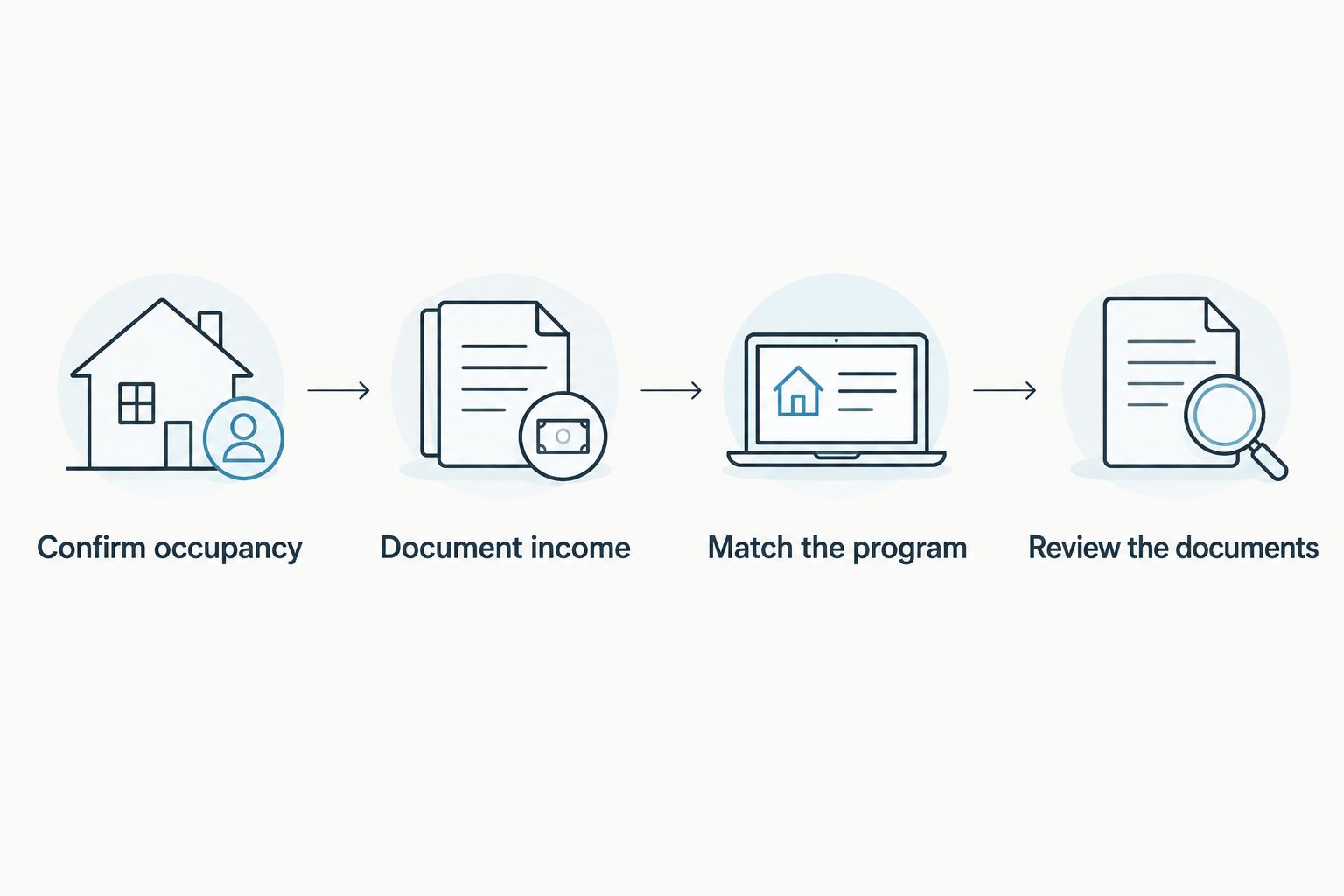
Choose a program that accepts both your intended occupancy and your income documentation.
Before you proceed, request a written explanation of any restriction you do not understand. A verbal description of flexibility does not replace the conditions in the documents you sign.
You should also explain unusual details early: living in a separate unit, keeping a room for personal use, or planning to move after renovations. Those details belong in the initial discussion, not as corrections after underwriting has advanced.
FAQ
Can you use a DSCR loan for a primary residence in 2026?
No. Standard investment-property DSCR loans do not finance a primary residence you intend to occupy. Choose a mortgage program that explicitly permits owner occupancy.
Can I get a DSCR loan if I am self-employed and want to buy my own home?
Self-employment does not make a primary residence eligible for standard investment-property DSCR financing. Ask about owner-occupied mortgages with standard or alternative income documentation, including bank-statement programs.
Can I live in one unit of a duplex with a DSCR loan?
Not under a standard non-owner-occupied DSCR program. Living in 1 unit of a 2-unit duplex requires financing that permits owner occupancy, even if you rent the other unit.
Does putting my home in an LLC make it eligible for a DSCR loan?
No. LLC ownership does not change the fact that you intend to occupy the property. The loan must permit the actual use, regardless of the ownership structure.
Can I move into my DSCR rental after waiting a year?
Waiting a year does not automatically authorize owner occupancy. Review your loan documents and contact the lender or servicer before changing the property's use.
Is a bank-statement mortgage the same as a DSCR loan?
No. Bank-statement underwriting evaluates eligible deposits to establish qualifying income, while residential investor DSCR underwriting evaluates rental income against the program's housing expense. Confirm occupancy eligibility separately.
Can Loanguys help me compare mortgage categories?
Loanguys is a mortgage broker offering DSCR, bank-statement, bridge, fix-and-flip, and short-term rental loan programs. Explain your intended occupancy and income documentation so the discussion starts with the correct financing category.
One last thing
A strong rental forecast cannot fix the wrong occupancy declaration. For your 2026 purchase, start the mortgage conversation with a plain statement: you intend to live in the property, or you intend to operate it as a rental.
Knowingly misrepresenting occupancy can constitute mortgage fraud. If an application describes a rental while you are planning a personal move-in, stop and correct it before signing. Accurate disclosure protects your ability to choose financing that actually fits.


