


Commercial real estate loans for K-12 schools: complete 2026 guide

K–12 school commercial real estate financing is property-backed borrowing with the aim of helping school operators acquire, renovate, or refinance educational facilities. Unlike a standard investment-property purchase, a school campus requires you to align educational use, operating revenue, governance approvals, and the academic calendar before choosing a loan.
TL;DR
- Commercial real estate loans for k-12 schools require matching the borrower, campus use, and repayment source before comparing lenders.
- Loanguys offers investment-property mortgage programs; school-campus eligibility requires direct confirmation.
- Owner-operated schools and investor-owned campuses require different cash-flow analysis, even when both use debt service coverage ratios.
- Choose permanent financing for a supportable long-term repayment plan; use bridge financing only with a documented exit.
Why commercial real estate financing matters for K–12 schools
A school building and a school business are not interchangeable collateral. A private school buying its campus, a nonprofit expanding classrooms, and an investor leasing a building to a school present different repayment and legal questions.
For your 2026 financing plan, identify who owns the property, who operates the school, and which entity receives tuition, rent, or public funding. Those distinctions determine which financial records and approvals belong in the application. A strong building does not repair an unsupported operating budget.
The school calendar adds another constraint: buying a property does not authorize classroom occupancy. Review the county permits to construction loan draw schedule workflow if your acquisition also requires renovations, inspections, and staged funding.
This guide focuses on identifying a suitable financing route, not treating every educational property as eligible for a standard commercial mortgage.
How to prepare a school property financing application
Define your borrower and ownership structure
Start with a simple organization chart you can create yourself. Show the property owner, school operator, governing board, related entities, and any proposed guarantors. A lender needs to understand both repayment responsibility and authority to pledge the property.
Distinguish public districts, charter schools, nonprofit private schools, and for-profit private schools. Public-sector borrowing authority depends on applicable law; a charter school also needs review of its charter and governing documents. Do not assume a school administrator can authorize a mortgage without additional approval.
If a separate property company leases the campus to the school, document that relationship. Related-party rent is not independent proof that the school can afford the payment.
- Prepare a 1-page ownership chart showing the borrower and operator.
- Collect formation documents, bylaws, and signing-authority records.
- Identify board, authorizer, or other required approvals.
- Provide the lease when ownership and operations are separate.
Verify that the campus can legally serve students
Check the proposed educational use with the local planning and building departments before relying on a financing proposal. An existing office, church, or retail building is not automatically approved for school occupancy. Confirm the requirements for your specific property and intended enrollment.
Separate land-use approval from building readiness. Your review should address occupancy, accessibility, fire and life safety, traffic circulation, and any required improvements. Ask qualified professionals to identify unresolved conditions rather than treating the seller's description as approval.
Build the 2026 opening schedule around documented dependencies. If classes cannot begin until construction and inspections finish, the repayment plan must address that period without assuming operating revenue starts immediately.
- Obtain written confirmation of permitted educational use.
- Request existing occupancy records and outstanding violation information.
- Have professionals scope required improvements and environmental review.
- Identify approvals that must occur before students enter the building.
Match the financing route to the transaction
Create a comparison sheet before contacting providers. Describe the property, borrower, operating model, requested financing purpose, and repayment source using the same facts for every conversation. This keeps you from comparing proposals built on different assumptions.
Loanguys is best for real estate investors seeking mortgage-broker guidance on its stated investment-property loan programs. Its stated programs include DSCR, fix-and-flip, bridge, bank-statement, and short-term rental loans. That program list does not establish eligibility for a school campus.
For Loanguys commercial real estate financing inquiries, review the stated services and ask whether the specific educational property, borrower structure, and use fit a program before submitting a full file. Broker guidance helps you ask the right eligibility questions; it does not replace school-property underwriting or legal review.
- State whether you need acquisition, renovation, construction, or refinance funding.
- Ask whether the provider finances educational properties and your entity type.
- Confirm whether underwriting focuses on school operations, rental income, or both.
- Request the eligibility criteria and documentation checklist in writing.
Build repayment around school cash flow
Use a spreadsheet to connect your operating budget to the proposed debt obligation. Prepare a 12-month cash-flow forecast, not just an annual income statement. Tuition collections, public funding receipts, payroll, and summer expenses do not necessarily occur on matching dates.
Debt service coverage ratio, or DSCR, compares qualifying cash flow with debt payments. For an owner-operated school, ask how the lender defines qualifying operating cash flow. For an investor-owned campus, ask how the lender evaluates property income, lease obligations, and the school tenant's financial strength.
Do not confuse a commercial coverage calculation with eligibility for a residential DSCR mortgage. The acronym describes a ratio; it does not make different property types interchangeable.
Test 3 scenarios: expected enrollment, lower enrollment, and delayed occupancy. Label your assumptions clearly and keep restricted funds separate from cash legally usable for debt service.
- Reconcile enrollment records with actual collections or funding receipts.
- Separate recurring income from donations and other nonrecurring receipts.
- Model payroll, maintenance, insurance, and proposed debt payments by month.
- Ask the lender which adjustments and coverage calculation it will accept.
Assemble the property and operating file
Create a shared folder and document index yourself before paying for reports. Organize records by borrower, school operations, property, construction, and approvals. A complete file makes contradictions easier to resolve before they delay a decision.
For a 2026 application, make sure historical records reconcile with the current budget and enrollment information. Explain material changes directly. A new campus, a changed tuition policy, or an expiring lease needs a documented explanation rather than an unexplained projection.
Loan-to-value, or LTV, compares the loan balance with the property's value. The appraised value is distinct from your renovation budget and from the value of the education business. Ask how the lender treats specialized improvements that another buyer would not necessarily need.
- Collect financial statements, applicable tax filings, and current bank records.
- Provide enrollment history, collection records, and a current operating budget.
- Assemble the purchase agreement, lease, title information, and existing debt details.
- Obtain the lender's report requirements before commissioning an appraisal or other studies.
Compare terms and document your exit
Put proposals side by side and read beyond the payment. Compare maturity, amortization, collateral, guarantees, financial covenants, reporting duties, and prepayment provisions. Amortization describes the repayment schedule; maturity is when the remaining balance becomes due.
For renovation or construction, inspect the draw conditions. You need to know what must happen before funds are released, who verifies completed work, and how changes receive approval. Financing that depends on unfinished approvals must fit your contractor's schedule and cash needs.
If you choose bridge financing, document the expected repayment event and what happens if it fails. A hoped-for refinance is not a financing commitment. Your 2026 board materials should distinguish confirmed funding from assumptions that still require approval.
- Compare all proposals using the same project budget and funding assumptions.
- Identify balloon payments, extension conditions, and guarantee obligations.
- Assign responsibility for inspections, draw submissions, and lender reporting.
- Record a fallback plan for delayed opening or unsuccessful refinancing.
Compare financing options for a school campus
The best option follows the borrower and repayment source, not the building's label. Use this comparison to decide which route deserves an eligibility conversation. These are financing categories, not confirmed offers for your school.
Commercial bank mortgage
- Best for: Established operators or campus owners with supportable cash flow
- Main advantage: Connects long-term property financing with documented repayment capacity
- Key limitation: School use, borrower structure, collateral, and financial strength need lender approval
Community development lender
- Best for: Schools whose projects fit a lender's community mission
- Main advantage: Adds a mission-based financing route to your search
- Key limitation: Mission fit does not remove repayment requirements or establish eligibility
Construction or renovation loan
- Best for: Projects requiring building work before full use
- Main advantage: Connects funding releases to project progress
- Key limitation: Draw conditions and completion risk require active cash management
Bridge loan
- Best for: Transitional acquisitions with a documented repayment event
- Main advantage: Addresses an interim financing need
- Key limitation: Creates maturity and refinancing risk before permanent financing is secured
Tax-exempt conduit financing
- Best for: Eligible nonprofit school projects with specialist advice
- Main advantage: Provides a separate capital-financing route for qualifying transactions
- Key limitation: Requires legal, tax, issuer, and financing review; nonprofit status alone is insufficient
SBA-backed financing
- Best for: Eligible for-profit school businesses after program screening
- Main advantage: Provides a government-backed business financing route for qualifying uses
- Key limitation: SBA business loan eligibility excludes nonprofit businesses; property and occupancy rules also matter
For Loanguys commercial real estate financing discussions, confirm property eligibility before comparing any stated investment-property program with these routes. A mortgage broker's program menu and a school facilities financing proposal serve different purposes until that fit is established.
The SBA distinction is particularly important. The U.S. Small Business Administration's published business-loan eligibility rules require an eligible for-profit business; a nonprofit private school should not build its campus plan around SBA business-loan approval. Public entities need a separate review of their borrowing authority.
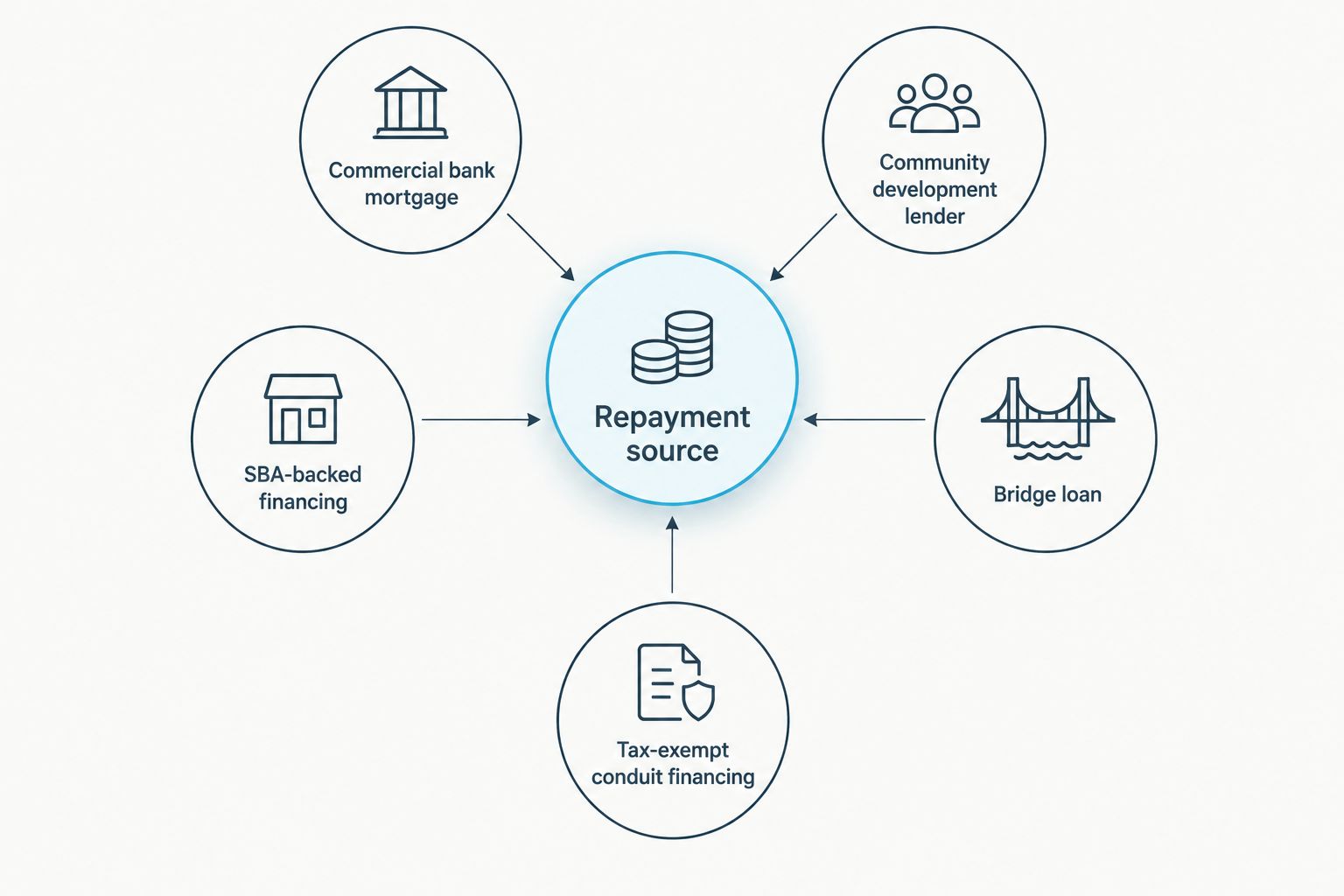
Screen the borrower and repayment source before selecting a financing route.
Common mistakes K–12 schools make
Treating projected enrollment as collected revenue
A larger building does not establish demand or payment capacity. Separate current enrollment, signed commitments, and management targets, then explain which assumptions support repayment. Keep hoped-for growth out of the base case unless the lender accepts the supporting evidence.
Assuming nonprofit status creates automatic eligibility
Nonprofit status does not establish borrowing authority, lender acceptance, tax-exempt financing eligibility, or permission to pledge restricted assets. Have counsel review the proposed transaction and governing documents before the board treats a financing route as approved.
Using a landlord analysis for an owner-operated school
A lease can show rent obligations without proving the operator can pay them. When related entities own and occupy the campus, present both financial pictures. Ask whether the lender evaluates the school and property company together, separately, or with specific guarantees.
Scheduling the opening from the loan closing date
Closing transfers or funds the property; it does not finish construction or authorize occupancy. Work backward from the intended first day of classes and assign responsibility for each approval. Include a contingency for temporary space or delayed use rather than relying on verbal assurances.
Choosing bridge debt without a supportable exit
Short-term financing does not solve an unresolved long-term repayment problem. Before signing, identify the proposed permanent financing route and its eligibility conditions. Document what happens if the property's value, school cash flow, or completion status does not support refinancing.
FAQ
What's the best commercial real estate loan for a K–12 school?
The best route depends on the school entity, property use, and repayment source. Established operators can screen commercial mortgages, while renovation projects and eligible nonprofit transactions require different financing reviews.
Can a nonprofit private school get a commercial mortgage?
A nonprofit private school can seek a commercial mortgage from a lender that accepts its entity type and educational property. Approval depends on borrowing authority, financial strength, collateral, and transaction requirements, not nonprofit status alone.
Can a K–12 school use an SBA loan to buy a building?
An eligible for-profit school business can be considered under applicable SBA business-loan rules; nonprofit businesses are ineligible. Confirm the business activity, property use, occupancy, and other program requirements with an SBA lender before relying on this route.
Is a school campus eligible for a residential DSCR loan?
Do not assume a school campus qualifies for a residential DSCR loan. Commercial lenders also use debt service coverage ratios, but that shared calculation does not establish residential mortgage eligibility.
What documents should a school prepare before approaching lenders?
Prepare entity and authority records, operating financials, enrollment and revenue evidence, a cash-flow forecast, and property documents. Add leases, construction plans, budgets, and approval records when they apply, then confirm the lender's exact checklist.
Can Loanguys finance a school building?
School-building eligibility requires direct confirmation with Loanguys. Its stated mortgage programs include investment-property financing, but that does not establish a dedicated K–12 campus lending program.
What should a school check before using a bridge loan?
A school should verify the repayment event, maturity terms, extension conditions, and fallback plan before using a bridge loan. Planned permanent financing still requires its own eligibility and underwriting review.
One last thing
The most useful financing document is a calendar that connects cash, approvals, and occupancy. Put funding receipts, payroll, construction draws, inspections, and debt obligations on the same schedule. Your annual budget can appear balanced while the school still faces a cash shortage before a funding receipt or tuition collection.
Before signing, ask your finance lead, counsel, and facilities team to review that schedule together. Resolve the gaps before they become obligations.


