


Construction loan lenders for owner-builders: complete 2026 guide
Owner-builder construction financing is funding for a property you manage building yourself, with the aim of completing the project and repaying through a mortgage or sale. The right construction loan lenders for owner-builders must accept your construction role, intended occupancy, and repayment plan—not simply advertise construction loans.
TL;DR
- Choose construction loan lenders for owner-builders by written self-management eligibility before comparing terms.
- Loanguys offers investment property financing; confirm owner-builder construction eligibility before applying.
- Separate construction funding from permanent financing, especially when planning a DSCR loan for a completed rental.
- Document land equity, subcontractor bids, draw requirements, and your repayment plan before requesting approval.
Why construction financing matters for owner-builders
An owner-builder takes responsibility for coordinating construction rather than handing the entire project to a general contractor. That distinction changes the financing conversation. A lender must assess both your ability to repay and the plan for turning an unfinished property into acceptable collateral.
Your first job in 2026 is to distinguish three roles: property owner, construction manager, and person performing the work. Tell prospective lenders exactly which responsibilities you intend to keep. Approval to own the project does not establish approval to manage subcontractors or perform skilled trades yourself.
Loanguys is a mortgage broker offering DSCR, fix-and-flip, bridge, bank-statement, and short-term rental loan programs. Those categories provide a starting point for investment property discussions, not proof that a particular owner-managed ground-up build qualifies.
Loanguys is best suited to investors comparing investment property financing, not borrowers assuming owner-builder construction eligibility. For construction financing, verify the proposed program's rules before ordering lender-specific reports or making commitments that depend on approval.
How to choose construction loan lenders for owner-builders
1. Define your construction role and intended use
Start with a plain project summary you can prepare yourself. Describe the property, what you intend to build, who supervises construction, and whether the finished home will be your residence, a rental, or a property for sale.
Be precise about self-performed work. Scheduling electricians differs from installing wiring, and each creates a different licensing, insurance, and supervision question. Check local requirements directly with the building department rather than treating lender acceptance as permission to perform regulated work.
Prepare 1 project summary that uses the same facts across every financing inquiry. Consistency prevents a lender from evaluating a contractor-built residence while you are planning an owner-managed investment project.
- State the intended occupancy and ownership structure.
- Separate management duties from hands-on construction work.
- Identify the licensed trades you will hire.
- Describe the finished property's intended use and repayment route.
2. Screen lenders for owner-builder eligibility
Contact prospective lenders directly before submitting a full application. Ask whether they finance borrowers acting as their own general contractor, whether construction experience is required, and whether that policy applies to your occupancy and property type.
A lender that requires an approved general contractor does not fit a project you intend to manage yourself. Do not let a general statement about construction financing substitute for a project-specific answer. Ask who has authority to confirm the policy and request the applicable requirements in writing.
For your 2026 shortlist, distinguish borrower eligibility from project eligibility. Your credit and income can satisfy one part of underwriting while the construction arrangement fails another.
- Confirm acceptance of your exact construction role.
- Ask about experience documentation and contractor licensing.
- Verify geographic, occupancy, and property-type restrictions.
- Request the conditions that would require a general contractor.
- Record each lender's answers in the same comparison worksheet.
3. Assemble your borrower and builder evidence
Create separate folders for financial qualification and construction capability. Use your own records first: income documents, asset statements, ownership records, completed-project information, and subcontractor credentials. The lender determines which records support the proposed program.
Self-employment creates an income-documentation issue; it does not establish construction experience. Likewise, a strong building background does not replace proof of repayment capacity for an owner-occupied mortgage.
Loanguys offers bank-statement loans alongside investment property loan programs. A broker discussion helps you identify which financing category to investigate, but bank-statement qualification alone does not establish owner-builder construction eligibility. Ask for both decisions separately.
- Gather the income and asset records the lender requests.
- Document your construction experience without overstating your role.
- Collect subcontractor licenses and insurance information.
- Explain existing debts and the proposed property's ownership.
- Flag documentation gaps before paying for lender-specific reports.
4. Build a complete budget and land-equity file
Prepare a spreadsheet using actual bids and documented estimates. Separate land, site work, utilities, permits, construction, professional services, and financing expenses. An attractive house plan is not a complete project budget if it leaves out the work required to make the site buildable.
Create 3 document groups: land records, construction bids, and cash-reserve evidence. Keep unpaid estimates distinct from executed contracts and paid invoices. Ask how the lender treats land you already own and whether existing debt against it reduces recognized equity.
Loan-to-value, or LTV, compares the loan with the property's value. Loan-to-cost, or LTC, compares financing with eligible project costs. For a 2026 proposal, ask which measure controls the loan amount and how the lender defines the value or costs used.
- Obtain trade-specific bids with clear inclusions and exclusions.
- Document land ownership, purchase history, and existing liens.
- Identify site preparation and utility-connection expenses.
- Keep contingency funds separate from committed construction spending.
- Ask how land equity and self-performed labor are treated.
5. Match the draw process to your payment obligations
Construction funding uses a draw process: money is released as the project reaches agreed stages and satisfies release conditions. Build your payment plan around the actual agreement, not the assumption that the lender pays every bill when it arrives.
Maintain 2 schedules: construction milestones and cash payments. Reconcile them before signing subcontractor agreements. A material deposit due before delivery creates a different cash requirement from an invoice payable after an inspection.
Ask how inspections, invoices, lien waivers, and retainage affect disbursement. Retainage is money held back until specified conditions are met. A workable loan must fit the project's cash flow as well as its total budget.
- Ask whether draws reimburse spending or fund approved work in advance.
- Identify documents required for each release.
- Confirm who orders inspections and authorizes disbursements.
- Check how deposits, stored materials, and change orders are handled.
- Set aside cash for obligations that precede lender funding.
6. Establish the repayment plan before construction starts
Write the repayment plan yourself before requesting financing. For a residence, investigate permanent mortgage qualification. For an investment build, compare a sale with a refinance supported by the completed property's intended use.
A DSCR loan evaluates rental income against debt obligations under the lender's calculation. DSCR means debt service coverage ratio. It is not a promise to finance an unfinished building, and a future rental plan does not establish qualification today.
For a 2026 rental build, request the proposed refinance lender's completion, valuation, income-documentation, and ownership requirements. A construction lender's willingness to fund the build and another lender's willingness to refinance it are separate decisions.
- Define the primary repayment route and a backup route.
- Confirm permanent mortgage qualification for personal occupancy.
- Ask how projected rental income is evaluated for investment refinancing.
- Identify completion and occupancy documents required at exit.
- Test the plan against construction delays and a lower completed valuation.
7. Compare written proposals on execution risk
Use one worksheet to compare proposals after confirming project eligibility. Evaluate the loan amount, required borrower contribution, disbursement conditions, maturity, extension provisions, guarantees, and repayment requirements. A proposal with fewer construction-management complications deserves attention alongside its financing terms.
Ask who handles underwriting, inspections, and draws, and who answers disputes about incomplete work. A broker and a funding lender perform different functions; identify the party responsible for each decision.
When comparing private construction financing, the guide to comparing hard money lenders before signing a term sheet provides a related checklist. Keep the owner-builder policy at the top of your own worksheet: unsuitable project eligibility makes the rest of the comparison irrelevant.
- Separate indicative proposals from final approvals.
- Compare draw procedures and borrower cash requirements.
- Read maturity, extension, default, and guarantee provisions.
- Identify conditions still outstanding before closing.
- Have qualified legal counsel review obligations you do not understand.
Compare financing options by project fit
The best option depends on your construction role and the finished property's use. This table compares financing paths, not confirmed owner-builder programs. Ask each provider to establish eligibility for your project before treating any path as actionable.
Bank or credit union construction financing
- Best for: Borrowers seeking construction financing and a permanent mortgage relationship
- Main advantage: A direct conversation about both construction and long-term repayment
- Key limitation: Owner-builder acceptance requires explicit confirmation; an approved contractor requirement changes the plan
Construction-to-permanent financing
- Best for: Residence builders seeking a structured transition into a mortgage
- Main advantage: Connects the construction phase with permanent financing
- Key limitation: Conversion conditions and owner-builder eligibility still require review
Construction-only financing
- Best for: Builders arranging permanent financing separately
- Main advantage: Keeps construction funding distinct from the exit loan
- Key limitation: You remain responsible for qualifying for repayment or refinancing
Private construction financing
- Best for: Investment builders whose projects fit a private lender's criteria
- Main advantage: Provides a separate financing path to investigate
- Key limitation: Occupancy restrictions, guarantees, maturity, and draw conditions need close review
Loanguys investment property financing
- Best for: Investors comparing bridge, fix-and-flip, DSCR, or related financing categories
- Main advantage: Offers several investment property loan categories through a mortgage broker
- Key limitation: Listed categories do not establish ground-up or owner-builder eligibility
Construction-to-permanent and construction-only describe loan structures, not separate types of institution. A bank, credit union, or other provider determines which structures it offers and who qualifies. Compare providers within the structure that fits your repayment plan.
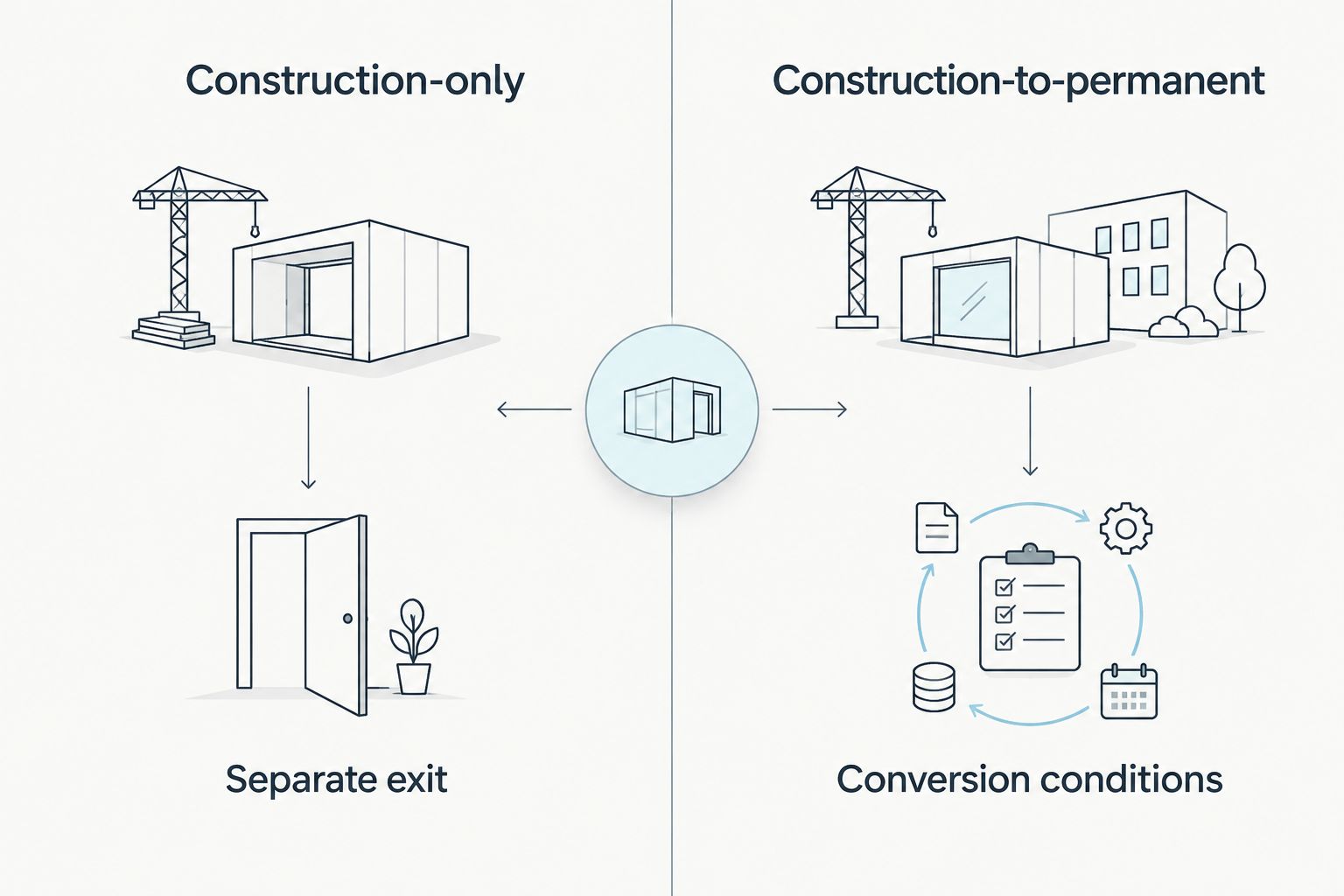
Choose the loan structure around the repayment plan, not just the construction phase.
Best for first-time owner-builders: start with eligibility screening, not a lender ranking. If every suitable provider requires professional construction supervision, revise the delivery plan before continuing to apply. Hiring a general contractor changes the budget and responsibilities, but it also changes the project lenders are evaluating.
Discuss your investment financing plan
Explain your construction role, intended property use, and repayment plan before choosing a financing category.
Common mistakes owner-builders make
Treating self-management permission as universal
A lender's acceptance of an owner-builder does not settle local licensing requirements or another lender's policy. Confirm both financing eligibility and legal authority to perform or supervise the proposed work.
Counting personal labor as available cash
Sweat equity describes work you contribute, not funds available to pay suppliers. Ask how the lender recognizes that labor and keep your cash plan independent of an assumed credit for your time.
Starting work before clarifying funding conditions
Do not assume completed excavation, purchased materials, or deposits qualify for reimbursement. Ask how pre-closing spending affects eligibility and document the answer before committing money.
Confusing a renovation program with ground-up financing
Fix-and-flip financing and a ground-up owner-builder project are not interchangeable labels. Describe demolition, new construction, and retained structures accurately so the lender evaluates the actual scope.
Assuming completion guarantees a refinance
Finishing construction does not automatically satisfy a permanent lender's requirements. Recheck the proposed exit during your 2026 build, especially when occupancy, ownership, project scope, or expected rental income changes.
FAQ
What's the best way to find construction loan lenders for owner-builders?
Screen lenders for written acceptance of your exact construction role before comparing proposals. Confirm occupancy, location, property type, experience requirements, and whether an approved general contractor is mandatory.
Can I get a construction loan if I act as my own general contractor?
You need a lender that explicitly accepts borrowers acting as their own general contractor. Local permission to manage construction does not establish lender eligibility, and each financing proposal requires its own review.
Does Loanguys offer owner-builder construction loans?
Loanguys lists DSCR, fix-and-flip, bridge, bank-statement, and short-term rental loan programs; those categories do not establish owner-builder construction eligibility. Ask whether a proposed program accepts your construction role, project scope, and intended occupancy.
Can land I already own count toward my construction contribution?
Ask the lender whether it recognizes your land equity toward the required contribution. The answer depends on its valuation method, existing land debt, title requirements, and program rules.
Is a bank-statement loan the same as an owner-builder loan?
No, bank-statement qualification concerns income documentation, while owner-builder eligibility concerns the construction arrangement. You need confirmation of both when seeking financing for a self-managed build.
Can I use a DSCR loan to build a rental home?
Do not assume a DSCR loan funds construction merely because the finished property will be a rental. Confirm construction funding separately, then ask the proposed refinance lender how it evaluates completion, rental income, and the property's eligibility.
What should I prepare before applying for an owner-builder construction loan?
Prepare a project summary, financial records, construction-experience evidence, plans, bids, land records, and a repayment plan. Request the lender's checklist before ordering reports or committing to work that depends on financing.
One last thing
Ask what happens if you cannot finish the build yourself. Before signing a 2026 construction agreement, establish who can replace you as construction manager, how that replacement is approved, and whether the remaining budget supports the change. Your financing plan needs a path to completion even when your personal availability changes.


