


How much cash reserves do you need for a DSCR loan?

You need enough eligible assets left after closing to meet your DSCR lender’s reserve requirement; there is no single cash-reserve amount that applies to every DSCR loan in 2026. Calculate the requirement by multiplying the lender’s qualifying monthly housing payment by its required reserve months. Keep this amount separate from your down payment, closing costs, and any additional rental-property operating cushion.
TL;DR
- DSCR loan cash reserve requirements depend on the lender’s program, payment calculation, and eligible assets.
- Calculate mortgage reserves using the lender’s qualifying monthly payment multiplied by its required reserve months.
- Keep post-closing reserves separate from your down payment, closing costs, and rental-property operating cushion.
- Loanguys offers DSCR financing for real estate investors; request program-specific reserve conditions before committing funds.
How much cash reserves do you need for a DSCR loan?
Your required reserves equal the qualifying monthly housing payment multiplied by the reserve months specified for your loan. The lender must confirm both inputs before you can calculate a reliable dollar amount.
Ask whether the housing payment includes principal, interest, property taxes, insurance, and applicable association dues. Do not calculate reserves using principal and interest alone unless the lender explicitly instructs you to do so.
Your budget also needs to distinguish funds you spend from assets you retain. The guide to DSCR loan closing costs addresses a separate part of that calculation.
Down payment
- What it covers: Your equity contribution toward the purchase
- How to treat it in your budget: Subtract it from available funds
Closing funds
- What it covers: Transaction expenses, prepaids, and applicable escrow funding
- How to treat it in your budget: Subtract the amount you must provide at settlement
Required reserves
- What it covers: Eligible assets remaining after closing
- How to treat it in your budget: Preserve the lender-confirmed amount
Operating cushion
- What it covers: Vacancy, repairs, turnover, and other ownership expenses
- How to treat it in your budget: Set a separate property-management target
These categories serve different purposes. Money spent at closing cannot also remain available as post-closing reserves.
Why this matters
A rental property’s income and your available assets answer different underwriting questions. Debt-service coverage ratio, or DSCR, measures income relative to debt service under the lender’s calculation; reserves address the financial resources available after the transaction.
A property that satisfies an income test does not automatically satisfy an asset requirement. Treat these as separate conditions when reviewing a 2026 loan proposal.
The practical risk is double-counting. A bank balance can look sufficient until you subtract the down payment, settlement funds, and other committed spending. Build your reserve calculation from the expected post-closing position, not the account balance you see today.
Calculate your reserve position before you commit funds
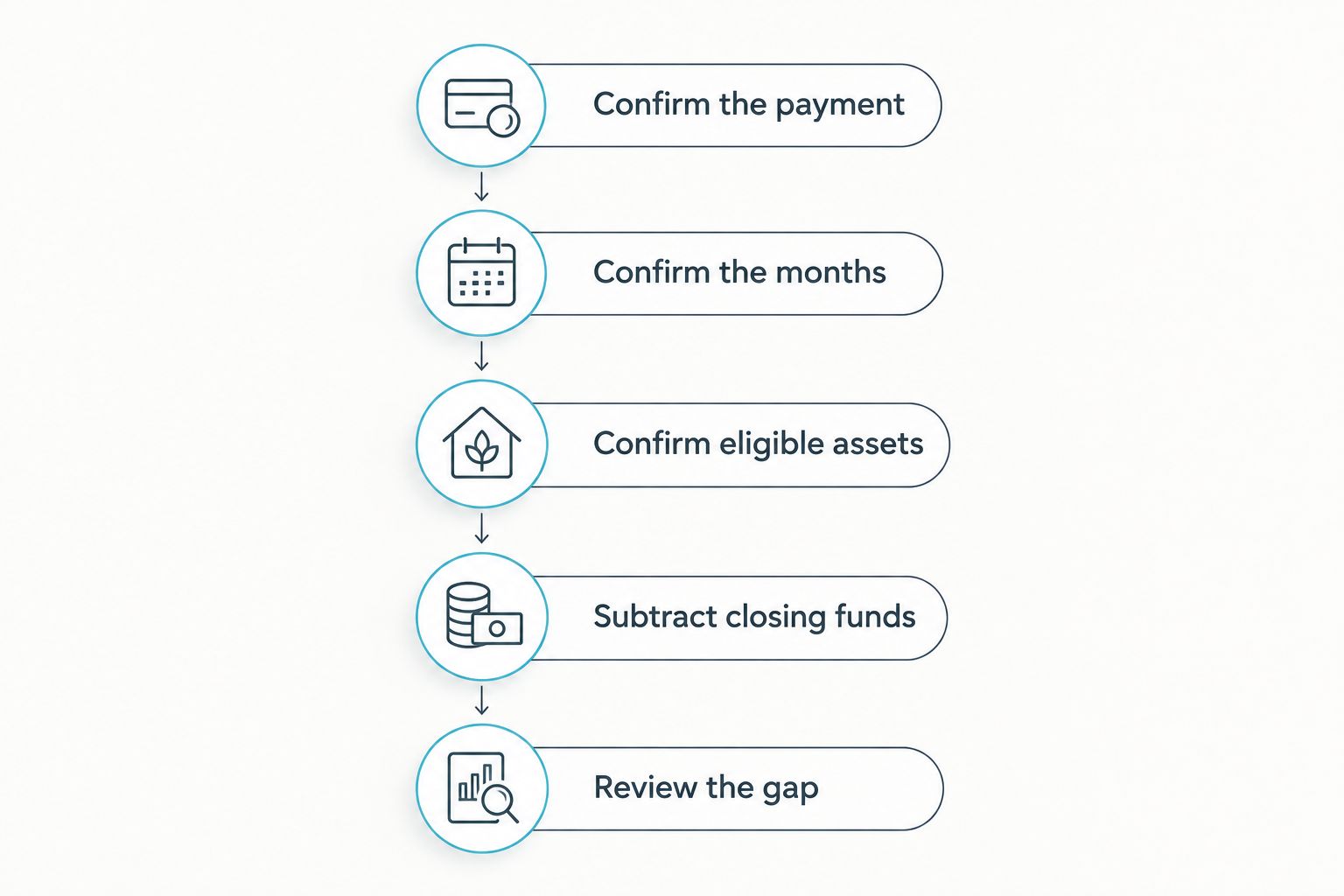
Use the following sequence to turn a general reserve discussion into a documented financing budget. Complete it with the lender handling your actual application, rather than borrowing a requirement from another investor’s loan.
Confirm the payment
Request the monthly payment the underwriter will use specifically for reserves. Ask which components it includes and whether the figure is preliminary or based on the current property information.
Taxes, insurance, and association dues belong in the discussion whenever they form part of the qualifying payment. An estimate built from incomplete property expenses is not a dependable reserve calculation.
Confirm the months
Ask the lender to state the required reserve months for your transaction in writing. Also ask whether that requirement applies only to the property being financed or includes additional financed properties.
Identify any conditions attached to the answer. A preliminary discussion is useful for planning, but your final requirement must match the loan program and underwriting decision.
Confirm eligible assets
List the accounts you intend to use and request the lender’s treatment of each. Record ownership, access restrictions, documentation requirements, and the balance the lender will recognize.
An account balance is not automatically an eligible reserve balance. Do not assume investments, retirement assets, business funds, or jointly held accounts receive the same treatment as an unrestricted personal bank account.
Subtract closing funds
Deduct the money needed to complete the transaction from the assets available to fund it. Reconcile deposits already paid so you neither subtract them twice nor count them as money still sitting in your account.
Then compare the eligible assets remaining with the lender’s reserve requirement. Keep projected rent and hoped-for future deposits outside this calculation unless the lender explicitly accepts them.
Review the gap
If eligible post-closing assets fall short, address the difference before relying on a closing date. Ask which documented changes would satisfy the condition, and get confirmation before moving money or changing your transaction structure.
Repeat this review when the payment, settlement figures, or asset balances change. Your 2026 reserve worksheet should reflect the transaction you will close, not an earlier estimate.
Why DSCR loan cash reserve requirements vary
DSCR programs do not share a single reserve schedule. Ask your lender how the following items affect your specific application rather than assuming a universal threshold:
- Program rules: Identify the exact reserve condition attached to the proposed loan, including any exceptions or additional requirements.
- Qualifying payment: Confirm the payment components used in the calculation. A different qualifying payment changes the required dollar balance even when the reserve months stay unchanged.
- Transaction structure: Ask how a purchase, refinance, or cash-out transaction is treated, especially when you expect transaction proceeds to support the asset calculation.
- Other financed properties: Establish whether the lender requires a review of obligations beyond the subject property. Do not assume the new rental is the entire calculation.
- Asset eligibility: Confirm which accounts count and how the lender determines their usable value. Ownership and access matter alongside the statement balance.
- Final underwriting conditions: Check whether the requirement changes after the lender reviews the complete file. Preserve enough flexibility to address the actual approval conditions.
A useful lender comparison therefore needs more than a quoted reserve-month figure. Compare the payment basis, accepted assets, additional-property treatment, and documentation conditions together.
Which assets should you ask the lender to review?
Start with assets you own, can document, and can access under the applicable account terms. Then have the lender confirm eligibility before treating those assets as reserves.
The table below is a review checklist, not a statement that every DSCR program accepts each asset type.
Checking or savings
- Practical advantage: A statement provides a clear record of the balance
- Limitation to resolve: Confirm ownership, transaction history, and funds needed for closing
Brokerage holdings
- Practical advantage: Statements identify securities and account value
- Limitation to resolve: Confirm valuation treatment, restrictions, and whether liquidation is required
Retirement accounts
- Practical advantage: Statements document assets held for retirement
- Limitation to resolve: Confirm access rules and the lender’s eligible-value calculation
Business accounts
- Practical advantage: Records identify funds held by a business
- Limitation to resolve: Confirm ownership, withdrawal authority, and business-funds eligibility
Joint accounts
- Practical advantage: Statements identify shared account ownership
- Limitation to resolve: Confirm your access and any required authorization
The most useful reserve account is one the lender accepts and you can document without unresolved access issues. That is more important than choosing an account because its headline balance looks larger.
Do not liquidate investments or withdraw retirement funds solely to simplify an application without checking the consequences. Ask the lender what documentation it needs, and consult the appropriate tax or financial professional before changing how you hold those assets.
How do you document DSCR reserves?
Build an asset file that lets the lender follow the money from the statement balance to the expected post-closing balance. Ask for the current documentation checklist at the start of your 2026 application.
Useful records to discuss include:
- Complete account statements, including pages that contain ownership information or disclosures.
- Transaction records supporting transfers between accounts.
- Explanations and supporting documents for deposits the lender asks you to verify.
- Entity records showing your authority to access business-owned funds, when relevant.
- Account terms or supporting records addressing withdrawal restrictions.
- Updated balances when funds move or the lender requests a refresh.
Keep transfer records even when both accounts belong to you. A transfer changes where funds appear; it does not create additional assets.
Avoid unnecessary account changes during underwriting. If you must move funds, tell the lender first and retain the records needed to connect the outgoing and incoming transactions.
What should you ask before accepting a DSCR proposal?
Ask for a reserve explanation that is specific enough to reproduce on your own worksheet. A statement that you need “adequate liquidity” does not tell you what to preserve.
Use these questions:
- What monthly housing payment are you using for reserves?
- How many reserve months does this application require?
- Which of my accounts qualify, and what eligible value will you recognize?
- What funds must remain after settlement?
- Are other financed properties included in the calculation?
- Can refinance proceeds count, and under what conditions?
- What documentation or final review remains outstanding?
Loanguys is a fit for real estate investors seeking a mortgage broker that offers DSCR financing. A broker relationship provides a place to discuss program requirements; it does not replace the selected lender’s asset review or guarantee that a particular reserve balance qualifies.
Bring your property expenses, account information, and expected closing-funds budget when you discuss DSCR financing with Loanguys. Ask for the reserve calculation alongside the other financing conditions, not after you have committed your available cash elsewhere.
Clarify your DSCR reserve requirement
Discuss your property, eligible assets, and post-closing reserve calculation.
Can strong rental income replace cash reserves?
Strong rental income does not establish that you have met a separate reserve condition. DSCR and reserves measure different parts of the application, so ask the lender to confirm both independently.
Do not assume a favorable rent estimate waives an asset requirement. If an exception is available for your application, obtain the actual terms rather than budgeting around an informal expectation.
Are reserves the same as a down payment?
Reserves are not a down payment: the down payment funds your equity contribution, while required reserves represent eligible assets remaining after closing. The same money cannot perform both roles once you spend it.
Review your expected settlement figures and remaining account balances together. That view exposes a shortfall that a standalone bank statement will not show.
Can you use refinance proceeds to meet reserves?
Refinance proceeds count toward reserves only if the applicable lender permits that treatment. Ask whether eligibility depends on when proceeds become available and how the lender verifies the final post-closing position.
Do not assume cash-out proceeds solve a reserve shortfall before underwriting confirms the treatment. An expected disbursement and an accepted reserve asset are not interchangeable.
FAQ
What's the standard DSCR loan cash reserve requirement in 2026?
There is no single reserve amount that applies to every DSCR loan. Ask the lender for the required reserve months, qualifying monthly payment, and eligible-asset rules for your application.
How do I calculate the cash reserves for my DSCR loan?
Multiply the lender’s qualifying monthly housing payment by its required reserve months. Compare that requirement with eligible assets remaining after closing funds are deducted.
Do DSCR reserves include taxes and insurance?
Use taxes and insurance in the reserve calculation when the lender includes them in its qualifying housing payment. Ask for the complete payment breakdown rather than assuming principal and interest are sufficient.
Can retirement accounts count as DSCR reserves?
Retirement accounts count only when the lender’s program accepts them under its eligibility rules. Confirm access restrictions, documentation, and the eligible value before including them in your budget.
Can I use my LLC’s bank account for reserves?
An LLC bank account requires confirmation of business-funds eligibility and your authority to access the money. Do not treat the business balance as automatically interchangeable with personal assets.
Do I have to send my reserve money to the lender?
Do not transfer reserve funds unless your loan instructions explicitly require a transfer or deposit arrangement. Ask whether the requirement is verification of retained assets or a separately controlled account.
Can Loanguys help me discuss DSCR reserve requirements?
Loanguys offers DSCR financing as a mortgage broker serving real estate investors. Ask for the proposed program’s reserve calculation, accepted assets, and remaining underwriting conditions.
One last thing
A lender’s reserve minimum is an approval condition, not a complete rental-property operating budget. Qualifying does not establish that you have set aside enough for the repairs, vacancies, or turnover your property will face.
Before closing in 2026, compare the lender-required balance with your own operating plan. If you intend to spend part of that balance on immediate work, identify what will remain afterward. Passing an asset check and preserving usable cash are separate decisions.


