


How much equity do you need for a HELOC on an investment property?

You need enough equity to cover both the HELOC you want and the equity your lender requires you to leave in the investment property; there is no single minimum that applies to every lender in 2026. The deciding calculation is your lender’s maximum combined loan-to-value ratio, minus the debt already secured by the property. Equity alone does not establish eligibility, and borrowing against your rental puts the property at risk if you cannot repay.
TL;DR
- Equity needed for HELOC on investment property depends on the lender’s combined loan-to-value limit and your existing mortgage.
- Borrowable equity is not total equity: subtract existing secured debt from the lender’s permitted total debt.
- Confirm rental-property eligibility before paying for an appraisal or preparing a full application.
- Loanguys serves real estate investors seeking mortgage-broker guidance on investment-property financing.
How much equity do you need for a HELOC on an investment property?
You need more equity than the amount you intend to borrow because the lender requires an equity cushion after the HELOC is added. The size of that cushion comes from the specific investment-property program, not a universal HELOC rule.
Start by confirming that the lender accepts non-owner-occupied properties. A lender’s primary-residence requirements do not automatically apply to rentals; the guide to getting a HELOC on a rental property you don’t live in addresses that eligibility distinction.
Calculate borrowing room before applying
Use the lender’s accepted property value and its investment-property limit:
Potential HELOC limit = accepted property value × maximum permitted combined loan-to-value ratio − existing secured debt.
Combined loan-to-value, or CLTV, measures the property’s combined mortgage debt against its value. It differs from the loan-to-value ratio of your first mortgage alone.
Work through the calculation in this order:
- Confirm eligibility. Ask whether the program accepts your property’s occupancy, ownership structure, and rental use.
- Confirm property value. Ask which valuation method the lender requires. An online estimate is not an approved lending value.
- Confirm existing debt. Include your first mortgage and disclose other loans or liens secured by the property.
- Confirm the limit. Obtain the program’s maximum CLTV and ask how it treats the proposed credit line.
- Calculate borrowing room. Subtract the existing secured debt from the total debt the lender permits.
A positive result identifies potential collateral capacity, not an approval. Income, credit, title, and other underwriting requirements still apply.
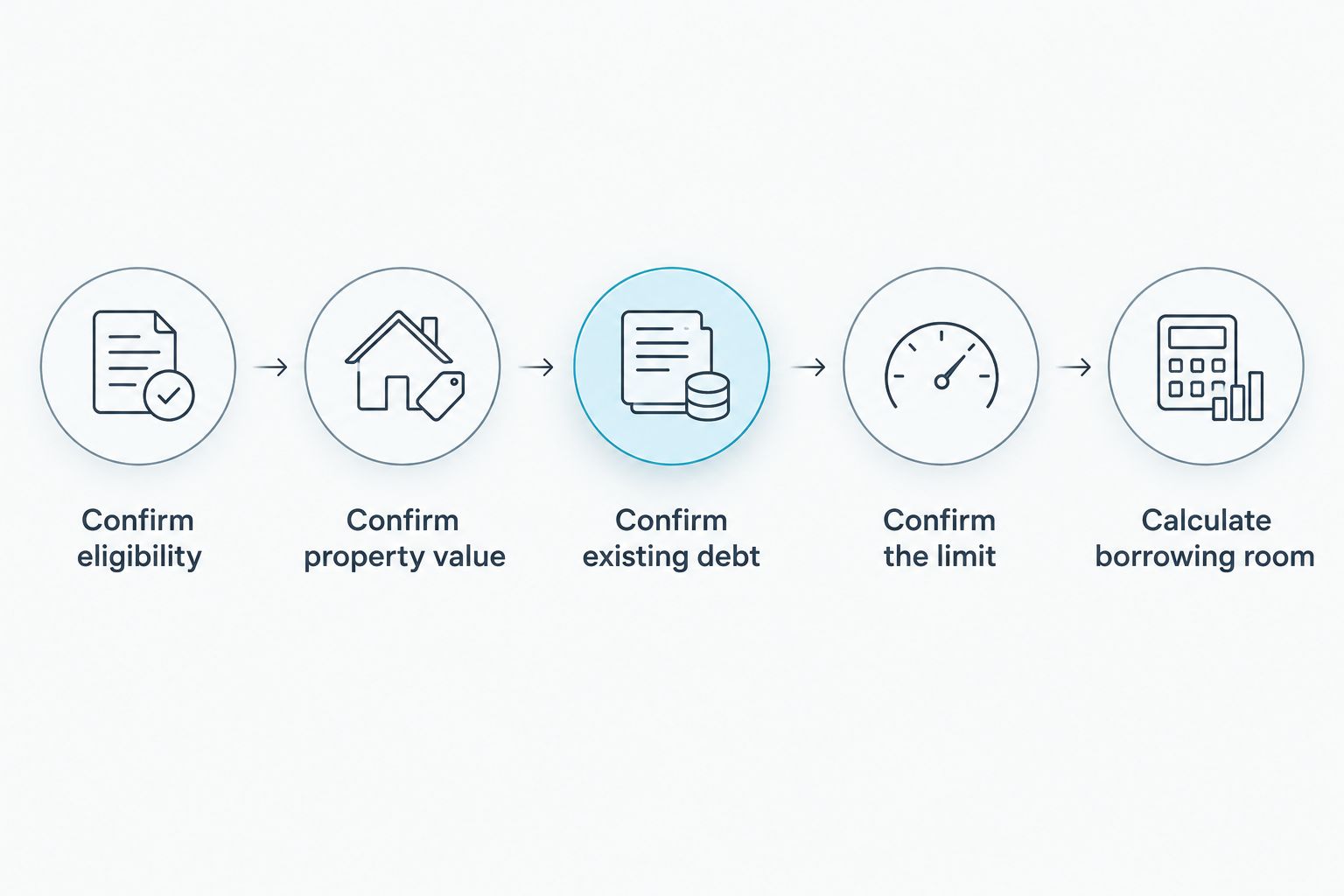
Check program eligibility before treating property equity as borrowing capacity.
Why this matters
Property equity is part of your net worth, but it is not the same as cash you can withdraw. A lender limits how much debt the property can support and separately checks whether you qualify to repay it.
For a 2026 renovation or acquisition, that distinction affects your budget before work begins. Do not commit funds based on an estimated property value and an assumed lending limit. Get the property classification and borrowing calculation confirmed first.
Total equity versus borrowable equity
Total equity is the property’s value minus the debt secured by it. Borrowable equity is the portion a lender permits you to access through a new loan or credit line.
The difference is the equity you must retain. A property can have substantial total equity but limited borrowing room if the proposed financing reaches the lender’s maximum permitted CLTV.
Total equity
- What it tells you: Your ownership value after secured debt
- What it does not establish: How much a lender will advance
First-mortgage LTV
- What it tells you: The first mortgage relative to property value
- What it does not establish: The effect of an additional credit line
Combined LTV
- What it tells you: Combined secured debt relative to property value
- What it does not establish: Whether you meet income or credit requirements
Potential HELOC limit
- What it tells you: Collateral-based room under the program’s limit
- What it does not establish: Final approval or funds you should spend
Ask whether the lender calculates CLTV using the full proposed credit limit rather than your intended opening draw. A plan to borrow only part of the line does not necessarily change how the lender measures its exposure.
Keep the calculation property-specific. Equity in another rental does not automatically increase the borrowing room on the property securing this HELOC.
Why the equity requirement varies
Investment-property HELOC requirements depend on the lender’s program and the application. For a 2026 comparison, ask each lender to evaluate the same property, ownership structure, and requested line amount.
- Property use and type. Confirm that the program accepts your rental use and property category before comparing other terms.
- Accepted valuation. A lower accepted value reduces borrowing room even when the mortgage balance has not changed.
- Existing secured debt. Your first mortgage and other secured obligations affect the capacity left for another lien.
- Credit and repayment history. Meeting the collateral calculation does not replace the lender’s borrower requirements.
- Income and repayment capacity. Ask how the lender documents income, treats rent, and evaluates existing obligations.
- Title and ownership. Disclose LLC ownership, trusts, co-owners, and recorded liens so the lender can assess eligibility.
Do not combine the most favorable feature from several lenders into an imaginary program. The property eligibility, CLTV limit, documentation rules, and repayment terms must all work within the same actual offer.
What documents help establish your usable equity?
Prepare records that let a lender verify the property, debt, and borrower. Organization reduces avoidable questions; it does not replace underwriting.
Property and ownership records
Have the property address, current ownership information, insurance records, and property-tax information ready. Include leases and rental records when requested, and explain whether the property operates as a long-term or short-term rental.
Tell the lender about planned changes in use. An application based on one rental arrangement should not omit a different intended use after closing.
Mortgage and lien records
Gather current mortgage statements and identify other debt secured by the property. Ask whether the lender needs payoff statements, even if you intend to keep the existing mortgage.
For a 2026 application, use current balances rather than figures from an older financial worksheet. Payments, additional borrowing, and recorded liens change the calculation.
Income, credit, and reserves
Expect the lender to specify acceptable income and asset documentation. Ask how rental income is treated and whether cash reserves are required.
Equity is collateral, not proof of repayment capacity. A strong property position does not eliminate the need to satisfy the program’s remaining conditions.
Should you choose a HELOC, home equity loan, or cash-out refinance?
Choose the structure around how you will use and repay the money. A revolving line, a lump-sum second loan, and a replacement mortgage solve different financing problems.
Investment-property HELOC
- Best for: Borrowers funding eligible expenses in stages
- Main advantage: Access to a revolving credit line during the draw period
- Main limitation: Payments and access depend on the agreement; variable rates create payment uncertainty
Home equity loan
- Best for: Borrowers with a defined lump-sum need
- Main advantage: A separate loan without replacing the first mortgage
- Main limitation: Less flexibility to borrow repeatedly than a revolving line
Cash-out refinance
- Best for: Borrowers who want to replace the mortgage while accessing equity
- Main advantage: Combines the replacement mortgage and equity withdrawal
- Main limitation: Changes the first mortgage and requires evaluating the whole financing arrangement
Investment-property HELOC: best for staged borrowing
A HELOC fits a funding need that occurs over time, provided the program accepts the rental and its repayment terms fit your budget. Review the draw period, repayment period, rate structure, and conditions that affect access to the line.
The trade-off is uncertainty. With a variable-rate line, borrowing costs and required payments change under the agreement, so your rental needs room for more than the initial payment.
Home equity loan: best for a defined funding need
A home equity loan supplies a lump sum rather than revolving access. It suits a project with a clear funding requirement when you want to leave the first mortgage in place.
The limitation is reduced borrowing flexibility. If the project expands later, the original loan does not function like a reusable credit line.
Cash-out refinance: best for replacing the existing mortgage
A cash-out refinance pays off the existing mortgage with a larger replacement loan and releases eligible proceeds. Evaluate the new mortgage as a whole, not just the cash it produces.
The trade-off is changing financing you already have. Compare repayment terms, transaction expenses, and the effect on rental cash flow before replacing the first mortgage.
Loanguys is best for real estate investors seeking mortgage-broker guidance on investment-property financing. Loanguys offers DSCR, bridge, fix-and-flip, bank-statement, and short-term rental loan programs; assess the fit for your objective rather than treating these programs as interchangeable with a HELOC.
What should you ask before submitting a HELOC application?
Ask for a property-specific explanation, not a headline lending limit. The useful answer connects the accepted value, existing debt, requested line, and qualification requirements.
Use this checklist when comparing 2026 offers:
- Does this program accept a rental property with my ownership structure?
- What maximum CLTV applies to this specific application?
- Does the calculation use the full credit limit or another measure?
- Which existing liens must be included, paid off, or otherwise addressed?
- What valuation and income documents are required?
- How are payments calculated during the draw and repayment periods?
- What conditions permit the lender to reduce or suspend further draws?
- What transaction expenses and ongoing account charges apply?
Keep written answers with the proposed agreement. If a verbal explanation conflicts with the documents, resolve the difference before signing.
Can I qualify if my rental property is owned by an LLC?
LLC ownership requires a program that accepts that ownership structure; sufficient equity does not resolve the eligibility question. Tell the lender who owns the property before ordering a valuation or preparing a full application.
Also ask whether the borrowing entity, individual guarantors, and title must meet separate requirements. Do not transfer ownership simply to fit an application without reviewing the legal and financing consequences with qualified advisers.
Does rental income replace the equity requirement?
Rental income does not replace the equity requirement. It addresses repayment capacity, while the CLTV calculation addresses how much secured debt the lender permits against the property.
Ask how the lender treats rent, vacancies, and property expenses. Strong rent collections do not make every property or ownership structure eligible for a HELOC.
FAQ
What is the equity needed for HELOC on investment property?
The equity needed for HELOC on investment property depends on the lender’s maximum combined loan-to-value ratio, accepted property value, existing secured debt, and requested credit line. You must retain the equity cushion required by the specific program.
Can I borrow all the equity in my rental property?
Do not treat all your rental-property equity as borrowable. The lender’s maximum combined loan-to-value ratio limits total permitted debt, and existing secured debt reduces the room left for a HELOC.
Does an unused HELOC count toward combined loan-to-value?
An unused HELOC can count toward combined loan-to-value when the lender uses the credit limit rather than the outstanding balance. Ask how both existing and proposed credit lines enter the calculation.
Can I get an investment-property HELOC without replacing my mortgage?
A HELOC can be structured as an additional lien without replacing your existing first mortgage. Confirm that the lender accepts the lien position, property use, and ownership structure.
Is a rental-property HELOC better than a cash-out refinance?
A rental-property HELOC fits revolving borrowing needs, while a cash-out refinance replaces the existing mortgage. Compare the full repayment structure and effect on rental cash flow rather than judging only the amount of equity released.
Can a lender reject my HELOC application even if I have substantial equity?
Yes, substantial equity does not guarantee HELOC approval. Property eligibility, credit, repayment capacity, title, and program requirements still apply.
Will an online property estimate determine my HELOC limit?
An online property estimate does not establish the value a lender will accept for a HELOC. Ask which valuation method the lender requires before relying on an estimated borrowing amount.
One last thing
Size the HELOC around a repayment plan, not the largest line you qualify for. Before borrowing, identify the expense, the source of repayment, and what you will do if rent stops or the project runs over budget.
Repeat the borrowing-room calculation when the accepted value or secured debt changes. Yesterday’s equity estimate is not a financing commitment.


