


How soon after buying can you do a cash-out refinance on a rental?

You generally need 6 months of ownership, plus 12 months of seasoning on an existing first mortgage being paid off, for a standard Fannie Mae cash-out refinance on a rental in 2026. Those are separate requirements, not a single waiting period, and meeting them does not guarantee approval or enough equity to receive cash. An eligible all-cash purchase can qualify for delayed financing before the normal ownership waiting period; DSCR cash-out requirements depend on the lender.
TL;DR
- The seasoning period for cash-out refinance investment property depends on ownership, existing mortgage age, and the loan program.
- Fannie Mae generally requires 6 months of ownership and 12 months of seasoning on an existing first mortgage.
- Delayed financing provides an exception for eligible, documented all-cash purchases—not unrestricted access to new appraisal equity.
- Loanguys is a mortgage broker; confirm the selected lender’s cash-out refinance requirements before planning your next purchase.
Why this matters
A rental can have equity before its financing qualifies for cash-out. If you treat the purchase anniversary as your only deadline, you risk scheduling another investment around money you cannot yet access.
Start with how you bought the property. Investors who paid cash should review delayed financing after a cash purchase, while investors replacing acquisition debt need to check the age and classification of that debt.
Your earliest eligible refinance date and your earliest closing date are different. Underwriting, title review, an acceptable valuation, and final loan conditions still stand between eligibility and funding.
How soon after buying can you do a cash-out refinance on a rental?
For a standard conventional cash-out refinance, check both the ownership clock and the mortgage clock. Fannie Mae’s Selling Guide, section B2-1.3-03, Cash-Out Refinance Transactions, is the source for the conventional requirements summarized here for 2026; these are not universal rules for every investment-property lender.
Standard conventional cash-out
- Seasoning rule to check: Generally 6 months of ownership; an existing first mortgage being paid off generally needs 12 months of seasoning
- Best for: Owners who meet conventional borrower and property requirements
- Main benefit: Published agency eligibility framework
- Main limitation: Ownership alone does not satisfy the mortgage-age requirement
Delayed financing
- Seasoning rule to check: Eligible cash purchase within the preceding 6 months, subject to the exception’s conditions
- Best for: Buyers recovering documented cash invested in acquisition
- Main benefit: Exception to the usual ownership waiting period
- Main limitation: Documentation and reimbursement limits apply
DSCR cash-out
- Seasoning rule to check: The selected lender’s ownership, debt, and valuation requirements
- Best for: Investors seeking qualification centered on rental income
- Main benefit: Rental cash flow is central to qualification
- Main limitation: No single seasoning rule applies across lenders
The table identifies routes to investigate, not interchangeable approvals. A conventional lender can impose additional requirements, and a DSCR lender’s purchase-loan rules do not establish its cash-out rules.
Ask for the guideline governing your transaction type, property type, and ownership structure. A general statement that a lender handles refinances is not enough.
Standard ownership seasoning: 6 months
Fannie Mae generally requires at least one borrower to have held title to the property for 6 months before disbursement on a standard cash-out refinance. The guide contains exceptions, including eligible delayed-financing transactions and certain inherited or legally awarded properties.
That requirement concerns ownership. It does not mean every investor can take cash out immediately after reaching the ownership anniversary.
If you bought with financing, the existing mortgage has its own seasoning test. If you bought without a mortgage, that particular mortgage-age test does not create a loan that must first exist; the ownership rule and other cash-out conditions still require review.
Bring the recorded deed and purchase closing statement to the lender. If title moved between you, a trust, or an LLC, disclose the complete chain rather than assuming every transfer either restarts or preserves the clock.
Do not change title solely to accelerate a refinance without confirming the consequences with the lender and your legal adviser. Borrower eligibility and title eligibility are separate questions.
Existing first-mortgage seasoning: 12 months
For Fannie Mae cash-out transactions paying off an existing first mortgage, that mortgage generally must be at least 12 months old. The measurement runs from the existing loan’s note date to the new loan’s note date, subject to applicable exceptions.
This is why a rental owned for 6 months can still be too early for standard conventional cash-out. Satisfying the ownership requirement does not eliminate the debt-seasoning requirement.
Find the signed promissory note from your purchase closing. The first payment date is not the same as the note date, and counting monthly payments is not a substitute for checking the required dates.
For a planned 2026 refinance, ask the lender to identify the earliest compliant new note date in writing. Then ask whether the application, appraisal, or underwriting can begin before that date without creating avoidable expense.
A bridge or renovation loan also needs transaction-specific review. Do not assume that replacing short-term acquisition financing automatically qualifies as a cash-out exception.
Delayed financing: purchase within 6 months
Fannie Mae’s delayed-financing exception applies to qualifying properties purchased within the preceding 6 months. It allows eligible borrowers who bought without mortgage financing on the subject property to refinance under specified conditions without waiting through the normal ownership period.
The exception is not a promise to lend against every dollar of newly appraised equity. The loan amount is constrained by documented initial investment, permitted transaction expenses, applicable loan-to-value limits, and the guide’s other requirements.
Expect the lender to examine:
- The purchase closing statement and evidence that the acquisition was an arm’s-length transaction.
- Documentation of the funds used to buy the property.
- Whether the property was acquired without mortgage financing secured by it.
- Any borrowed acquisition funds and the required treatment of that debt.
- Title evidence, valuation, borrower qualification, and applicable loan limits.
A cash purchase funded from a bank account is not automatically the same as a purchase funded through an unsecured loan or another property’s credit line. Disclose the source before the lender classifies the transaction.
Best for: cash buyers seeking reimbursement of documented acquisition investment. The benefit is an ownership-seasoning exception; the limitation is that the exception has specific documentation and loan-amount rules.
DSCR cash-out: confirm the lender’s exact rule
A DSCR loan uses rental income in evaluating the property’s ability to support its debt. DSCR means debt-service coverage ratio: the relationship between qualifying rental income and the debt payment measured under the lender’s program.
That qualification approach does not establish a universal cash-out waiting period. Ownership seasoning, existing-loan seasoning, accepted rental documentation, and the valuation basis remain lender-specific.
Ask whether the lender uses the current appraised value or a restricted value basis for a recently purchased property. A shorter ownership requirement is not useful if the permitted loan amount leaves no proceeds after paying off acquisition debt.
Loanguys is best suited to real estate investors seeking a mortgage broker offering DSCR and bridge loan programs. That program range provides financing routes to discuss, not a guarantee of early cash-out approval.
You can start that discussion with Loanguys, using your actual purchase date, note date, title structure, rental income, and requested proceeds. Request a specific program assessment rather than a general estimate based only on property value.
Why the seasoning period varies
The seasoning period for cash-out refinance investment property depends on the transaction, not just how long you have collected rent. These factors determine which rules the lender applies:
- Loan program: Conventional agency requirements differ from individual DSCR lender guidelines.
- Acquisition funding: An all-cash purchase creates a different review from a purchase secured by a mortgage.
- Existing debt: The note date, lien position, and purpose of the debt affect refinance classification.
- Ownership history: Individual, LLC, trust, inheritance, and other title histories require different documentation.
- Value basis: The lender’s treatment of recent purchases and improvements affects the loan amount available.
- Lender requirements: Additional underwriting conditions can be stricter than the underlying program’s minimum rules.
Property condition and rental documentation also affect whether the file can close. They do not become seasoning simply because resolving them takes time.
For 2026 planning, separate three questions: when the transaction becomes eligible, what value the lender accepts, and what proceeds remain after payoff and settlement expenses. A favorable answer to only one does not establish a workable refinance.
How do you find your earliest realistic refinance date?
Use this sequence before committing refinance proceeds to another purchase. The goal is a documented financing plan, not merely a date on a calendar.
- Confirm ownership. Gather the deed, purchase closing statement, and any subsequent ownership-transfer documents.
- Identify debt. Provide the existing note, current mortgage statement, and details of other liens or acquisition borrowing.
- Match the program. Ask whether the transaction fits standard conventional cash-out, delayed financing, or a specific DSCR program.
- Verify value. Confirm the permitted valuation basis and what evidence the lender needs for improvements or rental income.
- Confirm proceeds. Obtain a written estimate that accounts for payoff obligations and settlement expenses before committing the money elsewhere.
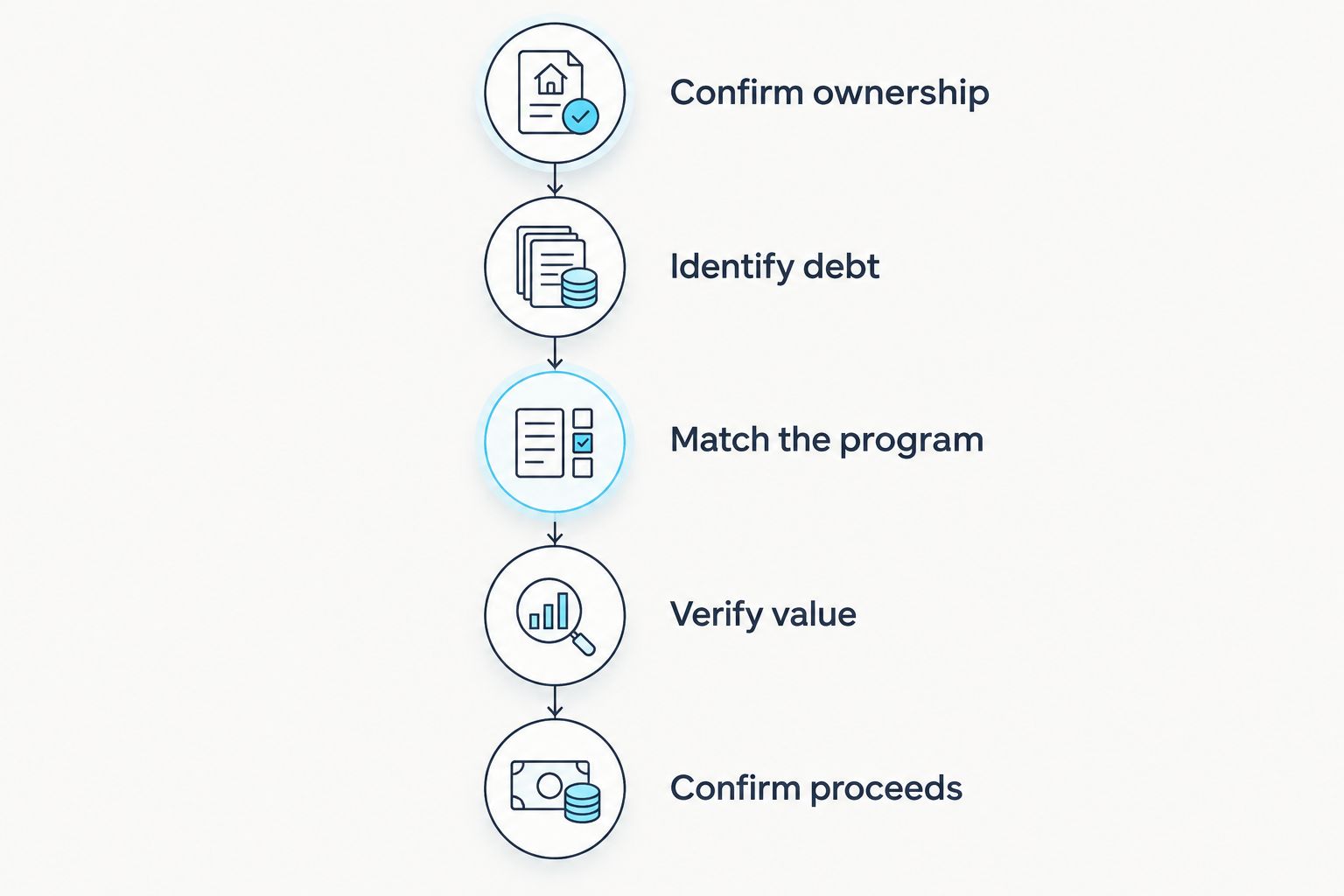
Check eligibility and usable proceeds before relying on a refinance to fund another purchase.
Keep a separate record of renovation invoices, permits where applicable, leases, and rent receipts. Those records explain the property’s condition and income, but they do not replace proof of acquisition funding or mortgage age.
Ask the lender to distinguish application readiness from closing eligibility. Ordering an appraisal early does not waive a seasoning requirement, and a preliminary estimate is not a final approval.
Can I refinance a rental after owning it for 6 months?
6 months of ownership can satisfy Fannie Mae’s general ownership requirement, but not necessarily its existing-mortgage requirement. If the cash-out refinance pays off an existing first mortgage, that mortgage generally needs 12 months of seasoning unless an applicable exception changes the analysis.
A rental purchased without mortgage financing requires a different review. Have the lender evaluate the ownership dates and acquisition documentation together.
Do I have to wait 12 months if I paid cash?
12 months of existing-mortgage seasoning does not create a waiting requirement on a mortgage that does not exist. A cash buyer still needs to satisfy the applicable ownership requirement or qualify for an exception, such as delayed financing.
For an eligible purchase within the preceding 6 months, request a delayed-financing review promptly. Do not assume a current appraisal alone establishes the reimbursable investment.
Does renovating a property shorten the waiting period?
Renovating a rental does not, by itself, waive the applicable cash-out seasoning requirements. Improvements concern property condition and valuation; ownership and mortgage age remain separate tests.
For a 2026 buy-rehab-rent-refinance plan, confirm the financing exit before acquisition. Ask how the lender will document completed work and whether the accepted value supports the planned payoff and cash withdrawal.
FAQ
What is the seasoning period for cash-out refinance on an investment property?
For standard Fannie Mae cash-out refinancing, the general requirements include 6 months of ownership and 12 months of seasoning on an existing first mortgage being paid off. Exceptions and additional lender requirements apply; DSCR programs have lender-specific rules.
Does the waiting period start when I make my first mortgage payment?
Fannie Mae’s existing-first-mortgage seasoning requirement uses note dates, not the first payment date. Ownership seasoning is a separate requirement measured against disbursement.
Can I get cash out immediately after buying a rental with cash?
An eligible all-cash purchase can qualify for delayed financing without the normal ownership waiting period. The exception requires acquisition-fund documentation and compliance with its loan-amount and underwriting conditions.
Does a DSCR loan always have a shorter seasoning period?
No universal rule makes DSCR cash-out seasoning shorter than conventional seasoning. Confirm the specific lender’s ownership requirement, existing-debt requirement, and valuation basis.
Will putting my rental into an LLC restart the seasoning clock?
An LLC transfer requires review of the program’s ownership and borrower rules. Provide the full title history and entity documents before assuming the transfer preserves or restarts seasoning.
Can I use a higher appraisal to get all my renovation money back?
A higher appraisal does not guarantee reimbursement of renovation spending. The accepted value basis, permitted loan amount, existing payoff, and transaction requirements determine usable proceeds.
Is a cash-out refinance the same as a rate-and-term refinance?
A cash-out refinance and a rate-and-term refinance have different transaction requirements. The lender must classify the transaction from its actual payoff structure and proceeds, not simply the label you prefer.
One last thing
The shortest waiting period is not automatically the strongest financing plan. A transaction can satisfy seasoning and still produce too little cash—or a payment that weakens the rental’s finances.
Before scheduling your next purchase, ask for the eligible closing date, accepted valuation basis, estimated net proceeds, and proposed payment in the same written assessment. That is the decision document to use, not the property’s estimated equity alone.


