


Non-QM Loan Structure for Two-Business Owners (2026)
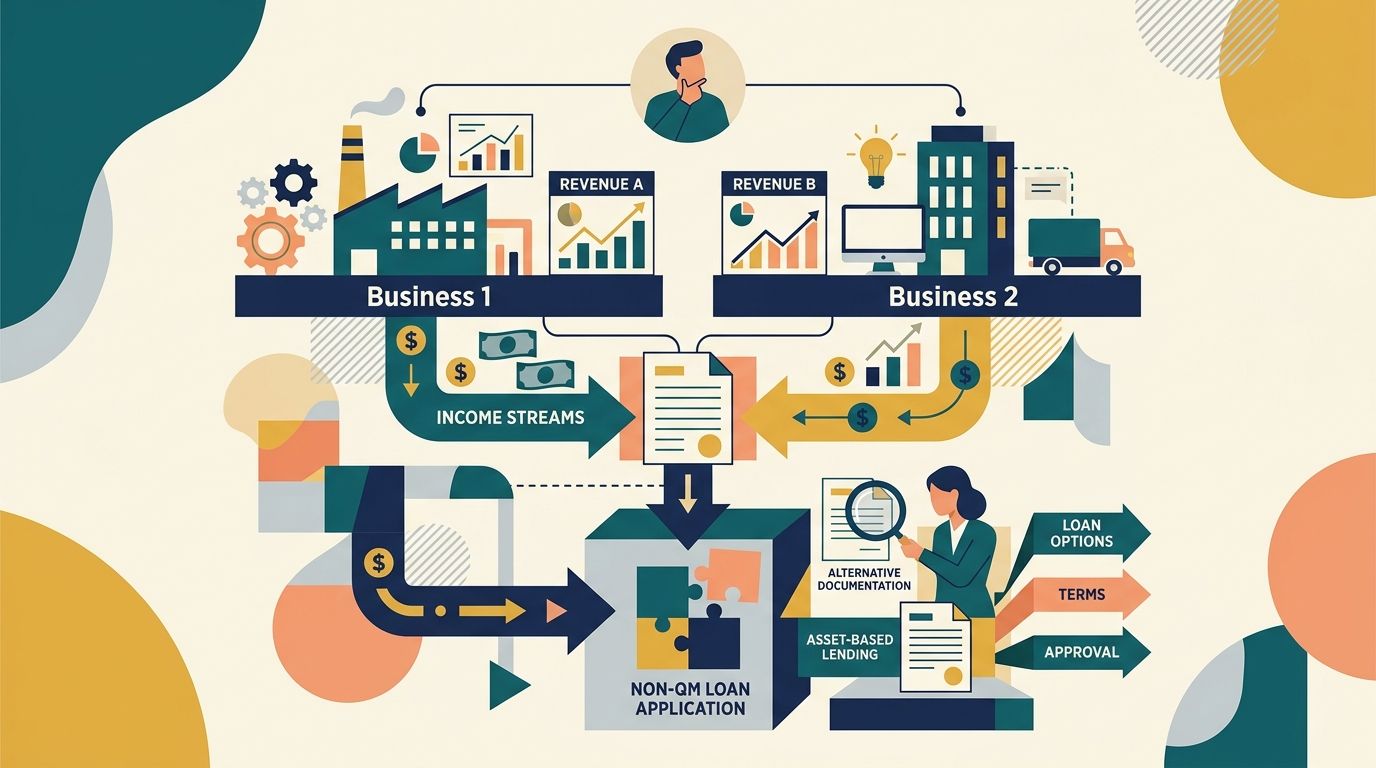
Structuring a non-QM loan for two-business owners comes down to picking which entity carries the loan and how the lender treats the second business's cash flow. Most non-QM lenders will qualify you on 12 to 24 months of bank statements from the business tied to the property, apply a standard expense factor around 50% to estimate real income, and treat the second business as a compensating factor rather than a second income stream unless you use a P&L only program built to consolidate both.
TL;DR
- Structure a non-QM loan for two businesses by anchoring qualification to the entity with the strongest deposit history.
- Bank statement programs typically use 12-24 months of statements and a 50% default expense ratio.
- DSCR loans skip personal and business income entirely, sidestepping the two-business documentation problem.
- P&L only mortgage loans can combine both businesses onto one statement when structured correctly.
- LLC ownership percentage and commingled accounts are the two factors that most often stall approval.
Why this matters
Owning two businesses is normal among self-employed borrowers, but it's also the single fastest way to get flagged for extra underwriting in a traditional mortgage file. A W-2 underwriter wants one clean income number; two Schedule Cs, two sets of deposits, and two different expense patterns don't fit that box.
Non-QM loans exist precisely because traditional banks can't model this kind of borrower. The structuring decision you make in 2026 — which entity anchors the loan, whether the second business gets counted at all — determines your approval odds more than your credit score does. Get the structure wrong and you'll spend six weeks producing documents that don't move the needle.
How to structure a non-QM loan when you own two businesses
The fastest structuring path is to pick one entity as the primary qualifying business and treat the second as either supplemental or irrelevant. Here's how the three common approaches stack up:
Bank statement loan, single entity
- How income is counted: 12-24 months of deposits from the stronger business only
- Best for: Owner with one dominant, high-deposit business
Bank statement loan, combined entities
- How income is counted: Deposits from both businesses averaged, expenses backed out separately
- Best for: Two businesses with similar deposit patterns and no commingling
DSCR loan (rental property purchase)
- How income is counted: Property's rent covers the payment; business income isn't reviewed
- Best for: Owner buying investment property, not a primary residence
P&L only mortgage
- How income is counted: A CPA-prepared profit and loss statement consolidates both businesses into one number
- Best for: Owner whose businesses are related or share overhead
A bank statement loan is the most common non-QM structure for a two-business owner, but it only works cleanly when one business clearly dominates the deposit history. If both businesses generate comparable revenue, the underwriter has to decide whether to average them or pick one, and that decision needs to happen before you apply, not during underwriting.
Bank statement loans: keep the businesses on separate ledgers
When your two businesses have separate bank accounts and separate tax IDs, a bank statement lender will typically qualify you off the account tied to the property or the transaction. Deposits from the second business generally aren't added unless you specifically request a combined review, and combining them usually means submitting statements for both accounts plus a letter explaining the relationship between the entities.
Verdict: Keep ledgers separate and qualify on the stronger business — it's the cleanest, fastest path in most files.
DSCR loans: business income never enters the equation
A DSCR loan for a rental property purchase qualifies you on the property's rental income against its own debt obligations, not on your personal or business cash flow. Owning two businesses is irrelevant to a DSCR file because the lender isn't reviewing your Schedule C, your bank statements, or your tax returns at all.
This makes DSCR the simplest structure for an investor who happens to also run two operating businesses. Verdict: Use a DSCR loan whenever the purchase is an investment property — it removes the two-business documentation problem entirely.
P&L only loans: one statement, two businesses
A P&L only mortgage lets a licensed CPA or tax preparer produce a single profit and loss statement that reflects income from both businesses combined. This structure works best when the two entities are related — say, a contracting business and a property management LLC that share the same owner and overlapping expenses.
The tradeoff is that the CPA's letter carries real underwriting weight, so it needs to be accurate and defensible, not optimistic. Verdict: Use a P&L only structure when the businesses are genuinely intertwined and a CPA can document combined income cleanly.
Why non-QM structuring for two businesses varies
- Ownership percentage — lenders generally review a business's finances once your ownership stake crosses 25%; below that, the business is often excluded from the file entirely.
- Entity type — an LLC, S-corp, or sole proprietorship each documents differently, and complex LLC structures with multiple members add extra verification steps.
- Commingled bank accounts — when personal and business funds mix in one account, or when both businesses deposit into the same account, expense ratio calculations get harder to isolate.
- Seasoning of the second business — a business open less than two years usually gets excluded from qualifying income regardless of how well it's performing.
- Debt-to-income overlap — if the second business carries its own debt obligations reported on your personal credit, that debt still counts against you even if the income doesn't.
- Property type — a primary residence purchase pulls in personal and business income review; an investment property purchase can often route around all of it through a DSCR structure.
Related questions
Can you use income from two businesses on one non-QM loan?
Yes, you can use income from two businesses on one non-QM loan, but only under a bank statement program that explicitly supports combined-entity review or a P&L only structure prepared by a CPA. Most single-entity bank statement programs will only count one business unless you request the combined review upfront.
Does a non-QM lender average two business bank statements together?
A non-QM lender will average two business bank statements together only when the file is structured as a combined-entity review from the start, not as a default practice. Ask your loan officer before submitting statements — retrofitting a single-entity file into a combined one usually means resubmitting the whole package.
What happens if one of my two businesses shows a loss?
A loss in one business generally doesn't disqualify you, but it can reduce your qualifying income if that business is included in the review at all. Excluding the losing business from the file — assuming it's not the entity tied to the property — usually protects your approved loan amount.
Do self-employed borrowers with two businesses need higher credit scores?
No, owning two businesses does not require a higher credit score on its own, though non-QM programs generally set their own minimums regardless of how many businesses you run. Self-employed borrowers with complex income are evaluated on documentation quality first, credit profile second.
LoanGuys structures non-QM files for two-business owners around whichever program actually fits the deposit pattern, rather than forcing every borrower into one bank statement template. That's the difference between a file that closes in 2026 on schedule and one that stalls waiting for a third round of business documentation.
Get your non-QM loan structured right
Talk through your two-business income before you apply, not after.
FAQ
How do you structure a non-QM loan when you own two businesses?
Structure it by anchoring qualification to the stronger entity's bank statements or by using a P&L only program that combines both businesses into one CPA-prepared statement. DSCR loans sidestep the issue entirely for investment property purchases since business income isn't reviewed.
Can a non-QM lender combine income from two separate LLCs?
A non-QM lender can combine income from two separate LLCs, but usually only through a P&L only mortgage or a bank statement program that explicitly reviews both accounts. Standard single-entity bank statement programs only count one business by default.
Is a DSCR loan easier than a bank statement loan for a two-business owner?
A DSCR loan is easier for a two-business owner buying an investment property because it qualifies on the property's rental income, not personal or business cash flow. Bank statement loans require sorting out which business's deposits count and how.
How many months of bank statements does a non-QM lender require?
Most non-QM bank statement programs require 12 to 24 months of statements from the qualifying business account. The exact number depends on the specific program and how deposits are structured.
Does owning two businesses hurt your debt-to-income ratio?
Owning two businesses can hurt your debt-to-income ratio if the second business carries its own reported debt, since that debt counts against you even when the income doesn't. Excluding the second business's income while its debt still shows on your credit file is the most common DTI trap.
What is a P&L only mortgage loan?
A P&L only mortgage loan qualifies a borrower using a CPA-prepared profit and loss statement instead of tax returns or bank statements. It can combine income from multiple related businesses into one document when the CPA documents it accurately.
Do you need to disclose a second business you don't use for qualifying income?
Yes, most non-QM lenders require disclosure of all business ownership even if the second business's income isn't used for qualifying. Undisclosed ownership stakes can surface during underwriting and delay closing.
One last thing
The single biggest structuring mistake in 2026 isn't picking the wrong loan program — it's deciding which business to qualify on after the file is already submitted. Tell your loan officer about both businesses on day one, even the one you don't want counted, because a lender who discovers it mid-file will re-run the whole review.


