


LoanGuys vs Quicken Loans: which is better in 2026

Choose Loanguys if you need a mortgage broker for DSCR, bank-statement, bridge, or fix-and-flip financing; choose Quicken Loans if your priority is comparing mortgage options through a lender-matching marketplace. For 2026, the useful distinction is specialist loan-program guidance versus a broader mortgage-shopping starting point—not which name sounds more familiar.
TL;DR
- Loanguys vs Quicken Loans comes down to specialist mortgage brokerage versus lender comparison.
- Choose the broker route for DSCR loans, bank-statement qualification, or renovation financing.
- Choose Quicken Loans when your first task is comparing participating mortgage lenders.
- Neither route guarantees approval, lower borrowing costs, or a particular closing date.
Why this matters
A mortgage comparison only helps when both options address your actual financing problem. Buying a home with documented employment income is different from financing a rental through its income or purchasing a property that needs substantial repairs.
Loanguys is the better starting point for investors seeking DSCR, fix-and-flip, or bridge financing. Its stated mortgage programs directly address those financing needs. The tradeoff is that a specialist broker conversation does not replace checking another source for competing terms.
Quicken Loans is a mortgage-shopping marketplace, distinct from the direct lender Rocket Mortgage. Its comparison role is useful when you want to explore participating lenders, but a marketplace introduction is not a lender's underwriting decision. Confirm which company will review your application, issue your disclosures, and fund the mortgage.
At a glance
Use this 2026 comparison to choose your starting point. Then evaluate the actual loan proposal rather than treating either business model as a guarantee of better terms.
Best for
- Loanguys: Investors and homeowners seeking specialist mortgage programs
- Quicken Loans: Borrowers starting with lender comparison
Standout feature
- Loanguys: Stated DSCR, bank-statement, bridge, fix-and-flip, and short-term rental programs
- Quicken Loans: Mortgage lender matching and comparison
Income qualification
- Loanguys: A direct starting point for discussing bank-statement or rental-income qualification
- Quicken Loans: A starting point for finding lenders, followed by program screening
Property projects
- Loanguys: Stated financing programs for flips and bridge needs
- Quicken Loans: Requires checking the matched lender's project eligibility
Comparison workflow
- Loanguys: Broker-led discussion of the financing scenario
- Quicken Loans: Marketplace-led exploration of participating lenders
Provider selection
- Loanguys: Ask which lender and program the broker proposes
- Quicken Loans: Useful when choosing among lender introductions is your first task
Pricing model
- Loanguys: Mortgage transaction costs; confirm broker compensation and lender charges
- Quicken Loans: Mortgage transaction costs depend on the selected lender; confirm any marketplace charges
Closing certainty
- Loanguys: Requires underwriting and completed closing conditions
- Quicken Loans: Requires underwriting and completed closing conditions
Specialist programs are the better fit for investor financing
Best for: a rental investor or self-employed borrower with a specific qualification problem. Start with the financing method your transaction requires, not a generic mortgage application.
The broker's stated mortgage services include DSCR and bank-statement programs. DSCR means debt-service coverage ratio: a measure of income relative to debt payments. In rental lending, the program's calculation determines how the property's income supports the proposed payment.
Bank-statement lending addresses a different problem. It uses an alternative income-documentation approach for eligible borrowers, rather than treating business deposits as identical to salary. Ask how the proposed lender treats expenses, transfers, business ownership, and irregular deposits.
The advantage is program relevance. The limitation is equally important: a program name does not establish your eligibility or tell you which lender will accept your file.
Quicken Loans is the better starting point when you have not yet chosen a lender and want comparison first. If you already know you need a particular alternative-documentation program, screen each introduction for that requirement before completing a full application.
The broker route is more direct for a flip or bridge scenario
Best for: an investor financing a property transition rather than a finished, stabilized home. Fix-and-flip and bridge financing are explicitly part of the broker's stated offering.
A flip needs a financing discussion that includes the property's present condition, planned work, and repayment strategy. A bridge loan addresses a temporary financing need; the exit could involve a sale or replacement financing, subject to the actual agreement.
Prepare these project details before requesting terms:
- Property condition: Describe work required before occupancy or rental.
- Repair budget: Separate acquisition funding from construction expenses.
- Exit plan: Explain whether you intend to sell or retain the property.
- Cash position: Identify funds for closing, repairs, and unexpected expenses.
The drawback is repayment risk. A project loan is not a substitute for a workable renovation budget or a credible exit plan.
A marketplace remains useful for comparing providers, but the matched lender must explicitly accept the property and project. Do not mistake a general mortgage inquiry for confirmation that a lender finances substantial rehabilitation.
Quicken Loans wins when lender comparison is the first task
Best for: a mortgage shopper who wants to explore lender options before choosing a provider. A marketplace fits that task more directly than starting with one broker relationship.
Quicken Loans gives you a lender-comparison starting point. That is useful when your immediate question is who to approach, rather than how to structure a rental-income or renovation loan.
The limitation is scope. A marketplace's participating lenders do not represent every lender or every mortgage program. An introduction also does not establish the final terms of a loan.
For a useful 2026 comparison, give each provider the same transaction details:
- Property use: primary residence, second home, or investment.
- Purchase or refinance purpose.
- Income sources and documentation approach.
- Property condition and intended work.
- Desired closing date and expected ownership period.
Consistent facts make proposals easier to compare. Otherwise, an apparent difference between providers can simply reflect different assumptions about your transaction.
Quicken Loans fits borrowers who want to select a lender first
Best for: a borrower who prefers reviewing lender introductions before discussing detailed loan structure. This is a workflow advantage, not proof of better underwriting or lower costs.
With a marketplace-first approach, you can focus on identifying potential lenders and then ask each lender about the application, documentation, and closing process. That order suits borrowers whose main uncertainty is provider selection.
The broker-first approach reverses the emphasis. You describe the financing problem and ask the broker which lender and program fit it.
Neither approach removes your responsibility to understand who does what. Before sharing sensitive documents, identify the company receiving them and ask who will handle underwriting questions.
The marketplace route loses its advantage when you repeatedly reach lenders that do not handle your property type or documentation needs. At that point, a program-specific conversation is more productive than another general introduction.
Both routes require real qualification—not just an inquiry
Best for: every borrower checking whether a promising conversation can become a closed loan. Neither a broker inquiry nor a marketplace match establishes final approval.
Ask for the distinction between an initial assessment and a decision based on reviewed documents. Also ask which property, income, credit, title, insurance, and asset conditions remain unresolved.
For DSCR financing, request the lender's actual calculation. For bank-statement financing, ask which deposits count as qualifying income and which deductions apply. For a renovation project, ask how the property condition and repair plan affect approval.
Use a simple sequence: Property fit, Income fit, then Written terms. Establish that the loan can address the transaction before spending time comparing detailed proposals.
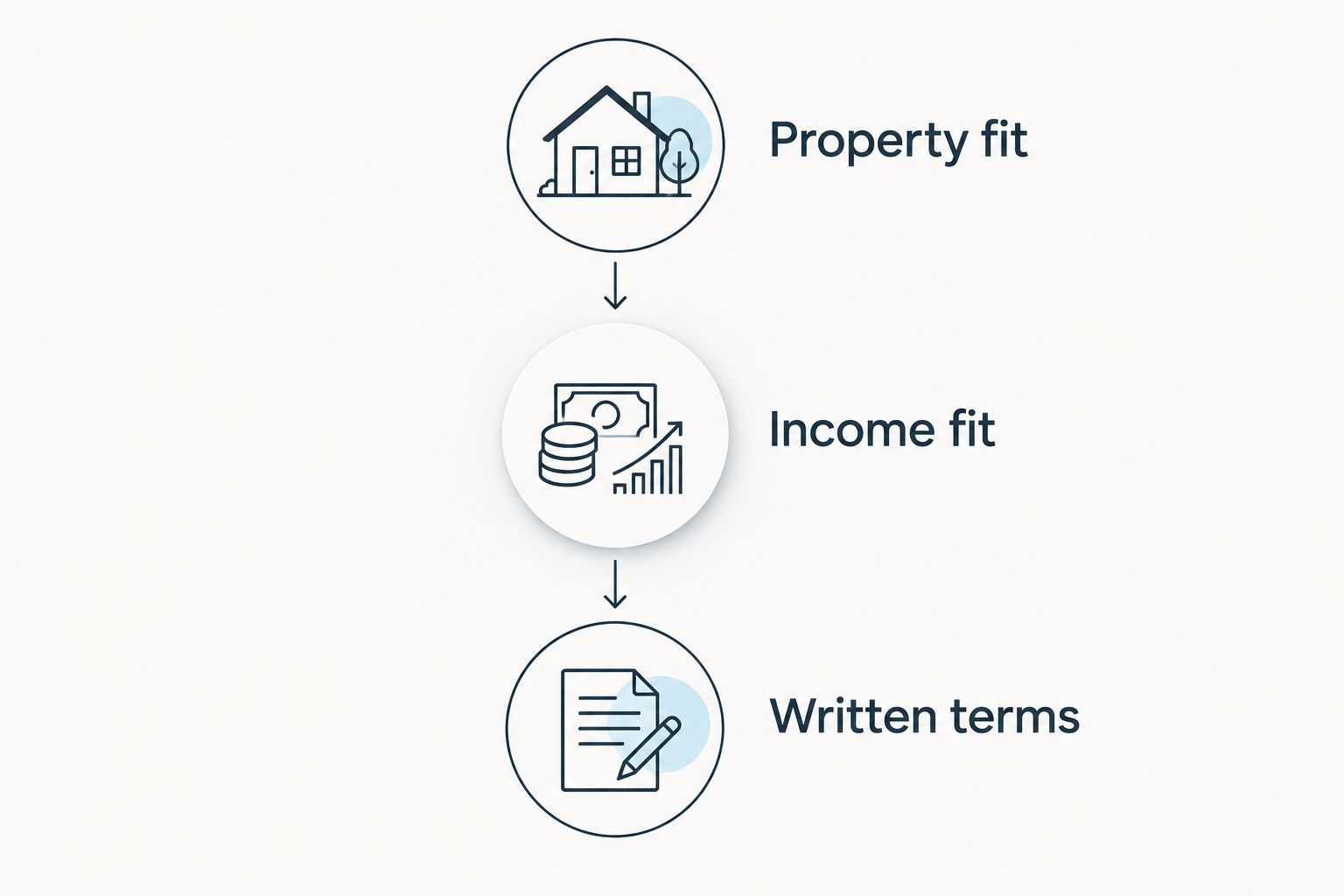
Confirm property and income eligibility before comparing detailed loan terms.
In 2026, the same discipline applies to both routes: ask what has been verified, what remains conditional, and who has authority to make the next decision. A confident conversation is not a substitute for written requirements.
Pricing: neither business model proves a better deal
Best for: borrowers comparing the complete transaction rather than an isolated headline. A mortgage broker and a lender-matching marketplace are different routes to financing, not competing subscription plans.
For the broker route, ask how compensation is handled and which lender charges apply. For Quicken Loans, establish which company is proposing the mortgage and whether any separate marketplace charge applies. Do not assume either route has a particular compensation arrangement.
Compare written proposals using the same loan amount, property use, documentation method, and lock assumptions. For consumer mortgages covered by the applicable disclosure rules, use the Loan Estimate to organize the comparison. Business-purpose investment loans can follow a different disclosure framework, so request an itemized written proposal.
Review these terms together:
- Cash required: Separate the down payment, transaction charges, and required reserves.
- Payment structure: Establish whether payments reduce principal and whether terms can change.
- Early repayment: Check for a prepayment penalty or another exit restriction.
- Project funding: For renovation financing, establish how repair funds are released.
- Loan maturity: Understand when the remaining balance becomes due.
A fixed payment structure supports planning; adjustable or temporary financing introduces different risks. Neither model is automatically right for your ownership plan. Compare the obligation you will sign, not the channel that introduced it.
Neither route wins on closing certainty
Best for: buyers with a contract deadline or investors coordinating a sale, renovation, or refinance. Choose based on the proposed transaction's remaining conditions, not the company's name.
There is no supported basis here for declaring either route faster. Ask the responsible lender which documents are outstanding, whether the appraisal is ordered, and which conditions must be satisfied before closing.
For a 2026 purchase, request a transaction-specific schedule with named responsibilities. Your part includes providing complete documents and responding to requests; the lender's part includes explaining review stages and unresolved requirements.
Bridge borrowers need another check: establish whether the planned repayment source is realistic. A future refinance requires its own qualification, and a projected sale is not a completed sale. Build your decision around those dependencies rather than assuming the next transaction will happen automatically.
Final verdict: choose the route that addresses your first problem
Choose Loanguys if you need specialist mortgage guidance
Named profile: the rental investor or self-employed buyer whose transaction needs a specific program. Start here when DSCR, bank-statement, fix-and-flip, bridge, or short-term rental financing matches the problem you need to solve.
The advantage is a relevant program discussion. The limitation is that lender selection, eligibility, compensation, and transaction terms still require confirmation. Ask for the proposed program and its conditions before treating the conversation as a financing plan.
Choose Quicken Loans if you want lender comparison first
Named profile: the mortgage shopper whose first decision is which lender to approach. Start here when you want marketplace introductions and are prepared to evaluate the resulting lenders separately.
The advantage is a comparison-oriented starting point. The limitation is that participating lenders and their underwriting rules define the options you actually receive. Screen for your property and income requirements early.
Specialist investor-program fit
- Winner: Specialist broker route
Flip and bridge project discussion
- Winner: Specialist broker route
Lender-comparison starting point
- Winner: Quicken Loans
Lender-first shopping workflow
- Winner: Quicken Loans
Qualification certainty
- Winner: Tie: underwriting decides
Pricing
- Winner: No universal winner: compare written proposals
Closing certainty
- Winner: Tie: unresolved conditions decide
FAQ
Is Loanguys better than Quicken Loans for investors?
Loanguys is the better starting point when you specifically need its stated DSCR, fix-and-flip, bridge, bank-statement, or short-term rental programs. Quicken Loans fits borrowers who want a lender-comparison marketplace first.
Is Quicken Loans the same as Rocket Mortgage?
Quicken Loans is a mortgage-shopping marketplace, while Rocket Mortgage is a direct mortgage lender. Confirm the company handling your application rather than treating the names as interchangeable.
Which option should I choose if I am self-employed?
Start with a bank-statement program discussion if alternative income documentation is your main requirement. Self-employment alone does not rule out other mortgage paths; ask each provider how it will calculate your qualifying income.
Does a DSCR loan mean I do not need documents?
No. DSCR financing evaluates rental-income coverage under the lender's rules, but it does not eliminate underwriting. Ask for the property, credit, asset, and entity documents required for your transaction.
Which option has better mortgage terms in 2026?
Neither business model establishes better terms on its own. Compare written proposals based on the same property use, loan structure, documentation method, and transaction assumptions.
Can I finance a fix-and-flip through a mortgage marketplace?
Only a matched lender that accepts the project can confirm that financing path. Establish renovation eligibility before proceeding with a general mortgage application.
What should I ask before choosing a mortgage provider?
Ask who will fund the loan, how income is calculated, which conditions remain, and how compensation is handled. For an investment project, also confirm repair funding, repayment restrictions, and the planned exit.
One last thing
Ask what would make the proposed loan fail. That question exposes property restrictions, documentation gaps, and repayment assumptions more directly than asking whether approval looks promising.
Before choosing a provider in 2026, write a short transaction summary and send the same version to each candidate. A useful response identifies the financing path and its unresolved conditions—not just the next application step.


