


Quicken Loans alternatives for self-employed borrowers

Quicken Loans, now known as Rocket Mortgage, is known for its online mortgage application experience, but application convenience does not resolve a mismatch between taxable income and mortgage qualifying income. The best Quicken Loans alternative in 2026 is Loanguys if you need bank-statement or investor financing; a portfolio lender is another option if you need an individual review of a complex financial profile.
TL;DR
- For quicken loans alternatives for self employed borrowers, consider Loanguys for bank-statement mortgages and investor financing.
- Bank-statement loans evaluate eligible deposits, not simply your total business revenue.
- DSCR financing focuses on rental-property income and is not a primary-residence mortgage.
- Keep Rocket Mortgage on your shortlist when documented self-employment income supports a standard mortgage.
Why this matters
Self-employment does not automatically disqualify you from a conventional mortgage. The problem is often how a lender calculates income after reviewing business expenses, tax returns, ownership, and income stability.
Your business revenue, taxable profit, and mortgage qualifying income are different figures. A busy business does not automatically produce enough qualifying income for the home you want.
Choose the income documentation method before choosing the lender. In 2026, that means separating a primary-home purchase from a rental investment, then identifying whether tax returns, eligible bank deposits, or rental income best support the application.
The alternatives below compare lending approaches, not guaranteed approvals. A broker, portfolio lender, and credit union also represent different business models, not interchangeable loan programs.
Quicken Loans alternatives at a glance
Quicken Loans / Rocket Mortgage
- Best for: Borrowers comfortable with an online mortgage process
- Standout feature: Established digital application experience
- Difference to investigate versus Quicken Loans: Use its actual income assessment as your benchmark
Loanguys
- Best for: Self-employed borrowers exploring bank-statement financing and investors seeking DSCR loans
- Standout feature: Mortgage broker offering bank-statement, DSCR, bridge, and fix-and-flip programs
- Difference to investigate versus Quicken Loans: Ask which documentation route fits your income and property
Portfolio lender
- Best for: Borrowers seeking an individual review outside a standardized loan structure
- Standout feature: Loans retained on the lender's own books
- Difference to investigate versus Quicken Loans: Ask whether its own underwriting policy addresses your specific obstacle
Credit union mortgage lender
- Best for: Eligible members seeking another mortgage assessment
- Standout feature: Member-based financial institution
- Difference to investigate versus Quicken Loans: Compare its income calculation and mortgage options rather than assuming membership means flexibility
Do not read this table as a claim that Rocket Mortgage rejects self-employed borrowers or lacks every alternative documentation option. Compare the programs each provider actually proposes for your application in 2026.
1. Loanguys: best for bank-statement and investor financing
Loanguys is a mortgage broker serving homeowners and real estate investors across the United States. Its stated programs include bank-statement, DSCR, fix-and-flip, bridge, and short-term rental loans.
Loanguys is best for self-employed borrowers seeking bank-statement mortgage options or financing for an investment property. The distinction matters: your own home and a rental property require different financing discussions.
Where it shines
- Bank-statement financing: A relevant route when eligible deposits provide a different picture from taxable business profit.
- Rental financing: DSCR programs provide an investor-focused option centered on the property's income and debt obligations.
- Project-specific programs: Bridge and fix-and-flip loans address different needs from a long-term home mortgage.
Where it falls short
- A broker is not the same as the institution funding your loan; confirm who makes the underwriting decision.
- The stated program list does not establish your eligibility, required down payment, or closing date.
- Bank-statement financing still requires income analysis. Deposits alone do not establish qualifying income.
- Investor programs are not substitutes for a mortgage on the home you intend to occupy.
Head-to-head with Quicken Loans
Provider model
- Broker alternative: Mortgage broker
- Quicken Loans / Rocket Mortgage: Mortgage lender
Relevant starting point
- Broker alternative: Ask about the stated bank-statement or DSCR programs
- Quicken Loans / Rocket Mortgage: Request an income review for the mortgage under consideration
Income question
- Broker alternative: Which documentation method fits this borrower?
- Quicken Loans / Rocket Mortgage: How much income qualifies under the proposed program?
Decision authority
- Broker alternative: Identify the funding lender and underwriting requirements
- Quicken Loans / Rocket Mortgage: Identify the proposed program's underwriting requirements
Best for: A business owner whose tax-return income creates a qualification problem, or an investor evaluating rental financing.
Verdict: Buy — pursue a program-fit review, not an assumed approval.
2. Portfolio lender: best for an individual underwriting review
A portfolio lender keeps loans on its own books rather than originating every loan for sale into the secondary mortgage market. That structure gives you a reason to ask about its own lending policy; it does not establish that the lender accepts your income profile.
Start with the exact obstacle. Declining business income, a recent ownership change, and complicated distributions are different underwriting questions.
Where a portfolio lender shines
- You can ask whether an internally held mortgage addresses a specific documentation issue.
- The conversation centers on that institution's own credit policy.
- A detailed financial explanation gives the lender something concrete to assess.
Where a portfolio lender falls short
- Keeping a loan does not mean ignoring repayment ability or credit risk.
- An institution's lending territory, property rules, and borrower requirements still apply.
- A relationship with the bank does not establish mortgage eligibility.
Approach
- Portfolio lender: Ask about an internally retained loan
- Quicken Loans / Rocket Mortgage: Ask about the proposed mortgage program
Key comparison
- Portfolio lender: Whether its own policy addresses your obstacle
- Quicken Loans / Rocket Mortgage: Whether its income assessment supports your application
Evidence needed
- Portfolio lender: Written eligibility explanation
- Quicken Loans / Rocket Mortgage: Written eligibility explanation
Best for: A borrower with a specific financial complication that deserves an individual review.
Verdict: Hold — proceed only after the lender explains how its policy fits your file.
3. Credit union: best for a second mortgage assessment
A credit union is a member-based financial institution, not a distinct self-employed mortgage program. Consider one when you meet its membership requirements and want another assessment of your documented income.
Do not assume a credit union offers bank-statement mortgages. Ask directly.
Where a credit union shines
- It adds another provider to your comparison without requiring you to change the property's intended use.
- An eligible member can ask about both standard mortgages and any internally retained options.
- A second income calculation helps identify whether the obstacle is documentation or program fit.
Where a credit union falls short
- Membership eligibility comes first.
- Membership does not override mortgage underwriting.
- A credit union using the same mortgage guidelines can reach the same qualification result as another lender.
Best for: An eligible member whose income is documentable and who wants another mortgage review.
Verdict: Hold — compare the actual program, not the institution's label.
Bank-statement loans versus DSCR loans
The most important choice is not between two company names. It is between ways of documenting repayment ability that match your property use.
A bank-statement mortgage evaluates eligible deposits under the lender's rules. Business transfers, borrowed funds, refunds, and other non-income deposits need to be distinguished from operating revenue. Business expenses also matter; gross deposits are not automatically spendable personal income.
A DSCR loan evaluates rental-property cash flow relative to debt obligations. DSCR means debt-service coverage ratio. A ratio of 1.0 means the income measured in the calculation equals the debt service measured in that calculation; it is not a universal approval threshold.
Main evidence
- Bank-statement mortgage: Eligible personal or business deposits
- DSCR investment loan: Rental income and property debt obligations
Main issue to resolve
- Bank-statement mortgage: What portion of deposits qualifies as income?
- DSCR investment loan: Does property income support the required calculation?
Property-use question
- Bank-statement mortgage: Confirm the program accepts your intended occupancy
- DSCR investment loan: Investment property, not a primary residence
Common misunderstanding
- Bank-statement mortgage: Every deposit counts
- DSCR investment loan: Rental income eliminates every other underwriting requirement
For a 2026 application, confirm the lender's calculation rather than using an online example as an eligibility promise. Different definitions of income and debt service change the result.
How to choose the right route
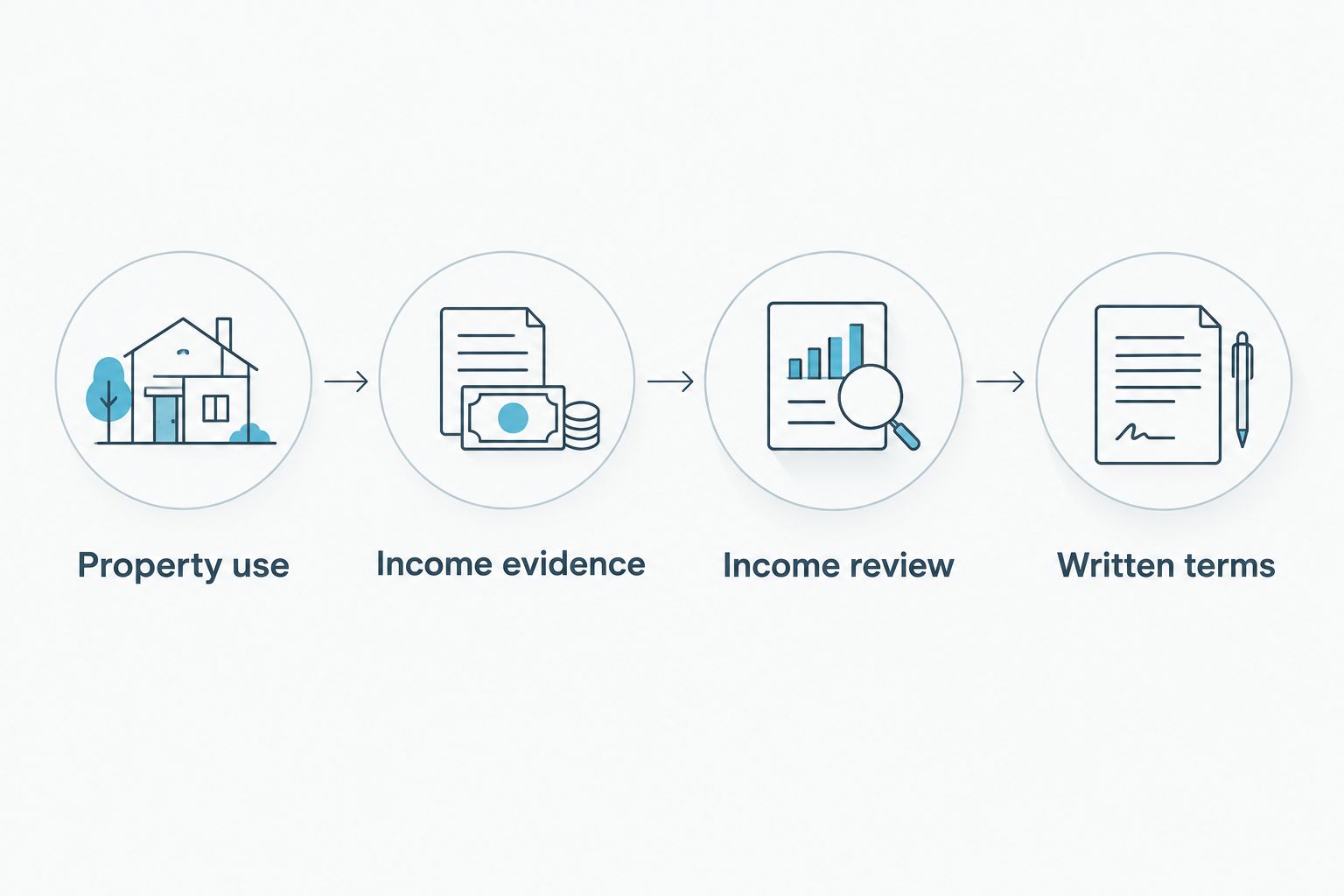
Use this sequence before submitting applications. It keeps the financing discussion tied to your actual problem.
- Property use: State whether you will occupy the home or operate it as an investment. Do not describe a primary residence as a rental to fit an investor program.
- Income evidence: Identify what supports repayment: tax-return income, business deposits, or rental-property income. Separate recurring earnings from account transfers.
- Income review: Ask the provider to explain its qualifying-income calculation and which documents support it. Request the reasoning, not just a maximum loan amount.
- Written terms: Review the proposed structure, required borrower funds, repayment schedule, and any prepayment restriction before committing.
The objective is a mortgage you understand and can repay. An alternative documentation method changes how income is established; it does not remove the need for sound underwriting.
Bring documents that explain the business
Prepare your business ownership information, relevant account statements, current financial records, existing debt information, and the property's intended use. Ask for a program-specific document list before ordering additional reports or accountant letters.
Explain unusual deposits upfront. Moving money between accounts does not create new income, and a lender needs to distinguish a transfer from a customer payment.
If your income has declined, address the reason directly. A different lender is not a substitute for explaining a genuine reduction in repayment capacity.
Discuss your mortgage documentation
Explain your business income and property plans to identify a relevant financing discussion.
Why people switch from Quicken Loans
A useful reason to switch is a documented mismatch between your application and the proposed mortgage program. A general preference for another brand does not solve that mismatch.
These are reasons to investigate alternatives, not claims about Rocket Mortgage's current underwriting decisions:
- The income calculation does not support the request. Ask whether eligible bank deposits support another documentation route.
- The property is an investment. Compare rental-focused financing with a mortgage based primarily on your personal income.
- The project requires different financing. A renovation-and-resale project calls for a different discussion from a move-in-ready primary home.
- The financial structure needs explanation. Multiple businesses and ownership interests require a clear account of where income comes from.
Before switching in 2026, ask the original provider what caused the obstacle. A credit issue, an ineligible property, and insufficient qualifying income need different solutions.
When staying with Quicken Loans is the right call
Stay with Rocket Mortgage if its proposed mortgage fits your property, its income review supports your application, and you understand the written terms. Self-employment alone is not a reason to abandon a standard mortgage.
The online application experience is a legitimate consideration. It should come after program fit, not replace it.
Do not change lenders solely because another provider advertises alternative documentation. Compare the actual mortgage structure and requirements. A bank-statement route is useful when it solves a real qualification issue, not simply because you own a business.
FAQ
What's the best Quicken Loans alternative for a self-employed borrower?
Loanguys is a relevant alternative when you need to explore bank-statement mortgages or investor financing. A portfolio lender is another route for an individual review of a complex financial profile; eligibility depends on the proposed program.
Can I qualify for a conventional mortgage if I'm self-employed?
Yes, self-employed borrowers can qualify for conventional mortgages. The lender evaluates documented income, business stability, credit, debts, and other applicable requirements.
Do bank-statement loans count every deposit as income?
No, bank-statement loans do not automatically count every deposit as income. The lender distinguishes eligible revenue from transfers and other non-income deposits and applies its rules for expenses and qualifying income.
Can I use a DSCR loan to buy my primary residence?
No, a DSCR investment-property loan is not a mortgage for your primary residence. Tell the provider how you intend to use the property before discussing programs.
Is a mortgage broker the same as a direct lender?
No, a mortgage broker arranges financing rather than necessarily funding the mortgage itself. Ask who funds the loan, who underwrites it, and which requirements apply.
Does a bank-statement mortgage mean no documentation?
No, a bank-statement mortgage uses alternative income documentation rather than eliminating documentation. Expect the lender to request records supporting income, assets, business ownership, and the property.
Should I switch lenders after a self-employed mortgage denial?
Switch only after identifying why the application was denied. Another documentation method can address an income-assessment mismatch, but it does not erase credit problems, unsupported earnings, or property restrictions.
One last thing
Ask every provider the same question: What income will you use to qualify me, and how did you calculate it? The answer reveals more than a list of loan programs.
For your 2026 mortgage search, get that explanation before committing to a new route. The right alternative addresses the reason your current application does not fit.


