


LoanGuys vs Zillow Home Loans: which is better in 2026

Choose Loanguys if you need investment property financing built around rental income, renovation plans, or bank statements; choose Zillow Home Loans if you want a direct mortgage lender for a primary-home purchase using traditional income documentation. This 2026 comparison separates investor financing from homebuyer financing so you can choose the right application path.
TL;DR
- Loanguys vs Zillow Home Loans comes down to investor financing versus a direct homebuyer mortgage relationship.
- Loanguys is the better starting point for DSCR, fix-and-flip, bridge, and bank-statement loan needs.
- Zillow Home Loans is the better starting point for a straightforward primary-home mortgage through a direct lender.
- Compare property eligibility, income documentation, repayment structure, and written terms before choosing either provider.
Why this matters
A mortgage for the home you occupy solves a different problem from financing a rental or renovation project. The property’s use, condition, income, and ownership structure affect which underwriting path fits.
Choosing the wrong path creates unnecessary work. Before submitting documents, tell the financing provider whether you will occupy the property, rent it, renovate and sell it, or refinance it after stabilization.
Loanguys investment property financing is best for borrowers seeking DSCR, fix-and-flip, bridge, or bank-statement programs. That is a program-fit verdict, not a claim that every applicant qualifies or receives better terms.
For your 2026 decision, separate three questions: Does the provider handle your transaction? Can you document qualification under that program? Do the written terms support your ownership plan? A recognizable name does not answer those questions.
At a glance
Best for
- Loanguys: Investors and homeowners seeking the stated alternative financing programs
- Zillow Home Loans: Homebuyers seeking a direct residential mortgage lender
Lending relationship
- Loanguys: Mortgage broker
- Zillow Home Loans: Direct mortgage lender
Income evidence
- Loanguys: DSCR and bank-statement program paths
- Zillow Home Loans: Traditional borrower-income mortgage path
Rental strategy
- Loanguys: Explicit DSCR and short-term rental programs
- Zillow Home Loans: Evaluate the proposed rental transaction against current lender guidelines
Renovation strategy
- Loanguys: Explicit fix-and-flip and bridge programs
- Zillow Home Loans: Start with a residential mortgage discussion; confirm property-condition eligibility
Standout feature
- Loanguys: Stated mix of investor and alternative-documentation programs
- Zillow Home Loans: Direct lender relationship for home financing
Approval certainty
- Loanguys: Subject to the selected program’s underwriting
- Zillow Home Loans: Subject to mortgage underwriting
Pricing model
- Loanguys: Transaction-specific mortgage quote through a broker
- Zillow Home Loans: Transaction-specific mortgage quote from a lender
The table identifies the strongest starting point, not blanket exclusions. Do not assume a direct lender rejects every investor or a specialist broker approves every unusual property.
Primary-home buyers get a clearer direct-lender path with Zillow Home Loans
Best for: homebuyers with traditionally documented income who prefer a direct lender. Zillow Home Loans is a mortgage lender, distinct from Zillow’s property-search service. Browsing a listing does not constitute mortgage approval.
The direct-lender relationship is the meaningful advantage here. You are evaluating the lender’s mortgage offer rather than choosing a broker relationship to arrange financing.
For a straightforward home purchase, begin with these questions:
- Does the mortgage support your intended occupancy?
- Which income and asset documents must you provide?
- What conditions remain before final approval?
- Who handles questions between application and closing?
The limitation is equally important: a homebuyer mortgage conversation does not establish that a rental-income qualification method or renovation funding structure fits. Describe the transaction before treating a prequalification as evidence that the property works.
A broker remains a valid option for a primary residence, especially when income documentation needs a different approach. The verdict favors Zillow Home Loans for the borrower profile above, not every homeowner.
Rental-income qualification favors the investor broker
Best for: rental investors who want the property’s income evaluated under a DSCR program. The broker’s stated offerings include DSCR and short-term rental loans, making this the more relevant starting point for an income-producing property.
DSCR means debt service coverage ratio. It compares the income measure accepted by the lender with the debt-payment measure required by that program; ask exactly what each includes.
A DSCR of 1.00x means the accepted income equals the debt service used in that calculation. It does not mean you break even after every operating expense, qualify automatically, or meet a universal lender minimum.
For a short-term rental, ask how the program evaluates rental income and whether it accepts the property’s intended use. A forecast, existing booking history, and a long-term lease are different evidence; do not assume they receive identical treatment.
The tradeoff is that property-based qualification still involves underwriting. Credit, assets, property condition, valuation, and the selected program’s rules remain relevant.
For your 2026 rental purchase, the practical recommendation is simple: start with an explicitly stated DSCR path when rental-income qualification is central to the deal. Compare a traditional mortgage path only after confirming it supports the same transaction.
Bank-statement qualification favors the alternative-documentation path
Best for: self-employed borrowers whose bank deposits need evaluation rather than relying solely on traditional income documents. The broker explicitly offers bank-statement loan programs, so this is a concrete reason to begin there.
A bank-statement mortgage is not a promise to count every deposit as income. Transfers, borrowed funds, business expenses, and the nature of the account affect the underwriting discussion.
Before applying, organize your account history and identify the source of recurring deposits. Ask which accounts the program reviews, how it treats business expenses, and what supporting documentation it requires.
The limitation is that alternative documentation does not remove the need to establish repayment ability under the applicable program. Nor does being self-employed make a traditional mortgage unsuitable.
Zillow Home Loans remains the better starting point when your traditionally documented income already supports a primary-home mortgage and you want a direct lender. Do not seek a more complicated qualification route just because you own a business.
Choose based on the evidence that best represents your finances. Employment labels alone are not a lending decision.
Fix-and-flip and bridge needs favor a stated project-financing program
Best for: investors financing a renovation-and-sale project or a temporary financing need. Fix-and-flip and bridge loans appear explicitly in the broker’s program offering.
A fix-and-flip discussion starts with acquisition, renovation, and the intended sale. A bridge discussion starts with why temporary funding is needed and how you will repay or replace it.
Ask about the project before discussing the application:
- Property fit: Does the program accept the property’s current condition and intended use?
- Income evidence: Which borrower or property documents support qualification?
- Exit strategy: Will repayment come from a sale, refinance, or another documented source?
- Loan terms: What repayment obligations and conditions apply throughout the project?
These questions form a decision framework, not an approval checklist. A provider must evaluate the actual transaction.
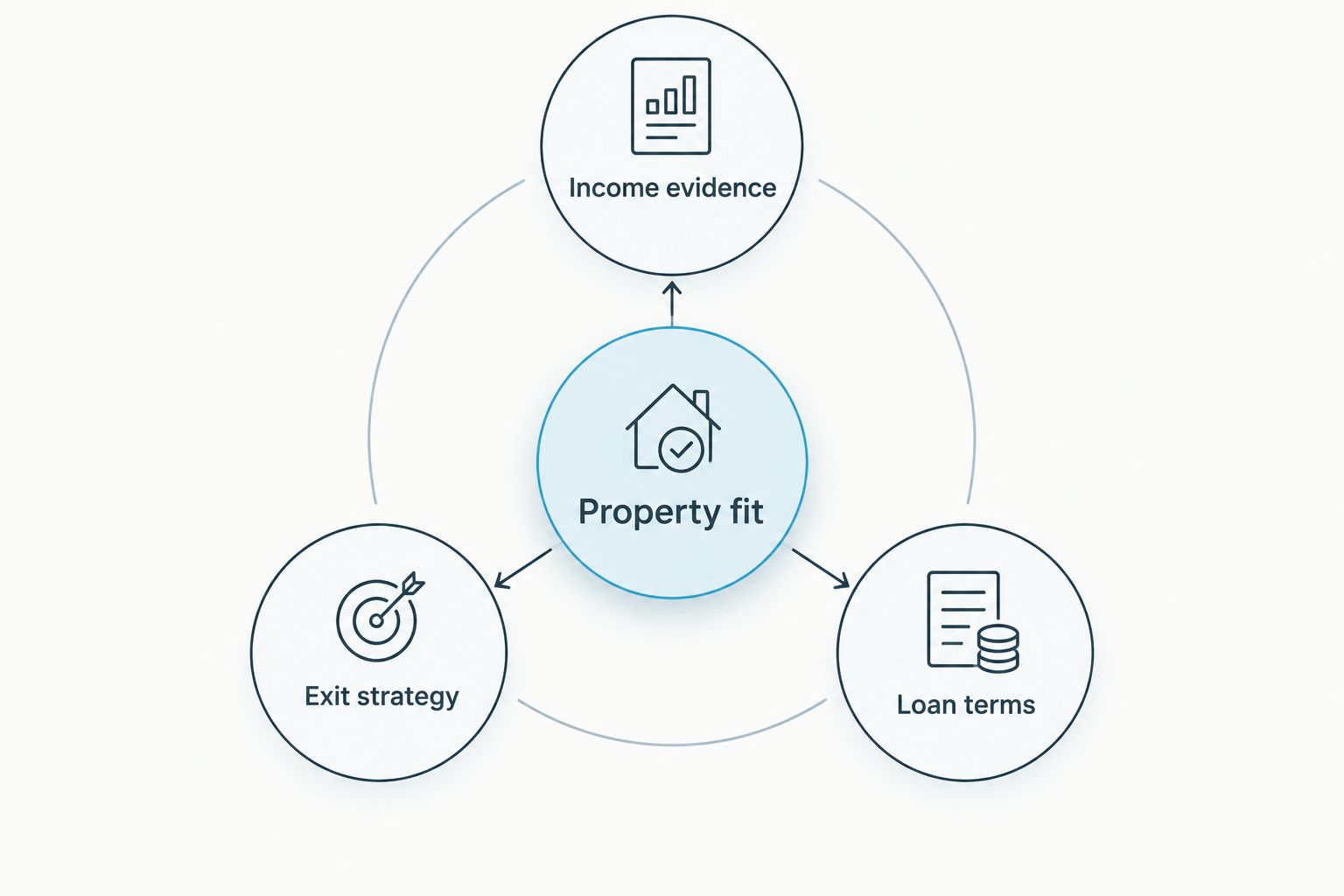
A project loan needs a property that fits and a credible repayment plan.
The downside of temporary financing is the need to execute that exit. A refinance is a separate underwriting decision; completing renovations does not guarantee replacement financing.
Zillow Home Loans is the better starting point for the contrasting scenario: a homebuyer pursuing a residential mortgage rather than financing an investor renovation-and-sale plan. Do not treat those products as substitutes simply because both involve real estate.
Neither provider wins on approval certainty
Best for: every borrower who needs to distinguish preliminary feedback from a final lending decision. Neither a broker relationship nor a direct-lender relationship eliminates underwriting.
Ask what stage the file has reached and which conditions remain. Credit review, income analysis, appraisal, title review, and other transaction requirements are separate from an initial conversation.
For a covered consumer mortgage, the lender generally must provide a Loan Estimate within 3 business days after receiving an application. The Consumer Financial Protection Bureau’s mortgage disclosure guidance explains this timing; it is not a promise that the loan will close within that period.
The same distinction matters with the Closing Disclosure. For covered transactions, the borrower generally must receive it at least 3 business days before closing, according to CFPB guidance. Certain changes trigger a new waiting period.
These are disclosure rules relevant to your 2026 comparison, not either provider’s service guarantee. Business-purpose investment loans can fall outside these consumer disclosure requirements.
Treat both providers as subject to underwriting, and ask which disclosures apply to your specific loan. Do not rank closing speed without a transaction-specific schedule and outstanding-condition list.
Pricing: compare the loan structure, not the company name
Both providers use transaction-specific mortgage quotes rather than a fixed subscription or flat product plan. The distinction is who arranges or originates the financing, not a universal pricing advantage.
The broker model creates a relationship around arranging financing under the selected program. The direct-lender model creates a relationship with the lender offering the mortgage. Ask each provider how compensation and lender-related charges appear in your written disclosures or proposal.
For a useful 2026 comparison, keep the transaction assumptions consistent:
- Same property and intended occupancy.
- Same requested loan amount and borrower profile.
- Same repayment structure and intended holding period.
- Same timing assumptions for the quote.
- Same understanding of any prepayment restrictions.
LTV means loan-to-value ratio: the loan amount divided by the property value used for that calculation. As a percentage, 100% LTV means those amounts are equal; this definition does not imply either provider offers that financing level.
Loan structure also affects predictability. A payment structure you understand supports planning, while temporary financing requires a defined repayment event. Flexibility is useful only when the resulting obligations fit your plan.
Neither provider earns a pricing win without comparable written terms. Review the complete offer, including repayment obligations, rather than selecting a name from a headline.
Final verdict: choose the provider that matches your qualification path
Choose Loanguys if you are an investor or alternative-documentation borrower
Your named profile is the rental investor, renovation investor, or self-employed borrower seeking a stated specialist program. Start here when DSCR, short-term rental, fix-and-flip, bridge, or bank-statement financing addresses the actual obstacle in your transaction.
The advantage is relevant program fit. The limitation is that fit does not establish eligibility, guarantee an approval, or settle the economics of the offer.
Before proceeding, describe the property, occupancy, ownership structure, income evidence, and exit strategy. Ask for confirmation that the proposed program supports those facts.
Choose Zillow Home Loans if you are a traditionally documented homebuyer
Your named profile is the primary-home buyer who wants a direct lender and can document income through a traditional mortgage path. This is the clearer starting point when you are buying a home to occupy, rather than solving a rental-income or project-financing problem.
The advantage is the direct-lender relationship. The limitation is that this relationship alone does not answer questions about specialist investor financing or alternative income documentation.
In 2026, the strongest choice is the provider whose underwriting path matches your transaction—not the provider whose name you recognize first.
Best for
- Winner: Split: specialist investor borrower versus traditional homebuyer
Lending relationship
- Winner: Zillow Home Loans for borrowers specifically seeking a direct lender
Income evidence
- Winner: Investor broker for stated DSCR and bank-statement paths
Rental strategy
- Winner: Investor broker for explicitly stated rental programs
Renovation strategy
- Winner: Investor broker for explicitly stated fix-and-flip and bridge programs
Standout feature
- Winner: Split: specialist program mix versus direct mortgage lending
Approval certainty
- Winner: Tie: underwriting determines approval
Pricing model
- Winner: Tie: compare transaction-specific written terms
FAQ
Is Loanguys vs Zillow Home Loans mainly an investor comparison?
The main distinction is specialist investor financing versus a direct homebuyer mortgage relationship. The broker’s stated programs include DSCR, fix-and-flip, bridge, bank-statement, and short-term rental loans; choose the path that matches your property and qualification needs.
Which is better for buying a home to live in?
Zillow Home Loans is the better starting point for a primary-home buyer who wants a direct lender and uses traditional income documentation. A broker with a bank-statement program is also relevant when your income requires an alternative documentation approach.
Which is better for a rental property using DSCR?
The broker with an explicitly stated DSCR program is the better starting point for rental-income qualification. Confirm how the program calculates income and debt service, then review the remaining borrower and property requirements.
Can I get a bank-statement loan if I am self-employed?
A bank-statement program provides a mortgage qualification path for eligible borrowers using accepted account evidence. Self-employment alone does not establish eligibility, and deposits do not automatically equal qualifying income.
Is Zillow Home Loans the same as searching for homes on Zillow?
No, Zillow Home Loans is a mortgage lender, while searching property listings is a separate activity. Finding a property does not mean the lender has approved you or accepted that property for financing.
Does either provider guarantee faster closing?
A provider’s business model does not establish a guaranteed closing timeline. Ask for a transaction-specific schedule and a clear explanation of outstanding underwriting, appraisal, title, and disclosure requirements.
How should I compare mortgage costs in 2026?
Compare current written offers using the same property, loan amount, occupancy, and repayment assumptions. For a covered consumer mortgage, review the Loan Estimate; for a business-purpose loan, ask which written proposal and disclosures apply.
One last thing
Decide how you will use the property before deciding how you will finance it. A home you occupy, a long-term rental, a short-term rental, and a renovation project create different lending questions even when the building looks identical.
Put that intended use in your first financing inquiry. Then ask the provider to explain the matching program, the evidence needed to qualify, and the repayment obligations before you commit.


