


RentRedi payment history to DSCR loan underwriting: 2026 workflow

Instead of manually matching RentRedi payment history to bank deposits whenever a lender requests documents, build a property-level reconciliation file and submit it with your lease and supporting statements. This 2026 RentRedi payment history DSCR loan workflow organizes the evidence for underwriting; it does not create a direct software connection or guarantee approval.
TL;DR
- Use the RentRedi payment history DSCR loan workflow to reconcile rent records, leases, and deposits before underwriting.
- Loanguys offers DSCR financing; payment history supports the file but does not determine qualifying rental income.
- Separate rent from deposits, refunds, and other receipts so your reconciliation does not overstate rental income.
- Confirm the lender’s documentation period and DSCR formula before preparing your submission.
Why this matters
A payment record, a lease, and a bank statement answer different questions. The payment record tracks recorded activity, the lease establishes the rental obligation, and the statement documents money reaching the account. Your underwriting package needs to explain how those records connect.
Loanguys is best for investors seeking a mortgage broker for DSCR financing, not payment-history software. You can discuss the financing route with Loanguys while keeping responsibility for accurate source records and reconciliation.
DSCR means debt service coverage ratio: qualifying property income divided by the debt-service amount defined by the loan program. For residential investment-property programs, underwriting commonly compares qualifying monthly rent with principal, interest, taxes, insurance, and applicable association dues. Commercial underwriting commonly uses net operating income divided by debt service instead.
Do not treat collected rent as automatically equal to qualifying rent. Confirm the specific program’s calculation for your 2026 application before building a ratio from your records.
Before you start
- Secure access: Have authorized access to the relevant RentRedi records, the receiving bank statements, signed leases, amendments, and documents explaining concessions or refunds. Use the lender’s designated submission channel for sensitive documents.
- Confirm the scope: Ask the lender which properties, reporting dates, document formats, and rental-income evidence the program requires. Also confirm the DSCR calculation and proposed housing-payment components.
- Resolve the timing gotcha: A recorded payment date and a bank posting date are not interchangeable. Confirm how you will document unsettled payments, grouped deposits, deductions, and reversals before preparing totals.
Use the following spreadsheet labels exactly as written when building your own reconciliation. They are worksheet labels you create, not RentRedi menu names. Keep original source documents separate from your working file.
Source file setup
Establish the reporting boundary
- Create a folder for the subject property and a worksheet named Source index. Record the property address, borrower or borrowing entity, preparation date, and lender-requested reporting period.
- Gather the relevant RentRedi payment-history records using the reporting or document-access functions available in your account. Preserve the original file or document without editing its contents.
- Add the signed lease, applicable amendments, and receiving bank statements. Include records covering boundary transactions that post outside the main reporting period when needed to explain the match.
- In Source index, create the columns Document, Property, Period, and Notes. List each source and identify missing coverage before calculating totals.
Expected result: Every document has a defined property and reporting period. A reviewer can identify which records support the worksheet without searching through unrelated files.
For a 2026 submission, label the actual covered dates rather than naming every file simply “rent history.” An organized filename is useful; a filename that implies broader coverage than the document contains is not.
Rent classification setup
Separate rental income from other activity
- Create a worksheet named Rent reconciliation, with columns for Property, Unit, Rent month, Payment date, Amount, Category, and Source reference.
- Enter the recorded transactions for the requested period. Keep separate entries for partial payments rather than combining them into a total that hides the collection sequence.
- Classify each entry by its documented purpose. Distinguish rent from security deposits, late charges, reimbursements, credits, refunds, and other activity. Do not reclassify money solely to improve a coverage ratio.
- Compare the rent assigned to each month with the lease obligation and any documented amendment or concession. Add Explanation and Supporting document columns for differences.
Expected result: Your worksheet distinguishes what the tenant owed, what the records show, and why those amounts differ.
Use 1 property per reconciliation tab when separate properties would otherwise become mixed. Summarize by 1 calendar month per row in a separate monthly summary, while retaining the transaction-level detail underneath.
A payment covering several rental periods needs an allocation supported by the ledger and lease. Likewise, an unpaid balance remains unpaid until the records establish otherwise; an expected future payment is not a completed collection.
Deposit matching setup
Build the audit trail to the bank
- Add the columns Bank posting date, Bank reference, Matched amount, and Difference to your working reconciliation. Preserve the recorded payment date alongside the posting date.
- Match each receipt to the corresponding bank activity. Where the bank shows a combined deposit, prepare a supporting schedule identifying the receipts included in that deposit.
- Document differences caused by timing, processing deductions, refunds, returned payments, or receipts belonging to another property. Use source records to explain each difference rather than adjusting the original transaction.
- Create an Exceptions worksheet for unresolved items. Record the issue, supporting evidence still needed, responsible person, and current status.
Expected result: A reviewer can trace a receipt from the payment record to the receiving account or see a documented reason why the match remains unresolved.
Keep 2 dates per matched receipt: the recorded payment date and the bank posting date. This preserves the distinction between tenant activity and account settlement without imposing an assumed settlement timeline.
The workflow follows a straightforward sequence: Source records, Rent classification, Deposit matching, and Lender review. Each stage answers a different underwriting question; none replaces the next.
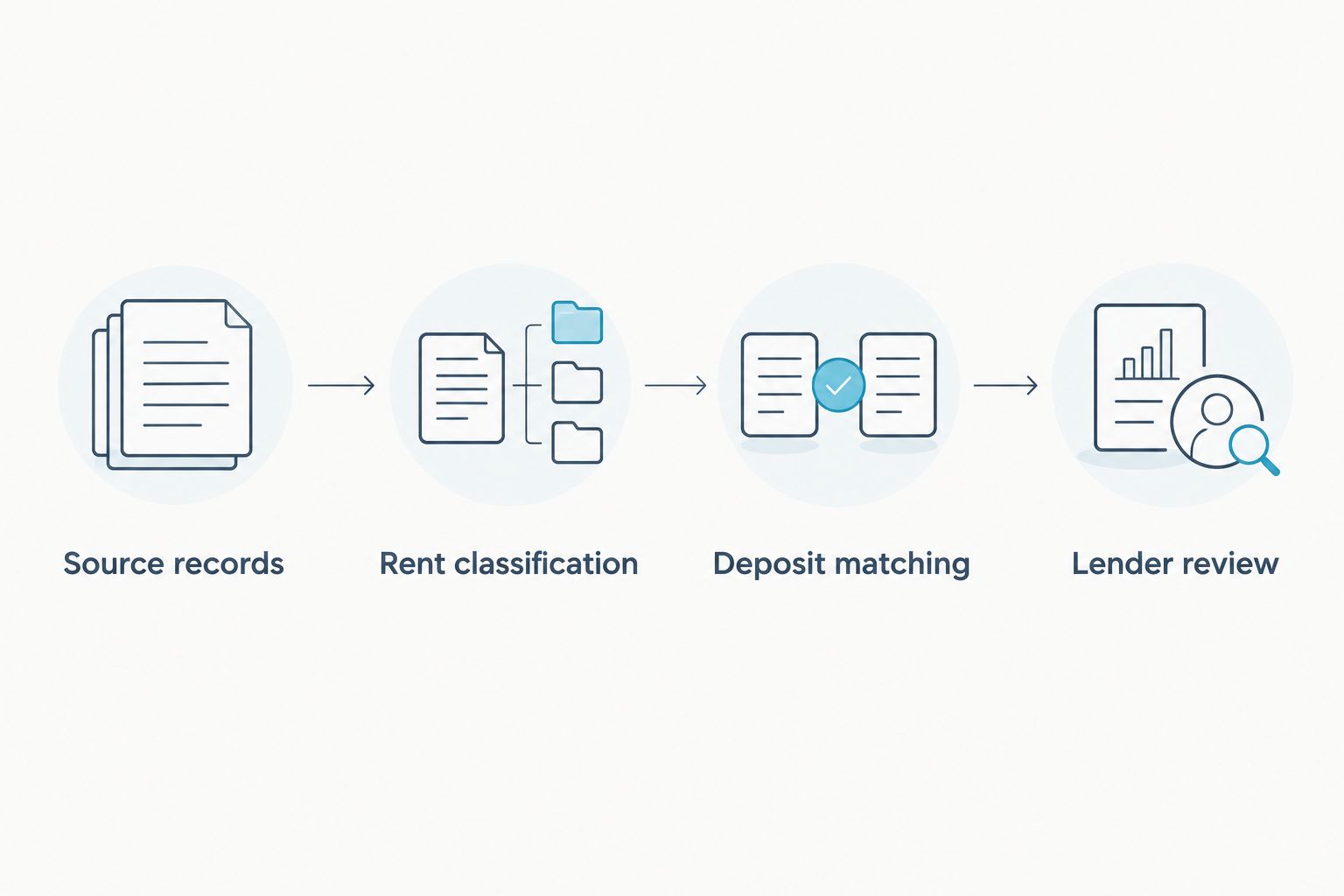
Payment history becomes easier to review when every receipt has a documented path to the bank.
Underwriting package setup
Separate your reconciliation from the lender’s decision
- Prepare a cover sheet listing the property, requested transaction, reporting period, current lease status, and unresolved exceptions. Identify your worksheet as borrower-prepared supporting material.
- Attach the original payment-history records, signed lease documents, relevant bank statements, and reconciliation. Preserve document page order and retain complete originals in your records.
- Ask the lender to confirm the qualifying rental-income source and the required denominator. Obtain the applicable proposed mortgage payment, property taxes, insurance, and association obligations rather than relying on the existing mortgage payment.
- Record the lender’s requested follow-up documents in a separate Conditions worksheet. Track each request through submission and confirmation of receipt.
Expected result: The lender receives a traceable evidence package, while the qualifying income and DSCR calculation remain subject to program underwriting.
A DSCR of 1.00x means the qualifying income equals the defined debt-service amount. It is a mathematical relationship, not a universal approval threshold. Credit, property eligibility, valuation, reserves, and other program requirements still matter.
For your 2026 file, confirm the calculation again if the proposed loan structure, insurance, taxes, or rental assumptions change. A clean payment history cannot correct a ratio calculated with the wrong inputs.
Discuss your DSCR financing
Review your property, rental documentation, and financing needs with Loanguys.
Update the package when rental activity changes
A second workflow is useful after the initial submission: refresh the evidence when a material transaction or lease change affects the file. This is an event-driven document update, not an automatic RentRedi-to-lender integration.
Choose the review method that fits your application stage. Neither method authorizes changes to original source documents.
Scheduled review
- Best for: Routine rental recordkeeping before an application
- Main advantage: Creates a consistent reconciliation habit
- Main limitation: Changes between reviews still need attention
Event-driven update
- Best for: An active loan file with new payments, reversals, or lease changes
- Main advantage: Addresses changes relevant to current underwriting
- Main limitation: Requires you to identify material changes promptly
For an event-driven update:
- Preserve the previously submitted package and create a dated revision.
- Add the new source record and update only the affected transactions or lease information.
- Recheck the deposit match and monthly summary, then describe the change on the cover sheet.
- Submit the revision through the lender’s designated channel and identify the earlier version it replaces.
Expected result: The reviewer can distinguish new evidence from the original submission without reconstructing the entire history.
During a 2026 application, ask whether the updated evidence changes qualifying income or simply satisfies a documentation request. Do not assume that every new collection increases the amount the lender will recognize.
Troubleshooting
The payment history and bank statement do not agree
Match the transactions before comparing totals. Check reporting boundaries, posting dates, combined deposits, deductions, and reversals. A difference needs an explanation tied to records, not a balancing entry created to make the worksheet agree.
The tenant paid several months together
Allocate the receipt to the periods it actually covers, supported by the lease and payment records. Preserve both the total receipt and the monthly allocation so the file does not imply a recurring monthly increase.
A security deposit appears in total receipts
Separate the deposit from rent in your reconciliation and retain the supporting lease provision or deposit record. Receipt of money does not, by itself, establish qualifying rental income.
A payment was recorded but later returned
Keep both the original activity and the reversal visible. Update the affected collection total, identify any replacement payment separately, and notify the reviewer if the earlier package included the returned amount.
The lender calculates a different DSCR
Request the lender’s qualifying income, debt-service components, and calculation basis. Compare those inputs with your worksheet before disputing the result; lease rent, collected rent, and appraiser-supported market rent are different evidence sources.
Customize your workflow
Expand the reconciliation by property, entity, or account without mixing unrelated receipts. For portfolio reporting, keep a consolidated index that points back to each property’s source documents rather than replacing property-level detail with a single portfolio total.
For an LLC-owned property, identify the owner, lease landlord, receiving account holder, and proposed borrower. Explain naming differences with supporting documents. The guide to DSCR loans for LLC-owned rental properties covers the related financing topic.
Loanguys offers DSCR and other mortgage programs, which makes a broker discussion useful when you need to evaluate a financing route. The limitation is equally important: choosing a mortgage broker does not replace your rent reconciliation, property documentation, or the lender’s underwriting requirements.
Keep the recordkeeping workflow separate from the credit decision. Use the payment history to explain rental activity, then ask which evidence the selected program actually uses to qualify the property.
FAQ
Can I use RentRedi payment history for a DSCR loan?
RentRedi payment history can form part of your supporting rental documentation, but the lender determines whether it meets the selected program’s requirements. Confirm the required reporting period, format, and supporting documents before preparing the package.
Does RentRedi connect directly to DSCR loan underwriting?
This workflow is a document handoff, not a direct RentRedi-to-lender connection. You gather records, reconcile the activity, and submit the evidence through the lender’s designated channel.
Is collected rent the same as qualifying rent for a DSCR loan?
Collected rent is not automatically qualifying rent. The loan program determines the acceptable income source and calculation, which can involve lease documentation or appraiser-supported rental evidence.
How many months of RentRedi payment history do I need?
Use the reporting period requested by the lender for the specific loan program. Do not assume a universal history requirement or substitute an arbitrary period for the requested coverage.
What if my RentRedi records do not match my bank deposits?
Prepare a transaction-level reconciliation explaining each difference. Check posting dates, grouped deposits, deductions, returned payments, and receipts associated with other properties.
Can Loanguys help with DSCR financing in 2026?
Loanguys offers DSCR loan programs as a mortgage broker serving real estate investors. Discuss the property and documentation requirements before treating a payment-history package as sufficient for underwriting.
Should I include security deposits when calculating rental income?
Keep security deposits separate from rent in your reconciliation. Ask the lender which income categories qualify rather than using total receipts as the rental-income figure.
One last thing
The most useful final check runs backward. Select a bank deposit, trace it to the payment record, then connect it to the correct property, rental period, and lease obligation. If that path breaks, fix the explanation before submitting another summary.


