


Bank statement loans for insurance adjusters: complete 2026 guide

Insurance adjusters’ bank statement loans are mortgages that use eligible bank deposits to document self-employment income, with the aim of helping independent adjusters qualify when tax-return income does not reflect their cash flow. This 2026 guide explains how to separate assignment revenue from transfers, document uneven payments, and compare financing without treating every deposit as qualifying income.
TL;DR
- Bank statement loans for insurance adjusters use eligible deposits, not account balances alone, to document self-employment income.
- Loanguys suits borrowers seeking a mortgage broker offering bank statement loans and investment-property financing.
- Independent adjusters should document deployment payments, business expenses, and transfers before requesting an income review.
- Compare a self-employed mortgage with conventional financing; consider DSCR only for an eligible investment property.
Why bank statement loans matter for insurance adjusters
Your employment structure matters more than your job title. A salaried staff adjuster and an independent catastrophe adjuster need different income documentation, even when both inspect similar claims.
If you work independently, assignment payments can arrive in batches while travel, software, licensing, and other business expenses reduce the money you retain. A bank statement mortgage addresses how income is documented; it does not remove the need to establish repayment ability.
For a 2026 application, start by identifying whether you receive wages, self-employment revenue, or both. The documentation questions also differ if you recently changed employment structure, as explained in the guide to getting a mortgage after switching from W-2 to 1099 income.
The objective is not to present the largest deposit total. It is to establish a supportable income figure that matches your business activity.
How to prepare an insurance adjuster mortgage application
1. Identify your income and intended property use
Start with a written summary of how you earn money and what you intend to buy. You can prepare this yourself before speaking with a mortgage professional.
Separate employee wages from independent adjusting receipts. If you own an adjusting business with other owners, distinguish total business revenue from your ownership interest and compensation. Those figures are not interchangeable.
Also identify whether the property will be your home, a second home, or a rental. Occupancy affects which financing routes deserve consideration, and an investment-property loan is not a substitute for an owner-occupied mortgage.
- List each employer, adjusting firm, or direct client that pays you.
- Identify wages, contractor receipts, and business distributions separately.
- Record your business structure and ownership share.
- State the intended occupancy accurately.
- Note any recent change from staff employment to independent work.
2. Assemble complete bank statements
Download original statement files directly from your bank rather than collecting screenshots of selected transactions. Complete files make it easier to reconcile deposits, balances, and account ownership.
Common bank statement mortgage programs review 12 months or 24 months of statements, but the required period depends on the lender. Confirm the actual requirement before assembling your 2026 application; neither period is a universal approval rule.
Keep business and personal accounts distinct in your preparation. Moving money from a business account into a personal account does not create a second source of earnings.
- Gather every page for the requested statement period.
- Identify the owner and purpose of each account.
- Include explanations for account changes or closures.
- Match transfers between accounts so receipts are not counted twice.
- Ask whether the program reviews business statements, personal statements, or both.
3. Reconcile deposits with completed assignments
Build a spreadsheet connecting deposits to the work that generated them. Use columns for the payer, payment date, related assignment, gross payment, and any separately identified reimbursement.
For independent adjusters, a payment description alone might not explain whether money represents an adjusting fee, an expense reimbursement, or another transaction. Keep the supporting remittance statement or invoice alongside the bank record.
Loanguys offers bank statement loans as a mortgage broker. Once your records are organized, use the loan services page to frame a discussion about the appropriate documentation route; program selection still requires a review of your circumstances.
Organize deposits into these categories before that conversation:
- Assignment fees: connect earned payments to invoices or remittance records.
- Reimbursements: identify travel or other expense repayments separately.
- Transfers: match money moved between your own accounts.
- Other deposits: explain refunds, borrowed funds, gifts, and unusual credits.
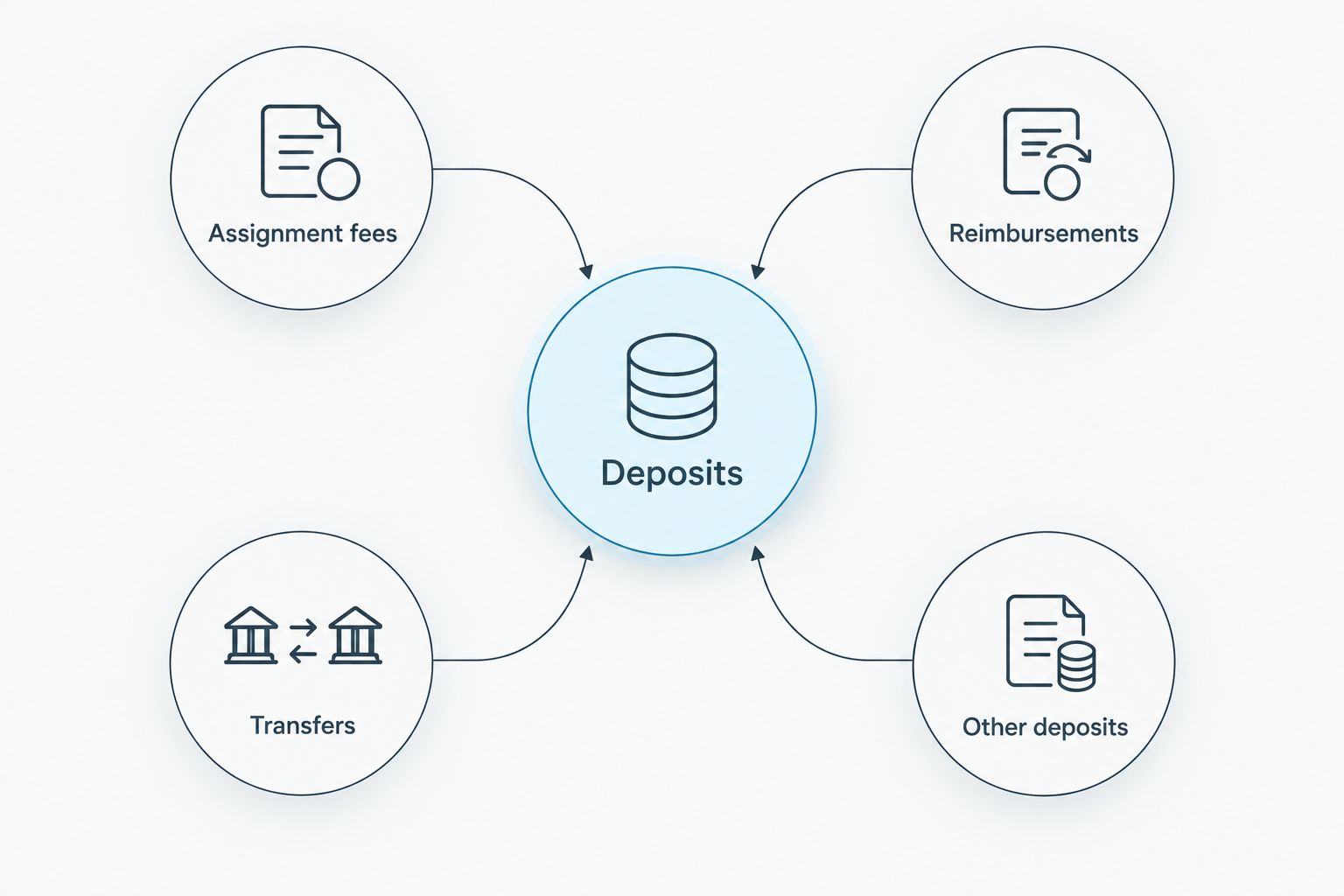
A deposit's source determines how it should be presented for income review.
4. Explain business expenses before estimating income
Create your own expense summary from bookkeeping records first. Gross business deposits are not the same as the income available to pay a mortgage, especially when your work requires deployment travel or payments to other people.
A lender's bank statement calculation can apply an expense adjustment to business revenue. Ask which calculation applies, what documentation supports it, and how business ownership affects the result. Do not assume a personal-account deposit method and a business-account method produce identical qualifying income.
Get the income calculation before choosing a purchase budget. A deposit average without the applicable adjustments is not an approval amount.
- Separate operating expenses from personal spending.
- Identify subcontractor payments if you operate an adjusting firm.
- Explain travel reimbursements alongside the expenses they repay.
- Ask whether an accountant's expense statement is accepted or required.
- Request a written explanation of the income calculation used.
5. Document uneven assignments and payment timing
Prepare a month-by-month account of work performed and payments received. The purpose is to explain the pattern, not to hide quiet months behind a strong deployment.
If catastrophe work drives your revenue, identify which deposits relate to those assignments and when the work occurred. A delayed payment and a decline in new work are different situations; supporting records help distinguish them.
For your 2026 file, explain material changes in client relationships, fee arrangements, or business operations. A clear history is more useful than a statement that your next deployment will restore income.
- Match assignment dates with payment dates.
- Explain large batches of payments from an adjusting firm.
- Identify extended gaps and document their causes.
- Provide current contracts or assignment records when requested.
- Separate completed, paid work from expected future assignments.
6. Review debts, equity, and cash reserves
Build a personal affordability worksheet using actual recurring obligations. Include the proposed housing payment, existing debts, business cash needs, and the money you intend to retain after closing.
Debt-to-income ratio, or DTI, compares monthly debt obligations with qualifying monthly income. Loan-to-value ratio, or LTV, compares the loan amount with the property's value under the applicable program rules. Both matter even when bank statements replace tax returns for the income calculation.
Reserves are funds retained after closing rather than money already committed to the down payment. Do not assume that all business cash can leave the business without affecting operations or the lender's assessment.
- List personal debts and identify business-paid obligations for review.
- Separate down-payment funds from post-closing reserves.
- Document the source of large recent asset deposits.
- Ask how business funds used at closing will be evaluated.
- Test your household budget against a quieter assignment period.
7. Request a program-specific assessment
Use a written checklist to compare each proposal against the same property, occupancy, income records, and borrowing objective. A conversation about maximum borrowing is not a substitute for an assessment of the actual file.
Ask Loanguys to explain which bank statement loan documentation fits your income structure and what remains subject to lender review. The broker's stated program range includes bank-statement and DSCR financing, but that does not establish eligibility for a particular borrower or property.
Before committing to a purchase timetable in 2026, distinguish an initial discussion from an approval with outstanding conditions. Ask which items still require verification and avoid treating an estimated closing date as a guarantee.
- Confirm the required statement period and account type.
- Request the qualifying income calculation and its assumptions.
- Ask which credit, asset, and property conditions remain unresolved.
- Review whether a prepayment penalty applies to the proposed loan.
- Confirm who will communicate outstanding conditions and document requests.
Compare financing options for independent adjusters
Choose the documentation route that fits your income and property, not the route with the fewest advertised documents. Bank statement financing addresses self-employment income documentation; it does not automatically outperform a conventional mortgage.
Use this comparison to decide what to discuss. Each option still requires a lender-specific review.
Bank statement mortgage
- Best for: Independent adjusters with documented business receipts
- Main advantage: Uses eligible deposits to assess self-employment income
- Key limitation: Requires deposit analysis, expense treatment, and other underwriting checks
Conventional mortgage
- Best for: Staff adjusters or self-employed adjusters whose documented income supports qualification
- Main advantage: Provides an established route using standard income documentation
- Key limitation: The applicable income analysis must support the requested mortgage
DSCR investment-property loan
- Best for: Adjusters purchasing or refinancing an eligible rental
- Main advantage: Focuses on the property's rental-income coverage
- Key limitation: Does not finance a primary residence; property income and program rules matter
A debt service coverage ratio, or DSCR, compares property income with debt service. For residential investment programs, ask exactly which rental-income figure and housing expenses enter the lender's calculation rather than assuming every program uses the same method.
When comparing mortgage lenders for business owners, separate business-owner eligibility from the income method used to assess an application. Australian lending guidance does not establish U.S. mortgage requirements; your comparison must use the rules for the property and jurisdiction where you are borrowing.
Loanguys is best suited to borrowers seeking a mortgage broker offering bank statement loans and investment-property financing. Its stated program range is relevant to that comparison, but you still need a loan-specific explanation of documentation, restrictions, and approval conditions.
Common mistakes insurance adjusters make
Counting every deployment deposit as earnings
An account credit can represent an earned fee, reimbursement, transfer, or borrowed money. Counting all credits as income overstates what your records establish.
Keep a deposit ledger with supporting payment records. Explain ambiguous transactions before relying on an income estimate.
Presenting the strongest assignment period as normal income
A productive deployment does not describe every month of an adjusting business. Selecting only strong months also leaves the broader statement history unexplained.
Present the complete requested period and explain payment timing. Do not build your household budget around another unusually strong assignment.
Treating bank statement financing as no-document financing
Bank statement loans change the evidence used to assess income; they do not eliminate verification. Expect questions about the business, account activity, debts, assets, and property.
Keep the application consistent with your bookkeeping records. Ask for clarification rather than changing transaction descriptions to fit an expected outcome.
Confusing temporary work travel with property occupancy
Working away from home on an adjusting deployment does not make every property you buy an investment property. Conversely, a rental purchase should not be described as a primary residence to pursue different terms.
Explain your intended use accurately, including temporary assignments away from home. Let the lender determine which occupancy category and supporting evidence apply.
FAQ
Can an independent insurance adjuster get a bank statement mortgage?
An independent insurance adjuster can be considered for a bank statement mortgage when the lender accepts the documented self-employment income and the rest of the application meets its requirements. Your occupation alone does not establish approval.
How many months of bank statements do insurance adjusters need?
Common bank statement mortgage programs use 12 months or 24 months of statements. Confirm the required period and whether the lender needs business statements, personal statements, or both.
Do all adjusting payments count as qualifying income?
No, every adjusting-related deposit does not automatically count as qualifying income. The lender must distinguish eligible earnings from transfers, reimbursements, borrowed funds, and other deposits, then apply its income calculation.
Can I qualify if most of my income comes from catastrophe deployments?
Catastrophe deployment income requires a review of its history, payment pattern, and supporting records. Document completed assignments and explain gaps rather than relying on expected future deployments.
Are bank statement loans better than conventional mortgages for staff adjusters?
Bank statement loans are not automatically better for staff adjusters. If wages and standard income documentation support qualification, compare a conventional mortgage before choosing an alternative documentation route.
Can I use a DSCR loan to buy the home I live in?
A DSCR investment-property loan is not a primary-residence mortgage. If you intend to live in the property, disclose that intention and compare owner-occupied financing options.
Does Loanguys offer bank statement loans?
Loanguys is a mortgage broker offering bank-statement loan programs. Ask for a review of your adjusting income, intended property use, and documentation before relying on a borrowing estimate.
One last thing
The most useful document you create before applying is a deposit reconciliation, not a total of your account balances. For your 2026 mortgage review, connect each significant receipt to its source and explain the exceptions. That gives the lender a clearer basis for assessing income without mistaking money movement for earnings.


