


Bank statement loans for NIL college athletes: complete 2026 guide

NIL college athlete bank statement financing is a mortgage approach that uses eligible account deposits to evaluate income, with the aim of financing a property when traditional income documentation does not tell the full story. For athletes earning name, image, and likeness income, the central questions are whether those earnings qualify, how much remains after business expenses, and whether the income can continue.
TL;DR
- Bank statement loans for NIL college athletes require lender acceptance of the income, not just evidence of deposits.
- Loanguys offers bank statement loans; athlete eligibility requires a review of the specific borrower and property.
- Separate endorsement revenue from transfers, gifts, reimbursements, and borrowed funds before estimating qualifying income.
- Compare a bank statement mortgage with conventional financing for a home and DSCR financing for an eligible rental.
Why bank statement financing matters for NIL college athletes
A large NIL agreement is not the same as mortgage-qualifying income. An underwriter needs to understand what you earned, what you spent to earn it, and what supports continued payments. A headline contract value does not answer those questions.
For a 2026 purchase, distinguish independent endorsement activity from employment compensation and other payments. Do not assume every payment connected to college athletics receives the same mortgage treatment.
Loanguys offers bank statement mortgage programs alongside other property-financing options. Loanguys is best suited to borrowers seeking mortgage-broker guidance on bank statement loans. That service is not evidence that a particular NIL income source qualifies.
The practical advantage of bank statement underwriting is an alternative way to document eligible income. The limitation is equally important: bank statements do not remove credit, repayment-capacity, property, or income-continuity requirements.
How to prepare for a bank statement mortgage
Define how you will use the property
Start by writing down who will live in the property and how you expect to use it. A home near campus, a second home, and a rental investment are different financing cases; proximity to your school does not determine occupancy.
Choose the financing around the actual property use, not the easiest application. If you intend to live in the property, say so. An investment-property DSCR loan, which evaluates rental income against debt obligations, is not a substitute for an owner-occupied mortgage.
Think beyond the current season. A transfer or graduation does not automatically decide your financing options, but it belongs in your housing plan. If your plans change during the application, tell the lender before closing.
- Write a plain-language occupancy statement.
- Identify whether you are buying or refinancing.
- Describe any planned rental use.
- List possible relocation triggers, including transfers and graduation.
- Ask which programs permit your intended use.
Separate NIL earnings from other deposits
Download complete statements and build a deposit ledger yourself before requesting an income calculation. Match each business receipt to an agreement, invoice, payment notice, or platform record. Screenshots of a balance do not explain where the money came from.
Separate recurring sponsorship payments from appearance fees, content revenue, and one-time campaigns. Identify transfers between your accounts so the same earnings do not appear twice in your estimate.
For ongoing organization, consider 2 separate accounts: a business account for NIL activity and a personal account for household spending. This is a recordkeeping recommendation, not a lender eligibility requirement. Moving money now does not rewrite earlier transaction history.
- Record each payer and payment date.
- Match deposits to supporting documents.
- Flag transfers, gifts, refunds, and borrowed funds.
- Identify business expenses and agent deductions.
- Keep original statements with every page intact.
Confirm how the lender calculates eligible income
Use your ledger to ask precise questions before choosing a property budget. Does the program accept your type of NIL activity? What operating history and statement period does it require? How does it evaluate irregular payments and agreements nearing expiration?
Ask the lender to explain its treatment of business expenses, account ownership, and revenue routed through an entity. Gross deposits are not automatically spendable income or qualifying income. Payments to agents, production teams, and other business providers belong in the discussion.
Loanguys offers bank statement loans, making a broker conversation relevant after you have organized the basic records. The limitation is that the program offering alone does not establish NIL eligibility, an income calculation, or approval.
For additional preparation, review how much income you need to qualify for a bank statement loan.
- Request the required statement period in writing.
- Confirm whether personal or business statements apply.
- Ask how expenses affect eligible deposits.
- Disclose business ownership and payment-routing arrangements.
- Request an explanation of income exclusions.
Document what happens when agreements end
Create a contract summary rather than expecting the underwriter to reconstruct your business from separate files. Include the payer, services, payment schedule, expiration date, and cancellation terms. Distinguish signed obligations from discussions about future sponsorships.
For your 2026 application, explain any known change involving your school, eligibility, sport participation, or business activity that affects the income you want considered. Ask the lender which supporting documents it needs; do not label an agreement guaranteed unless its terms support that description.
Have your agent or attorney explain unclear contract provisions. A mortgage broker evaluates financing options; contract interpretation and tax planning belong with the appropriate professionals.
- Prepare a summary for each active agreement.
- Highlight expiration and termination provisions.
- Separate completed campaigns from ongoing work.
- Document payment delays and disputes.
- Disclose known changes affecting future receipts.
Build a budget that survives uneven payments
Use a spreadsheet to map 12 monthly columns of expected cash inflows and household outflows. This is a planning exercise, not a statement-history requirement. Include housing payments, taxes, insurance, maintenance, business spending, and money reserved for tax obligations.
Your affordable payment is not necessarily the lender's maximum approved payment. NIL receipts can arrive on a different schedule from a monthly mortgage obligation. A cash balance needs to cover the gaps without treating tax reserves as money available for everything else.
Review 3 planning scenarios: expected receipts, a delayed sponsorship payment, and no renewal from your largest payer. These are stress tests, not predictions. Adjust your purchase budget if a missed payment forces you to rely on another unsigned agreement.
- Separate closing funds from ongoing living reserves.
- Budget for property expenses beyond the mortgage.
- Keep business obligations in the cash-flow forecast.
- Ask a tax professional about estimated tax planning.
- Test the loss or delay of a major payment source.
The preparation sequence is straightforward: establish the property use, explain the deposits, confirm the income calculation, and test the budget. A larger bank balance does not replace any of those decisions.
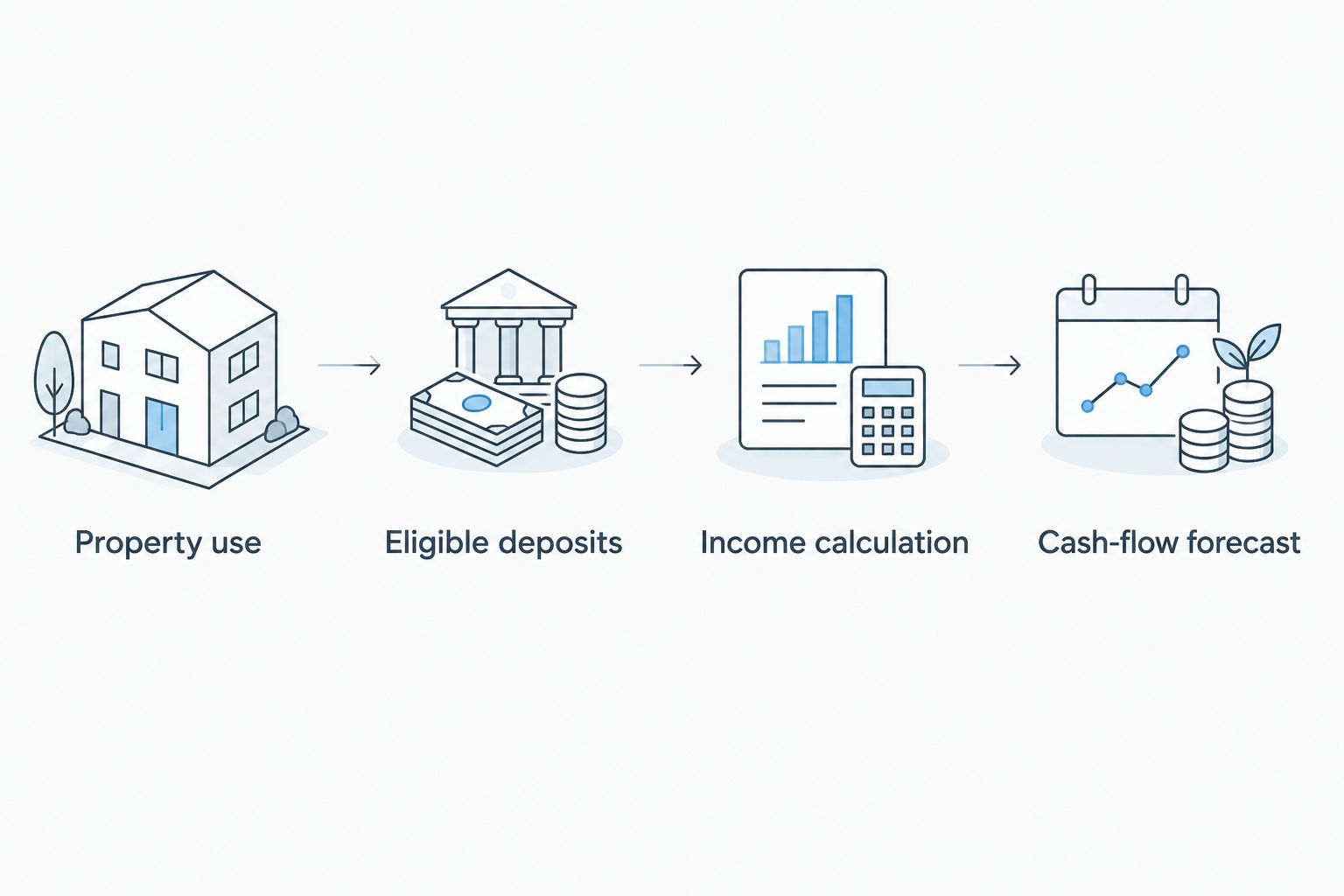
Confirm the income calculation before setting your property budget.
Compare written financing terms before committing
Create a side-by-side worksheet yourself and ask each financing provider to explain unresolved differences. Compare the same occupancy, transaction, and property assumptions. Otherwise, apparent differences can reflect different applications rather than different offers.
Your 2026 comparison should cover the loan structure, payment changes, required reserves, documentation conditions, and any prepayment restrictions. Ask whether the initial review is preliminary or whether an underwriter has reviewed your income documents.
Do not treat a conversation about possible financing as an unconditional commitment. Before making contractual promises, coordinate financing deadlines and contingencies with your real estate and legal advisers.
- Request written terms and outstanding conditions.
- Confirm fixed or adjustable payment features.
- Ask about balloon payments and prepayment restrictions.
- Identify remaining appraisal and property requirements.
- Confirm what must happen before final approval.
Compare mortgage options for NIL college athletes
Choose the option that matches both your documentation and your occupancy. Bank statement financing addresses an income-documentation problem; it does not solve every financing problem an athlete faces.
Bank statement mortgage
- Best for: Borrowers with eligible self-employed NIL income supported by account records
- Main advantage: Provides an alternative way to document qualifying income
- Key limitation: Deposits require analysis; limited history or uncertain continuation remains a concern
Conventional mortgage
- Best for: Borrowers whose documented income meets conventional underwriting requirements
- Main advantage: Uses a standard mortgage qualification route
- Key limitation: NIL income still needs acceptable documentation and treatment
DSCR investment-property loan
- Best for: Investors purchasing an eligible rental rather than a personal residence
- Main advantage: Focuses on the rental property's income relative to debt obligations
- Key limitation: Does not finance a primary residence; rental and property requirements still apply
Delay the purchase
- Best for: Athletes whose income history or housing plans remain unsettled
- Main advantage: Allows time to strengthen records and clarify future obligations
- Key limitation: Postpones ownership and does not guarantee later approval
A conventional review belongs in the comparison even if you first searched for bank statement loans. Alternative documentation is useful when it solves your actual obstacle, not simply because your earnings are unconventional.
For a rental investment, ask how the lender establishes rent and calculates debt-service coverage ratio, or DSCR. Do not assume your intended rent or NIL earnings alone establish rental-loan eligibility.
Common mistakes NIL college athletes make
Treating a contract announcement as an income record
A public announcement does not establish the amount paid, your business expenses, or the lender's acceptable income calculation. Submit the executed agreement and payment trail instead. Keep projected renewals separate from money already earned.
Counting every account credit as earnings
A transfer from savings, family contribution, or borrowed amount can increase your balance without increasing qualifying income. Label those transactions before submitting the file. Ask separately whether documented non-income funds qualify for the purpose you intend.
Ignoring what happens after a transfer
A housing decision and an endorsement agreement can both depend on circumstances that change when you move schools. Review the actual terms rather than assuming a transfer ends every agreement or leaves every agreement untouched. Explain known changes promptly.
Using rental financing for a personal home
Buying near campus does not make a property an investment if you intend to occupy it. State your plans accurately from the beginning. A program with a different occupancy requirement is not a workaround for an income-documentation issue.
Shopping only after signing a purchase contract
A short deadline does not make a new income source acceptable to an underwriter. Get an initial eligibility review before relying on financing in a purchase negotiation. Ask exactly which questions remain unresolved.
FAQ
Can college athletes get a mortgage using NIL income?
NIL income can support a mortgage application when it meets the lender's requirements for acceptable, documented income. College-athlete status and a signed sponsorship agreement do not establish approval by themselves.
Are bank statement loans for NIL college athletes a separate loan program?
Do not assume an athlete-specific program exists because a lender offers bank statement mortgages. Ask whether the lender accepts your particular NIL activity, income history, and property use under its existing guidelines.
How many bank statements do I need for an NIL mortgage?
The required statement period depends on the lender and program. Obtain the requirement before applying, and provide complete statements rather than selected pages or balance screenshots.
Does every NIL deposit count as mortgage income?
No, an account deposit is not automatically qualifying mortgage income. The lender evaluates eligible business receipts, expenses, transfers, and other deposits under its underwriting rules.
Can I qualify with a newly signed endorsement deal?
A newly signed endorsement deal does not establish mortgage qualification by itself. Ask how the lender evaluates income history, payment evidence, contract terms, and expected continuation.
Can I use a DSCR loan for the home I live in near campus?
No, an investment-property DSCR loan is not financing for your primary residence. Tell the lender how you will occupy the property and request a program that permits that use.
Does Loanguys offer bank statement loans for athletes?
Loanguys offers bank statement mortgage programs, but athlete-specific eligibility requires a review. Ask whether your NIL income sources, documentation history, and intended property qualify.
One last thing
For a 2026 purchase, prepare a payer-dependence list before deciding how much house to buy. Put your largest NIL payer first, then record its agreement end date and what happens to your monthly budget without that income.
The most useful question is not just whether your deposits qualify, but whether the payment still fits when a major agreement ends. Bring that answer to the financing discussion alongside your statements.


