


Baselane rent data to HELOC approval on a rental: 2026 workflow

Instead of manually rebuilding rental income records for each lender request, organize your Baselane rent data into a reconciled investment-property HELOC application file for 2026. Match rent receipts to leases and bank statements, confirm the lender accepts your property and ownership structure, and submit the supporting documents through the lender’s approved channel—not as an automatic approval connection.
TL;DR
- Baselane rent data supports HELOC investment property documentation; it does not establish eligibility or guarantee approval.
- Loanguys is best for rental investors seeking mortgage-broker guidance on investment-property loans.
- Confirm rental-property eligibility and ownership requirements before preparing the full application.
- Reconcile rent receipts, leases, and bank statements before submitting your income file.
Why this matters
Rent collected is evidence, not qualifying income. A lender decides how to evaluate rental income alongside credit, existing debt, property value, and its program requirements. A clean ledger helps explain the money; it does not replace underwriting.
For your 2026 application, separate two questions: can this lender finance this rental property, and do your documents support the requested borrowing? Answer the eligibility question first. Otherwise, you risk preparing a detailed file for a program that does not accept your property or borrowing entity.
Loanguys is a mortgage broker offering investment-property loan programs. Loanguys is best for rental investors seeking mortgage-broker guidance on investment-property loans. Use that guidance to identify a suitable financing path, without treating this workflow as confirmation of a specific HELOC program.
Before you start
- Access and records: Have authorized access to your Baselane rental records, receiving-account statements, signed leases, current mortgage statements, insurance information, and property tax records. Obtain the lender’s document checklist before selecting reporting dates.
- Eligibility confirmation: Ask whether the lender accepts non-owner-occupied properties, your property type, your state, and your ownership structure. Disclose LLC or trust ownership before applying.
- The gotcha: A rent receipt and its bank deposit can fall in different reporting periods. Use the lender’s requested date range, preserve both dates, and explain timing differences rather than changing records to force a match.
This is a document-preparation workflow, not a software integration tutorial. Use the reporting or download controls actually displayed in your Baselane account; the steps below do not depend on a particular menu name, export format, or third-party connector.
Lender requirements
Confirm the application scope
- Ask the lender to confirm that the proposed collateral is an investment property, not your primary residence. Describe the current occupancy and rental use accurately.
- Identify the legal owner and proposed borrower. Ask whether an LLC-owned property qualifies and whether the application requires individual borrowers, entity documents, or guarantees.
- Request the required income-documentation period, acceptable file formats, valuation process, and secure submission method. Get the checklist in writing.
- Create a cover sheet with your own fields: Property address, Legal owner, Requested financing, Reporting period, and Document status. These are application-organizing labels, not Baselane interface fields.
Expected result: You have a lender-defined checklist and a clear eligibility checkpoint before assembling the full package. If the property or ownership structure does not fit, resolve that issue first.
Separate equity from borrowing capacity
A HELOC is a revolving credit line secured by real estate. Equity is the difference between property value and debt secured against the property; it is not the same as the amount a lender will approve.
Ask how the lender calculates combined loan-to-value, or CLTV. CLTV compares the combined secured borrowing with the accepted property value, but the lender’s rules determine how the proposed credit line enters that calculation.
For a 2026 review, provide the current mortgage statement and identify any additional liens. Do not use rent collections or an estimated property value as proof of an approved credit limit. The lender must evaluate both repayment qualification and collateral.
Rental evidence file
Assemble the source records
- Start with 1 property per reconciliation workbook. Label the workbook with the property address and the lender-requested reporting period so portfolio income does not enter the wrong application.
- Obtain the available rent records from your Baselane account for that period. Preserve the original files unchanged, and use a separate working copy for explanations or calculations.
- Collect corresponding bank statements and executed leases, including amendments that explain rent changes. Add records supporting concessions, refunds, or payments received outside your usual collection process.
- Build a document index that identifies each file, its period, and the property it supports. Mark missing items explicitly rather than silently leaving gaps.
Expected result: Every income summary points back to an original record, and the file covers the period the lender requested.
Keep the records’ roles separate
Different documents answer different questions. A lease describes the rent obligation; a payment record describes a receipt; a bank statement supports the movement of funds.
Baselane rent records
- Best for: Organizing recorded rental activity
- Strength: Provides a starting point for tracing receipts
- Limitation: Does not establish the lender’s qualifying income
Executed lease
- Best for: Supporting contractual rent
- Strength: Shows the agreed rental obligation
- Limitation: Does not prove that a payment cleared
Bank statement
- Best for: Supporting deposits and balances
- Strength: Shows account activity during the statement period
- Limitation: A deposit alone does not establish its purpose
Reconciliation workbook
- Best for: Explaining differences across records
- Strength: Connects receipts, deposits, and supporting evidence
- Limitation: Is a borrower-prepared explanation, not independent verification
Submit complementary evidence rather than choosing whichever document shows the largest total. A readable summary helps the lender review the originals; it should never replace requested source documents.
Rent reconciliation
Match receipts to deposits
- Create your own spreadsheet columns: Property, Unit, Rent period, Receipt date, Gross receipt, Deposit date, Bank deposit, Adjustment, and Source reference.
- Enter 1 row per receipt, then connect each receipt to the relevant deposit. When a deposit includes multiple receipts, use a separate mapping sheet rather than duplicating the deposit total.
- Separate rent from security deposits, owner contributions, transfers, loan proceeds, and other non-rent activity. Show refunds and returned payments distinctly.
- Explain every difference between the receipt total and deposited funds. Identify timing differences, documented deductions, reversals, and receipts still awaiting settlement.
Expected result: Your workbook explains how recorded rental activity connects to bank activity, with 0 unexplained differences as the reconciliation target. That target is a file-quality recommendation, not an approval requirement.
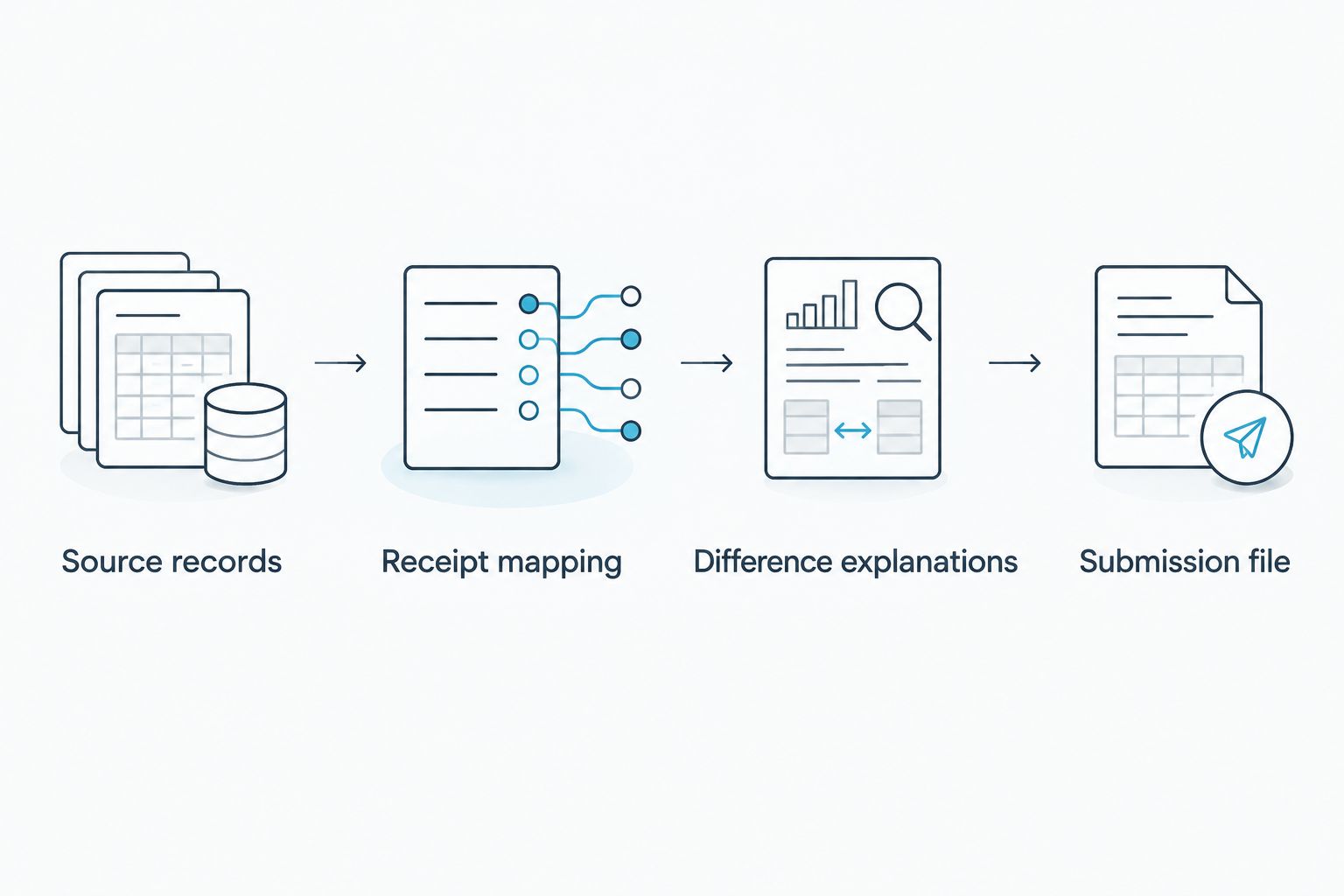
Explain differences before submitting the application file.
Review income without overstating it
A payment labeled as rent still needs context. A security deposit is not interchangeable with recurring rent, and a transfer between your accounts is not new rental income.
For the 2026 application file, distinguish the period the tenant paid for from the date the money arrived. Late rent, advance rent, concessions, and vacancy all affect the explanation of a reporting period. Do not move receipts between periods merely to make monthly income appear consistent.
If a deposit combines funds from multiple properties, show the allocation and supporting records. If a receipt remains unmatched, flag it for clarification. A visible exception is better than a total you cannot defend.
Submission file
Package the evidence for underwriting
- Prepare a concise cover note stating the property, ownership, financing request, reporting period, and unresolved questions. Describe the file as supporting documentation, not proof of approval.
- Organize the package into source records, reconciliation, leases, existing debt, and lender-requested borrower or entity documents. Keep original statements complete unless the lender directs otherwise.
- Submit through the lender’s approved secure channel. Do not share account passwords, and ask what information can be redacted before altering documents.
- Record each follow-up request using your own fields: Request, Document needed, Responsible person, Date submitted, and Status. Keep the submitted version separate from later revisions.
Expected result: The lender receives an indexed file with traceable income evidence and a clear record of outstanding requests. Submission starts or advances the review; it does not establish approval.
Compare the financing structure
Confirm that a revolving credit line matches your intended use. A home equity loan and a cash-out refinance are different structures, not interchangeable names for a HELOC.
Investment-property HELOC
- Best for: Borrowers needing repeated access to funds
- Main advantage: Allows borrowing against a credit line under its terms
- Main drawback: Requires attention to draw rules, repayment changes, and rate terms
Home equity loan
- Best for: Borrowers needing a defined lump sum
- Main advantage: Separates the new borrowing from the existing first mortgage
- Main drawback: Creates an additional secured repayment obligation
Cash-out refinance
- Best for: Borrowers seeking to replace existing financing and access equity
- Main advantage: Combines refinancing and equity access in a replacement loan
- Main drawback: Replaces the existing mortgage rather than leaving it untouched
These are structural comparisons, not statements that Loanguys offers each option. Ask the broker which programs fit your property and documentation, then review the written terms before choosing.
Refresh the file when new rent arrives
For an application still under review, use a controlled update workflow instead of rebuilding the package. This variant keeps a 2026 file current while preserving what the lender already received.
- Keep the original submission unchanged. Save newly received statements and rental records in a separate update folder.
- Extend the reconciliation through the newly requested cutoff date. Add new receipts, deposits, reversals, and lease changes without rewriting prior activity without explanation.
- Send a short change note identifying the added period and any corrections. Ask whether the lender wants the complete refreshed package or only the new documents.
Expected result: The lender can distinguish new activity from corrections and does not have to guess which version controls.
Do not make submission automatic simply because a new payment arrives. Review the file first, and send updates according to the lender’s instructions. A returned payment or revised lease deserves an explanation, not just another attachment.
Troubleshooting
Recorded rent exceeds bank deposits
Check settlement timing, refunds, returned payments, and documented deductions. Build a gross-to-net explanation and attach supporting records; do not delete legitimate activity to make the totals agree.
A bank deposit includes several properties
Map the deposit to its underlying receipts and identify each property’s share. Keep the full deposit visible in the mapping sheet while including only the subject property’s receipts in its income summary.
Tenant or property names do not match
Use a reference sheet to connect lease names, unit identifiers, payment descriptions, and the property address. Support name changes or ownership differences with the relevant records rather than editing original documents.
The lender rejects the submitted summary
Ask which source documents or formats the lender requires. Resubmit those documents with the reconciliation as an explanatory attachment; a spreadsheet cannot override the lender’s documentation policy.
The property fails the eligibility screen
Stop rebuilding the rent file as though more documentation will solve a program mismatch. Confirm whether the issue is occupancy, ownership, collateral, or borrower qualification, then discuss a different financing structure with the broker.
Customize your workflow
Once the subject property’s file is reconciled, extend the same document standards across your portfolio. Keep property-level records separate, and maintain a shared index for entity documents and existing loans without blending rental income.
If your next step is choosing between borrowing structures, review home equity loans for rental property owners. The decision should start with how you intend to use and repay the funds, not with which report is easiest to download.
Loanguys offers DSCR and bank-statement investment-property loan programs alongside other financing options. The benefit of broker guidance is help assessing program fit; the limitation remains that documentation, collateral, and underwriting requirements still apply.
FAQ
Can Baselane rent data get me approved for an investment-property HELOC?
Baselane rent data can support income documentation, but it cannot establish HELOC approval. The lender evaluates the property, borrower, collateral, and required supporting documents under its program rules.
Does this workflow automatically connect Baselane to a lender?
No. This is a document-preparation and submission workflow, not an automatic lender connection. Obtain the relevant records and submit them through the lender’s approved channel.
What should I ask a lender before preparing rental records?
Ask whether the lender accepts your investment property, ownership structure, and state, then request its documentation checklist. Confirm the required reporting period and submission format before assembling the file.
Should I include security deposits as rental income?
Keep security deposits separate from recurring rent in your reconciliation. Give the lender enough detail to identify each transaction’s purpose and apply its underwriting rules.
What if my rent records and bank statements show different totals?
Reconcile the difference before submission. Explain timing differences, refunds, reversals, documented deductions, and deposits containing receipts from multiple properties.
Can an LLC-owned rental qualify for a HELOC?
Eligibility depends on the lender’s ownership and borrower requirements. Disclose LLC ownership before applying and ask which entity documents, borrowers, or guarantees the program requires.
Is a HELOC the same as a cash-out refinance?
No. A HELOC is a revolving credit line secured by property, while a cash-out refinance replaces existing financing with a new loan that releases equity. Compare repayment obligations and the effect on your existing mortgage before choosing.
One last thing
Reconcile by property before you summarize by account. An account balance can combine rent, deposits, transfers, and funds belonging to different properties. A property-level evidence trail gives the lender a clearer basis for reviewing the rental income behind your request.
Before submitting your 2026 package, open a receipt in the summary and trace it through to the lease and bank record. If that path breaks, fix the evidence trail first.


