


Best construction loan lenders in 2026

Best for investor rehab and bridge financing: Loanguys, a mortgage broker rather than a direct construction lender. Best for a primary-home build: a construction-to-permanent lender; best for a spec home: a specialist construction lender—the best construction loan lenders in 2026 depend on what you are building and how you will repay the loan.
TL;DR
- The best construction loan lenders match your occupancy, construction scope, draw needs, and repayment plan.
- Loanguys is best suited to investors comparing fix-and-flip, bridge, and rental financing—not an assumed ground-up construction approval.
- Choose construction-to-permanent financing for a primary home when the conversion conditions fit your plans.
- Compare written draw procedures and completion requirements before committing to a construction lender.
Why this matters
A loan for renovating an existing rental is not interchangeable with financing for building a home on vacant land. Your lender must approve the actual work, not just the finished property's intended use.
Choose the financing structure before choosing the lender. Otherwise, you risk comparing proposals that fund different expenses, require different cash contributions, or leave you needing another loan after construction.
This 2026 shortlist ranks financing routes by use case, not named lenders by unverified rates or approval claims. It separates investor alternatives from dedicated construction financing so you can ask the right questions before submitting an application.
What makes the best construction loan lenders?
Use these six criteria to screen a lender before discussing an application:
- Project eligibility: Confirm ground-up construction, renovation, teardown, or expansion explicitly. Approval for one does not establish approval for another.
- Occupancy fit: Distinguish your primary residence from a speculative sale, rental property, or commercial development.
- Funding mechanics: Establish which expenses qualify, when you contribute equity, and how construction draws are released.
- Builder acceptance: Ask what contractor experience, licensing, insurance, and financial documentation the lender requires.
- Completion rules: Identify the construction deadline, inspection requirements, change-order process, and extension provisions.
- Repayment fit: Match the loan to a sale, permanent mortgage conversion, or separately underwritten refinance.
A lender that fails the first two criteria belongs off your shortlist, regardless of its other features. For your 2026 comparison, request written answers rather than relying on a general statement that the lender handles real estate loans.
Construction financing options at a glance
1. Loanguys, mortgage broker
- Best for: Investors comparing rehab, bridge, and rental financing
- Standout feature: Offers fix-and-flip, bridge, DSCR, and bank-statement programs
- Key limitation: Those programs do not establish ground-up construction eligibility
2. Construction-to-permanent lender
- Best for: Building your primary residence
- Standout feature: Connects construction financing with a permanent mortgage
- Key limitation: Conversion depends on the agreement's completion and qualification conditions
3. Community bank construction lender
- Best for: A custom home requiring local project review
- Standout feature: Direct discussion of the site, builder, and construction plan
- Key limitation: Project acceptance and permanent financing must be confirmed
4. Private construction specialist
- Best for: Building a spec home for resale
- Standout feature: A construction proposal organized around the project and sale exit
- Key limitation: A missed sale deadline creates repayment risk
5. Commercial construction lender
- Best for: Ground-up multifamily or commercial development
- Standout feature: Development underwriting covering construction and operating assumptions
- Key limitation: Documentation extends beyond an ordinary residential mortgage
1. Loanguys: best for investor rehab financing comparisons
Loanguys offers DSCR, fix-and-flip, bridge, bank-statement, and short-term rental loan programs. That makes the broker relevant when you are improving an existing investment property or comparing financing for its next stage.
Loanguys is best for investors comparing fix-and-flip, bridge, and rental loan programs. For construction financing, first establish whether your proposed work falls within an eligible program; do not treat a renovation loan as permission to build from the ground up.
Loanguys pros:
- Includes fix-and-flip financing among its stated programs.
- Includes bridge financing for a separate financing discussion.
- Offers rental financing programs relevant to a potential hold strategy.
Loanguys cons:
- Is a mortgage broker, not the direct construction lender in this comparison.
- Its stated programs do not confirm eligibility for your specific ground-up project.
Best for: An investor deciding between renovating and selling, bridging a property transition, or retaining a completed rental.
Verdict: Hold on a ground-up construction decision until the exact scope and funding structure are confirmed; consider the broker for the investor programs it explicitly offers.
2. Construction-to-permanent lenders: best for primary-home builds
Construction-to-permanent financing connects the building phase with a long-term mortgage. A single-close structure uses 1 loan closing; a separate construction loan and permanent mortgage involve 2 loan closings.
The distinction is contractual, not just administrative. Ask whether completion triggers a conversion under an existing agreement or requires another approval, and identify which borrower conditions must still be satisfied.
Construction-to-permanent lender pros:
- Connects the construction plan to a permanent financing structure.
- Gives you conversion conditions to evaluate before building.
- A single-close structure avoids arranging a separate loan closing for the permanent phase.
Construction-to-permanent lender cons:
- Conversion still depends on satisfying the agreement.
- Builder, property, and occupancy restrictions require review.
Best for: A borrower building a primary residence and planning to keep it.
Verdict: Buy this structure when the written conversion terms fit your homebuilding plan. Do not assume a product described as single-close has no remaining completion conditions.
3. Community bank lenders: best for locally reviewed custom homes
A community bank with a construction lending program is a candidate when you want a direct discussion about a particular site and builder. Ask the bank to evaluate the lot, construction contract, and intended occupancy together.
The bank's proximity does not establish project acceptance. Your shortlist should include only institutions that explicitly finance your construction type in the property's location.
Community bank lender pros:
- Offers a route to discuss a specific local construction project.
- Lets you address land financing and building costs in the same proposal.
- Provides an opportunity to clarify who handles construction administration.
Community bank lender cons:
- A local branch does not prove construction lending capability.
- Permanent financing requires confirmation rather than assumption.
Best for: A custom-home borrower seeking project-specific review from a bank serving the property's area.
Verdict: Buy a place on your shortlist only after confirming project eligibility, builder acceptance, and the permanent financing plan.
4. Private construction specialists: best for spec-home sales
A spec home is built for sale rather than for a committed owner-occupant. Evaluate a specialist construction lender against that sale-based repayment plan, including what happens if the property remains unsold at maturity.
Ground-up experience matters here. A lender handling acquisition or renovation loans is not automatically equipped to fund site work and a complete new build.
Private construction specialist pros:
- Provides a financing route to evaluate specifically for construction and resale.
- Allows a direct review of the build budget against the proposed sale exit.
- Gives you draw and completion provisions to compare across proposals.
Private construction specialist cons:
- Repayment depends on completing the project and executing the exit.
- Extension rights and personal guarantees require careful review.
Best for: An investor building a home for resale with a documented construction budget and exit plan.
Verdict: Buy only when the lender expressly accepts ground-up spec construction and the agreement addresses delays. Skip any proposal that leaves those questions unanswered.
5. Commercial construction lenders: best for larger developments
Commercial construction financing belongs on the shortlist for multifamily or commercial development. The underwriting examines the development itself, including the budget, sponsor, completion plan, and proposed operating or sale outcome.
Treat a build-to-rent project as both a construction problem and a future financing problem. Completing the buildings does not establish that a separate permanent lender will accept the property's income or occupancy profile.
Commercial construction lender pros:
- Fits a development-level financing discussion.
- Brings construction scope and operating assumptions into the same review.
- Allows you to address lease-up and permanent debt requirements before building.
Commercial construction lender cons:
- Requires development documentation beyond a household mortgage application.
- Lease-up and permanent financing create risks after physical completion.
Best for: A developer planning multifamily, build-to-rent, or commercial construction.
Verdict: Buy this route when the lender accepts the development type and the repayment plan accounts for both completion and occupancy.
Compare cash requirements before comparing approvals
For a 2026 construction project, separate the lender's equity requirement from the cash you need to keep work moving. Ask whether land equity receives credit, whether you must contribute funds before draws begin, and whether completed work is reimbursed rather than funded in advance.
Loan-to-cost, or LTC, compares the loan amount with the eligible project cost. Loan-to-value, or LTV, compares the loan amount with the value used by the lender; those denominators are different, so the same percentage does not describe the same financing commitment.
A lender financing less than 100% of eligible project costs leaves an equity contribution to cover. You also need to identify expenses outside the eligible budget rather than assuming the loan covers every payment connected with the project.
The distinction matters across jurisdictions: construction loan down payment requirements discussed for Australian borrowing do not establish a U.S. lender's equity rules. For a U.S. project, use the actual lender's written treatment of land equity, eligible expenses, and borrower contributions.
Check how the draw process works
A construction commitment is not the same as cash released to your contractor. Draws are staged disbursements, and your agreement determines what evidence the lender needs before releasing them.
Map the process before signing. The county permits to construction loan draw schedule workflow connects the permitting and funding questions you need to resolve with the construction team.
- Budget approval: Confirm the approved scope and eligible expenses.
- Equity contribution: Establish when your funds enter the project.
- Work verification: Identify inspection and supporting-document requirements.
- Draw release: Confirm the release conditions and payment recipient.
- Final completion: Identify remaining inspections and withheld funds.
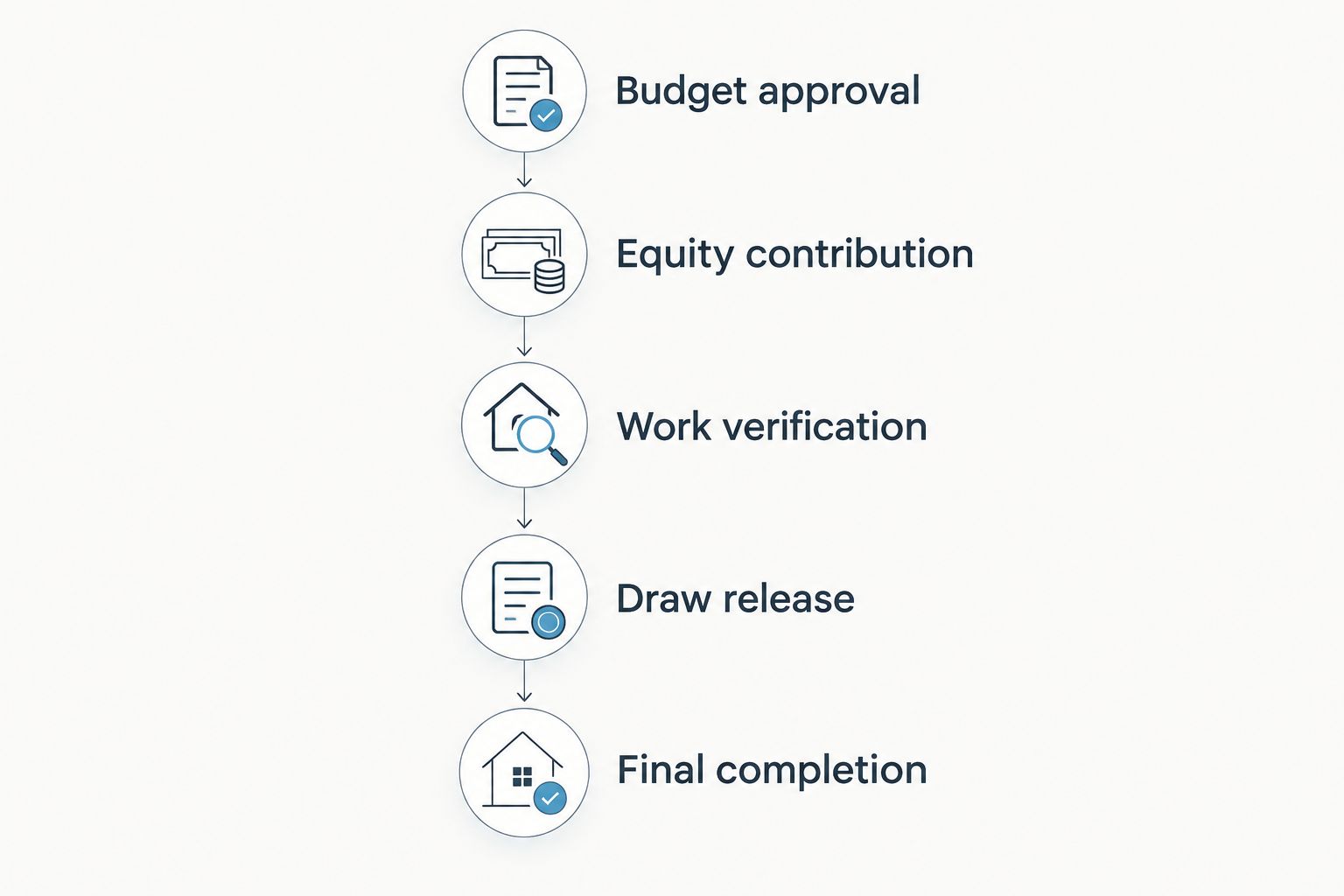
Resolve draw conditions before the contractor needs the next payment.
Ask who handles a disputed inspection and who approves a change order. Your 2026 construction schedule should account for the agreement's release conditions, not just the contractor's expected work dates.
Test the repayment plan before accepting a loan
For a sale exit, compare the loan maturity with the construction schedule and marketing period. Identify what happens if completion slips or the buyer's financing falls through.
For a rental exit, distinguish construction approval from permanent loan approval. DSCR means debt service coverage ratio; at its basic level, a 1.00x ratio means the income used in the calculation equals the debt service used in that calculation, not that a lender must approve the loan.
Ask the permanent lender how it treats rent, expenses, occupancy, and a newly completed property. A projected refinance is not a committed refinance. Obtain the relevant conditions before using that exit to justify construction debt.
How the options are ranked
This 2026 ranking uses project eligibility, occupancy, funding mechanics, builder acceptance, completion rules, and repayment fit. Each route has a distinct role; the order is not a claim about market share, approval speed, or loan performance.
The broker appears first for its stated investor programs, not as an assertion that it funds ground-up construction. Dedicated construction routes follow according to the borrower and project they are designed to evaluate.
Which construction lender should you choose?
For a primary-home build, start with construction-to-permanent lenders. For a spec home, start with lenders that expressly accept ground-up construction for resale; for multifamily development, start with commercial construction lenders.
If your project is an existing property's renovation, compare rehab financing instead of forcing the deal into a ground-up category. Request a written project eligibility decision before paying for work tied to a particular financing application.
FAQ
What's the best construction loan lender for me?
The best lender accepts your exact project, occupancy, builder, and repayment plan. Start with construction-to-permanent financing for a primary-home build, specialist construction financing for a spec home, or commercial construction financing for a development.
Does Loanguys offer ground-up construction loans?
Ground-up construction eligibility is not established by the stated program list. Loanguys offers DSCR, fix-and-flip, bridge, bank-statement, and short-term rental programs; confirm whether your exact construction scope qualifies before proceeding.
Is a construction-to-permanent loan better than separate loans?
A construction-to-permanent loan fits borrowers who want the construction and permanent phases connected under an agreed structure. Separate loans require another financing transaction, so compare conversion conditions and future qualification risk.
Can I use a fix-and-flip loan to build a new house?
Only use a fix-and-flip loan for a new build when the lender explicitly approves that scope. Renovation eligibility does not establish ground-up construction eligibility.
Can land equity count toward my construction contribution?
Land equity counts only when the lender's program and valuation treatment allow it. Ask how existing land debt, ownership history, and appraised value affect the contribution calculation.
What should I ask about construction loan draws?
Ask what work, inspections, and documents are required before each disbursement. Also establish when you contribute equity, who receives the funds, and how change orders affect releases.
Can I refinance a completed rental with a DSCR loan?
A DSCR refinance requires approval under the permanent lender's rules for the completed rental. Confirm income calculations, occupancy requirements, property eligibility, and other conditions before relying on that exit.
One last thing
Ask what happens if the builder stops work. A proposal that explains ordinary draws but leaves contractor replacement, unfinished work, and remaining funds unresolved is not ready for your signature.


