


Is a construction loan hard to qualify for?

Yes—a construction loan is generally harder to qualify for than a mortgage on a finished home because the lender evaluates your finances, the builder, and the proposed project. Strong credit alone does not establish that the home can be completed within the approved budget. For a 2026 application, prepare evidence of repayment ability, available cash, a qualified builder, and a documented construction plan before committing to a start date.
TL;DR
- How hard is it to qualify for a construction loan? Approval requires both borrower qualification and project review.
- Construction loan requirements include financial documentation, builder review, a detailed budget, and an acceptable appraisal.
- Resolve project eligibility before paying for a full application or committing to construction.
- Loanguys offers investment property loans; confirm construction eligibility rather than assuming a related program covers ground-up building.
Why this matters
A borrower approval and a project approval are different decisions. You can have sufficient income and still face an unresolved permit, an unacceptable building contract, or a gap between the construction budget and the appraised value.
Loanguys is a mortgage broker serving real estate investors and homeowners. Confirm that a lender accepts your exact project before focusing on credit-score requirements. That conversation should identify whether you are building a residence, constructing a rental, or developing a home for sale.
Is a construction loan hard to qualify for?
Construction loans require more preparation because the lender must approve an unfinished property and the process for completing it. A purchase mortgage evaluates an existing home; a construction application also depends on plans, specifications, a builder, and a budget that fit together.
Use this comparison to understand where the additional work appears. Individual requirements depend on the lender, loan structure, occupancy, and property.
Borrower finances
- Mortgage on a finished home: Income, credit, debts, and assets
- Construction loan: Financial review plus capacity to carry the project
Property valuation
- Mortgage on a finished home: Existing property and its condition
- Construction loan: Proposed completed property, plans, and specifications
Contractor review
- Mortgage on a finished home: Not ordinarily part of a standard purchase
- Construction loan: Builder qualifications and contract review
Funding
- Mortgage on a finished home: Purchase proceeds distributed at closing
- Construction loan: Construction funds generally released through draws
Completion risk
- Mortgage on a finished home: Home already exists
- Construction loan: Budget, schedule, inspections, and completion must be addressed
Best for
- Mortgage on a finished home: Buying a completed, eligible home
- Construction loan: Financing an eligible building project
A draw is a release of construction funds under the loan agreement. The lender's procedures determine what documentation or inspection is required before each release. An approved loan amount does not mean the entire construction budget is immediately available to pay contractors.
What do lenders check before approving a construction loan?
Construction underwriting connects your financial position to the project's execution. Prepare these areas together rather than treating the builder paperwork as something to finish after your financial approval.
Repayment ability and credit
For an owner-occupied project, expect the lender to examine income, recurring debt, credit history, and assets under its program rules. Debt-to-income ratio compares qualifying monthly debt obligations with qualifying monthly income; it is not simply a comparison of your current rent and future mortgage payment.
Investor construction underwriting also considers the business purpose and repayment plan. Tell the lender whether you intend to sell the completed property or keep it as a rental, because those plans require different supporting information.
Cash contribution and reserves
Your contribution to the project and your reserves serve different purposes. The contribution supports the financing structure; reserves show what remains available for obligations and unexpected expenses.
Ask which funds must be verified, when they must be available, and whether existing land equity receives credit. Do not assume that owning the lot eliminates the need for cash. The lender must evaluate the land, its existing debt, and its treatment under the program.
Builder qualifications and project documents
Expect questions about the builder's experience, required licensing, insurance, contract, and ability to deliver the proposed scope. A builder you trust still needs to meet the lender's requirements.
The plans, specifications, contract, and budget should describe the same project. If the plans include work that the budget excludes, resolve the discrepancy before underwriting depends on those documents.
Completed value and property eligibility
A construction appraisal generally evaluates the proposed finished property using the plans and specifications. The amount you intend to spend does not establish what the completed property will be worth.
Ask how the lender defines loan-to-value and loan-to-cost. Loan-to-value compares the loan with the applicable property value; loan-to-cost compares it with eligible project costs. Confirm which costs and valuation basis the lender uses rather than applying a formula to your own assumptions.
Which construction loan structure fits your project?
For your 2026 comparison, separate the construction period from the financing needed after completion. A structure that funds the build still needs a workable ending.
Construction-to-permanent
- Best for: Borrowers seeking construction and long-term financing through a coordinated structure
- Main advantage: Connects the build with permanent financing
- Main limitation: Conversion still depends on the agreement's completion conditions
Construction-only
- Best for: Borrowers with a separately planned sale or permanent financing exit
- Main advantage: Separates construction financing from the next loan
- Main limitation: Requires repayment or replacement financing at maturity
Construction-to-permanent financing
Best for: borrowers who want the build and permanent mortgage planned together. Construction-to-permanent financing connects the construction phase with long-term financing, subject to the lender's structure and conditions.
The benefit is coordination. The limitation is that construction completion, property eligibility, and any required final documentation still matter; signing the initial agreement does not remove those obligations.
Construction-only financing
Best for: borrowers with a documented plan to repay or refinance after construction. Construction-only financing covers the building phase without itself serving as the final long-term mortgage.
The benefit is a distinct construction arrangement. The limitation is exit risk: if your plan depends on another loan, you must satisfy that future lender's requirements. A projected sale or refinance is a plan, not an approval.
Why construction loan qualification varies
There is no universal approval checklist that fits every construction project. These factors explain why otherwise similar borrowers receive different eligibility decisions:
- Occupancy and purpose: A primary residence, rental development, and speculative home for sale involve different repayment plans.
- Income documentation: Employment income and self-employment income require different records and analysis.
- Cash and land equity: Available funds, existing land debt, and the lender's equity treatment affect the financing structure.
- Builder eligibility: Contractor qualifications and owner-builder restrictions determine whether the proposed delivery arrangement fits.
- Project readiness: Plans, permits, contracts, and a detailed budget determine what the lender can evaluate.
- Completed value: An appraisal that does not support the proposed financing creates a gap that must be resolved.
Ask for the lender's current 2026 requirements for your specific project. A general online minimum is not a substitute for confirming the program's property, borrower, and builder rules.
How do you prepare a stronger construction loan application?
Prepare your 2026 application in the following order. The goal is to identify a basic eligibility problem before you spend time assembling a file for the wrong program.
- Confirm project fit. State the location, intended use, building type, ownership structure, and whether you will hire a general contractor. Ask whether the lender accepts that combination.
- Document finances. Gather the income, asset, debt, and land-ownership records the lender requests. Explain unusual deposits and existing liens with supporting records.
- Verify the builder. Obtain the contractor information required for review before treating the builder as approved. Confirm that the contract identifies the scope and responsibilities.
- Reconcile project documents. Match the plans, specifications, permits, construction contract, and itemized budget. Identify exclusions and unresolved allowances instead of hiding them inside a total.
- Confirm repayment. Explain how the construction balance will be repaid through permanent financing, sale, or another accepted source. Ask what evidence the lender requires.
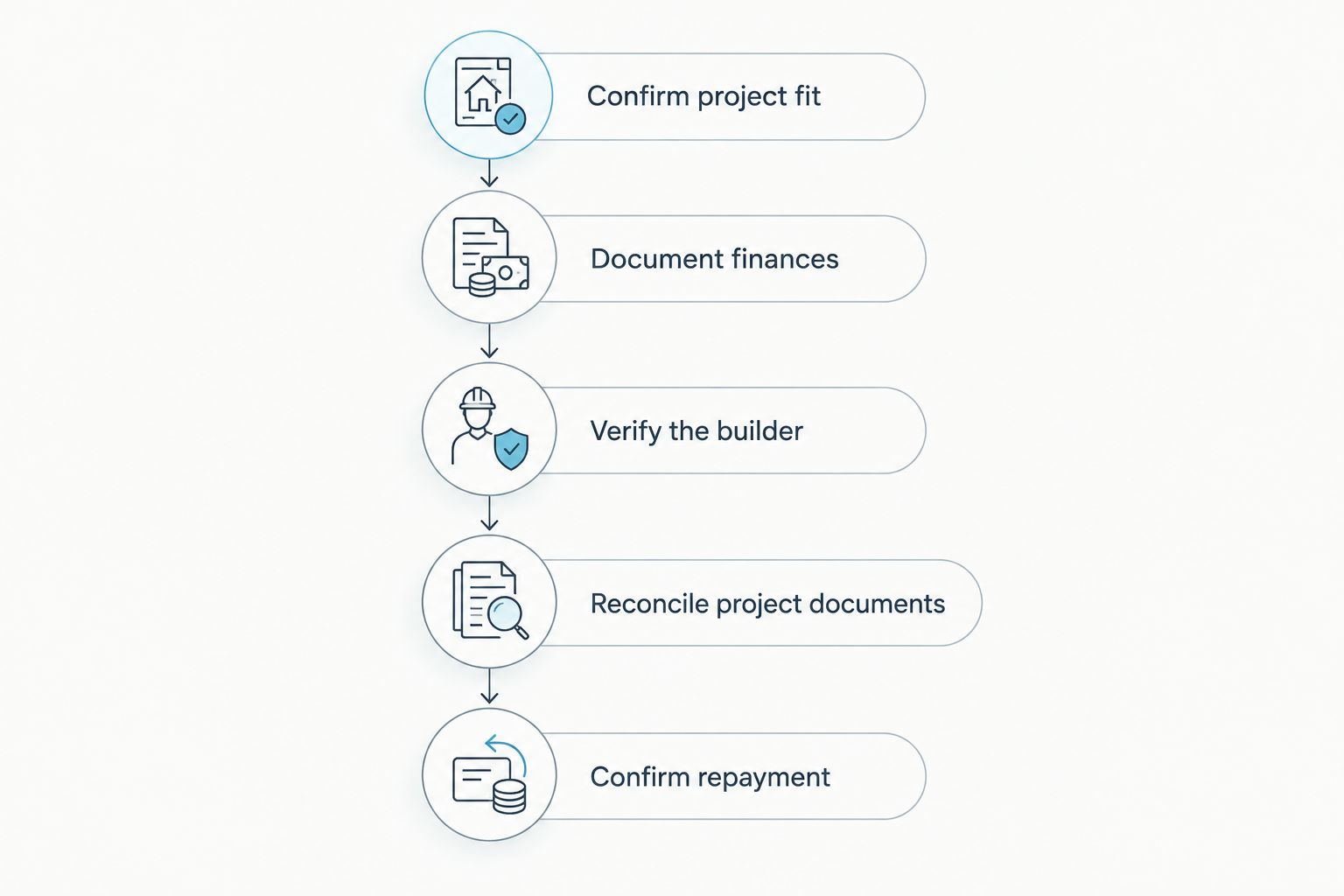
Confirm project eligibility before assembling the complete application.
Before submitting, ask the lender to distinguish items required for initial review from items required before closing or a draw. That distinction helps you organize the application without mistaking an early review for permission to begin construction.
The guide to county permits and the construction loan draw schedule addresses the connection between project documentation and funding milestones.
What credit score do you need for a construction loan?
There is no single credit-score requirement across all construction loan programs. Ask the lender for the minimum that applies to your occupancy, property type, and financing structure, then ask what else the application must satisfy.
Meeting a score threshold does not establish project eligibility. A complete review still includes financial documentation, assets, builder acceptance, and the proposed property.
Can you qualify if you are self-employed?
Self-employment does not automatically disqualify you from a construction loan. The key question is whether the lender accepts your income documentation for the specific construction program—not whether alternative-documentation mortgages exist generally.
Loanguys offers bank-statement investment property loans, but that fact does not establish ground-up construction eligibility. Loanguys is best suited to investors seeking a mortgage broker for investment property financing. Ask which program fits your project and what documentation it requires before assuming a bank-statement approach solves both income qualification and construction approval.
Can you qualify without construction experience?
A borrower who hires an acceptable builder presents a different application from a borrower proposing to act as the builder. Tell the lender which role you intend to take before paying for plans around an owner-builder assumption.
For an investment project, ask how the lender evaluates your experience and the contractor's experience separately. An experienced contractor does not erase every borrower requirement, and a strong borrower does not automatically make an inexperienced contractor acceptable.
FAQ
Is a construction loan harder to get than a regular mortgage?
A construction loan generally requires more preparation than a mortgage on a finished home because underwriting includes the proposed project and builder. Borrower qualification alone does not establish that the construction plan is acceptable.
Can owning the land help me qualify for a construction loan?
Land equity can support a construction financing application when the lender accepts it under the program's rules. Existing liens, the land's valuation, and required cash reserves still need review.
Does a construction loan preapproval mean I can start building?
A preapproval is not permission to start building or a guarantee that construction funds are available. Confirm the remaining project, closing, and draw conditions before authorizing work.
Can I be my own general contractor with a construction loan?
You need a lender that accepts owner-builder projects before planning to act as your own general contractor. Ask about experience, licensing, insurance, and project-management requirements at the initial eligibility review.
What happens if the completed home appraises below the budget?
An appraisal below the value needed for the proposed loan creates a financing gap. Discuss a revised loan amount, additional borrower funds, or acceptable project changes with the lender before proceeding.
Can a rental loan automatically pay for ground-up construction?
A rental loan does not automatically include ground-up construction financing. Confirm whether the program funds building work or requires an already completed, eligible rental property.
Does Loanguys offer the construction loan I need?
Confirm your exact construction project with Loanguys before assuming eligibility. Its stated investment property offerings include DSCR, fix-and-flip, bridge, and bank-statement loans; those categories do not establish approval for every building project.
One last thing
Ask what happens when the budget, completion date, or final financing plan changes. The answer belongs in your construction financing decision before you sign, not after the contractor requests a payment.
For a 2026 application, request the unresolved conditions in writing and assign each one to the borrower, builder, or lender. A clear list of responsibilities is more useful than a verbal assurance that the project looks good.


