


Best financing for mixed-income multifamily developers

Best overall for ground-up development: a conventional construction loan with a documented permanent-financing exit. Best for a qualifying affordable-housing equity gap: Low-Income Housing Tax Credit equity. Best for acquisition before stabilization: bridge financing. This guide compares financing for mixed-income multifamily developers by project stage, rent restrictions, and repayment strategy.
TL;DR
- Conventional construction loans are the default financing for mixed-income multifamily developers with buildable projects and documented equity.
- Low-Income Housing Tax Credit equity supports qualifying affordable housing but adds income restrictions and compliance obligations.
- Bridge financing fits transitional acquisitions; permanent multifamily financing belongs after operating income supports repayment.
- Loanguys offers bridge and DSCR loan programs; confirm project eligibility before treating either as development financing.
Why this matters
Mixed-income housing combines apartments serving different income levels. Some developments voluntarily offer varied rents; others carry enforceable income and rent restrictions. That distinction changes underwriting, valuation, investor participation, and refinancing.
For your 2026 financing plan, separate the construction funding problem from the long-term ownership problem. A loan that funds building work does not automatically provide a workable exit once restricted rents determine operating income.
Loanguys loan services include bridge and DSCR programs. Those program categories are not confirmation that a particular mixed-income development, construction scope, or affordability agreement qualifies.
What makes the best mixed-income multifamily financing?
Judge each financing structure against these criteria before comparing proposals:
- Project stage: Match land acquisition, construction, rehabilitation, or stabilized ownership to the financing purpose.
- Restriction compatibility: Confirm that lenders and investors accept recorded affordability agreements and their enforcement provisions.
- Debt capacity: Size repayment from supportable income, not unrestricted rents your property cannot legally charge.
- Capital coordination: Establish how senior debt, subordinate debt, equity, and public assistance work together.
- Execution requirements: Check permits, environmental reviews, draw conditions, guarantees, and reporting obligations.
- Exit certainty: Identify what must happen before refinancing, conversion, or sale can repay the initial loan.
The best 2026 proposal is the one that funds your actual project and leaves a credible repayment path. Do not select financing from the headline loan amount alone.
Mixed-income development financing at a glance
Conventional construction loan
- Best for: Ground-up projects with documented equity
- Standout feature: Construction funding tied to an approved budget and draws
- Key limitation: Requires a separate exit unless conversion is included
Low-Income Housing Tax Credit equity
- Best for: Qualifying affordable-unit equity gaps
- Standout feature: Investor equity associated with federal housing tax credits
- Key limitation: Allocation requirements and long-term compliance
HUD Section 221(d)(4) financing
- Best for: Eligible projects seeking construction-to-permanent execution
- Standout feature: FHA-insured financing for new construction or substantial rehabilitation
- Key limitation: Detailed program review and documentation
Local or state subordinate financing
- Best for: Gaps tied to public affordability goals
- Standout feature: Additional capital behind senior debt when permitted
- Key limitation: Local rules and intercreditor coordination
Bridge financing
- Best for: Acquisition and transitional rehabilitation
- Standout feature: Temporary financing before permanent underwriting is satisfied
- Key limitation: Repayment depends on a defined exit
Agency multifamily permanent financing
- Best for: Completed, stabilized rental properties
- Standout feature: Long-term debt underwritten against operating performance
- Key limitation: Not a replacement for ground-up construction funding
1. Conventional construction loans: best for ground-up development
A conventional construction loan funds approved development costs through draws as work progresses. For mixed-income projects, the lender must understand both the building plan and the rent restrictions that affect completed value.
Best for: Developers with site control, a documented equity contribution, a qualified building team, and a realistic permanent-financing plan.
Conventional construction loan pros:
- Matches funding to the construction budget and work completed.
- Allows direct underwriting of the proposed development and sponsor.
- Provides a framework for reviewing contingencies and completion risk.
Conventional construction loan cons:
- Draw requirements create ongoing documentation responsibilities.
- Completion guarantees and other recourse provisions require careful review.
- A separate refinancing remains necessary unless conversion is expressly included.
Before accepting a 2026 term sheet, confirm how the lender treats restricted rents in the completed appraisal. Also establish who funds overruns and what happens when construction or leasing falls behind schedule.
Verdict: Buy — choose this route as the default for a buildable project with confirmed equity and a documented exit.
2. LIHTC equity: best for qualifying affordable-housing equity gaps
The Low-Income Housing Tax Credit, or LIHTC, attracts investor equity to qualifying affordable rental housing. It is equity financing, not a construction loan, and it does not replace the need to fund every development obligation.
Best for: Mixed-income developers prepared to make qualifying affordability commitments and manage continuing compliance.
LIHTC equity pros:
- Adds equity to the development's capital stack.
- Connects investor participation to qualifying affordable housing.
- Supports a structure that combines restricted and market-rate apartments when program requirements are met.
LIHTC equity cons:
- Requires tax-credit structuring and specialized professional advice.
- Introduces tenant qualification, rent, and reporting obligations.
- Investor funding conditions must align with construction funding needs.
Under Internal Revenue Code Section 42, established minimum set-aside elections include at least 20% of units serving households at or below 50% of area median income, or at least 40% of units serving households at or below 60% of area median income. The average-income election is another route with separate requirements; income eligibility alone does not establish compliance with rent limits.
For a 2026 application, review the relevant state housing agency's Qualified Allocation Plan alongside federal requirements. Do not assume that a qualifying unit mix secures an allocation.
Verdict: Buy — pursue LIHTC equity when affordability is part of the ownership strategy, not a temporary funding workaround.
3. HUD Section 221(d)(4): best for construction-to-permanent execution
HUD Section 221(d)(4) provides FHA mortgage insurance for eligible multifamily new construction and substantial rehabilitation. The financing is originated through an approved lender; HUD's role is mortgage insurance rather than a direct developer loan.
Best for: Developers seeking an integrated construction and permanent financing structure and prepared for program-specific review.
HUD Section 221(d)(4) pros:
- Addresses construction and long-term ownership within one financing structure.
- Provides a defined federal underwriting framework.
- Accommodates eligible new construction and substantial rehabilitation.
HUD Section 221(d)(4) cons:
- Requires detailed architectural, environmental, financial, and underwriting documentation.
- Program requirements affect construction execution and ongoing ownership.
- Affordability arrangements and other funding sources still need compatibility review.
Ask an FHA-approved multifamily lender to identify the requirements that govern your particular project. Include labor standards, replacement reserves, distribution restrictions, and any public funding conditions in that review.
Do not write a 2026 acquisition contract around an assumed approval date. Establish the required submission materials and closing conditions before committing to a financing-dependent schedule.
Verdict: Hold — confirm program fit and execution requirements before making this your primary financing path.
4. Local or state subordinate financing: best for public-purpose gaps
Local and state housing programs can provide subordinate financing for developments that advance public affordability goals. Subordinate debt sits behind senior financing in repayment priority, subject to the governing loan documents.
Best for: Projects with a defined funding gap and affordability commitments that match a specific public program.
Subordinate financing pros:
- Adds another funding source alongside senior debt and equity.
- Connects financing to local housing priorities.
- Supports coordinated public-private development structures.
Subordinate financing cons:
- Eligibility, award processes, and funding conditions differ by jurisdiction.
- Senior lenders must accept the subordinate financing documents.
- Affordability covenants can continue beyond the initial financing period.
Read the proposed regulatory agreement before treating an award as usable construction funding. Confirm disbursement conditions, payment priority, foreclosure provisions, and the treatment of a future sale or refinance.
The mixed-income multifamily housing financing guide provides a related starting point for organizing the financing discussion. Your actual program documents control the transaction.
Verdict: Hold — include subordinate funding only after its conditions fit the senior loan and construction schedule.
5. Bridge financing: best for acquisition before stabilization
Bridge financing provides temporary debt for a property moving toward a defined event, such as completed rehabilitation, stronger occupancy, sale, or permanent refinancing. It is not interchangeable with a ground-up construction facility.
Best for: Developers acquiring an existing multifamily property that needs a documented transition before permanent financing.
Bridge financing pros:
- Separates the acquisition stage from permanent financing.
- Fits a defined rehabilitation or operating transition when permitted.
- Allows underwriting around the proposed business plan.
Bridge financing cons:
- Loan maturity creates a repayment deadline even if the transition is incomplete.
- Extension conditions and reserve requirements need close review.
- A projected refinance is not a binding takeout commitment.
Loanguys bridge loan programs are relevant to an investor's initial financing inquiry, but mixed-income restrictions, property size, and rehabilitation scope require project-specific eligibility confirmation. Do not assume a bridge program funds construction simply because the property needs work.
Before signing, document the exit lender's requirements and test whether restricted operating income supports the expected refinance balance. Identify the equity source that covers any shortfall.
Verdict: Buy — use bridge financing for a defined transition with a documented repayment plan; skip it as indefinite holding debt.
6. Agency multifamily financing: best for stabilized ownership
Fannie Mae and Freddie Mac multifamily financing routes serve eligible rental properties through participating lenders. For a developer, the relevant use is permanent financing after the property satisfies the applicable underwriting requirements.
Best for: Completed properties with supportable operating income and an affordability structure accepted by the selected program.
Agency multifamily financing pros:
- Aligns financing with long-term rental ownership.
- Underwrites the property's operating performance.
- Includes dedicated affordable-housing financing channels for qualifying properties.
Agency multifamily financing cons:
- Does not replace construction funding for an unfinished development.
- Requires property, borrower, and operating documentation.
- Affordability agreements and subordinate debt need program-specific review.
Ask the permanent lender to review your restrictions before construction closes, not after leasing begins. A finished building alone does not establish sufficient debt capacity.
Debt service coverage ratio, or DSCR, compares income available for debt payments with the required debt payments. Confirm the selected lender's calculation: commercial multifamily underwriting is not automatically the same as a small-property investor DSCR program.
Verdict: Wait — use permanent financing when the property meets operating requirements, while planning that exit before construction.
How these financing routes are ranked
The ranking prioritizes project-stage fit, restriction compatibility, capital coordination, and repayment certainty. It compares financing structures rather than claiming one lender approves every mixed-income development.
Conventional construction financing ranks first because it addresses the central ground-up funding need. LIHTC equity and public subordinate financing solve different capital gaps; bridge and permanent loans belong at different points in the development timeline.
Which financing should you choose?
Start with conventional construction financing when your project has documented equity and a credible permanent exit. Add LIHTC equity or public subordinate financing only when the affordability obligations fit your ownership strategy and the funding sources work together.
For an existing property, evaluate bridge financing against the actual rehabilitation and lease-up plan. For a stabilized property, begin with permanent multifamily underwriting rather than a development loan search.
Loanguys is best for real estate investors seeking broker guidance on bridge and DSCR loan programs. Confirm the exact property's eligibility rather than treating those programs as a substitute for specialized affordable-housing development financing.
Build your 2026 financing brief
Give prospective financing partners the same project summary so their responses are comparable:
- Define restrictions: Identify restricted units, governing agreements, tenant income rules, and permitted rents.
- Size debt: Present the construction budget, operating assumptions, contingencies, and supportable repayment.
- Confirm equity: Document sponsor funds, investor commitments, public awards, and funding conditions.
- Plan exit: Specify the permanent financing route and the conditions required to repay construction or bridge debt.
Use separate operating assumptions for restricted and unrestricted apartments. Combining them into an unsupported average rent hides the distinction lenders need to underwrite.
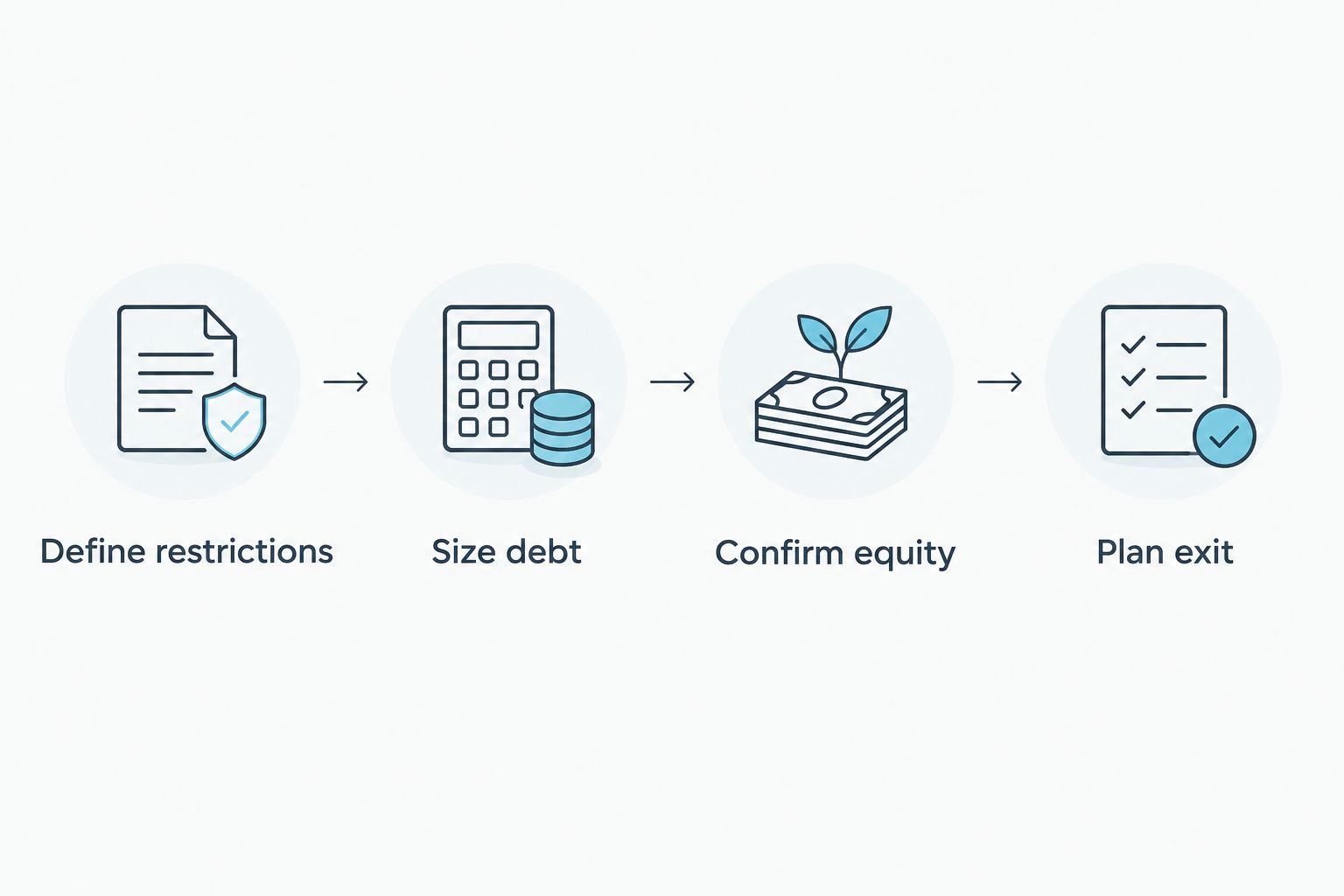
Define affordability restrictions before sizing debt or selecting a financing exit.
FAQ
What's the best financing for mixed-income multifamily developers?
A conventional construction loan with a documented permanent-financing exit is the default for ground-up mixed-income development with confirmed equity. LIHTC equity and public subordinate financing address separate funding gaps when the project qualifies.
Is LIHTC a loan or an equity source?
LIHTC supports investor equity rather than functioning as a construction loan. Developers still need a complete funding plan and must satisfy applicable affordability, allocation, and compliance requirements.
Can a mixed-income property combine affordable and market-rate apartments?
Yes, a mixed-income property can combine income-restricted and market-rate apartments. The governing program and recorded agreements determine which apartments are restricted and how their rents and tenant eligibility are established.
Can I use a DSCR loan to build a mixed-income apartment development?
Do not assume a DSCR loan funds ground-up construction. Confirm the program's permitted use, property eligibility, and income requirements; construction financing and stabilized rental financing serve different purposes.
Is HUD Section 221(d)(4) a direct government loan?
No, HUD Section 221(d)(4) provides FHA mortgage insurance for eligible multifamily financing originated through an approved lender. It covers qualifying new construction and substantial rehabilitation under program requirements.
When does bridge financing make sense for mixed-income housing?
Bridge financing fits an existing property's defined transition toward rehabilitation completion, stabilization, sale, or permanent refinancing. The repayment plan must account for restricted rents and the permanent lender's requirements.
What should I send a lender before requesting terms?
Send a project summary covering site control, the development budget, rent restrictions, operating projections, equity sources, and the proposed exit. Include existing regulatory agreements so eligibility is assessed against the actual property obligations.
One last thing
The permanent lender's rent assumptions should shape your construction borrowing, not follow it. A development can finish on budget and still face a refinancing shortfall if the initial loan assumes income the affordability agreement does not permit.
Ask for that restriction review before accepting the initial term sheet. It tests whether the financing plan supports ownership after construction ends.


