


Can you get a DSCR loan on a property you already own free and clear?

Yes, you can get a DSCR loan on property owned free and clear if the property and borrower meet the lender’s investment-property requirements. The transaction generally takes the form of a cash-out refinance, creating a new mortgage even though there is no existing loan to repay. Your rental income must support the proposed payment under the lender’s calculation, and closing expenses reduce the cash you receive.
TL;DR
- A DSCR loan on property owned free and clear generally uses a cash-out refinance to access rental-property equity.
- Owning the property outright does not remove rental-income, appraisal, credit, title, or reserve requirements.
- The new mortgage payment—not your current debt-free position—determines the property’s debt-service coverage.
- Loanguys offers DSCR loans; confirm cash-out eligibility and ownership-history requirements before committing to another purchase.
Can you get a DSCR loan on a property you already own free and clear?
Yes. Having no mortgage does not prevent you from borrowing against an eligible rental property. A DSCR cash-out refinance places a mortgage on the property and releases part of your equity as loan proceeds.
Start with the distinction between equity and repayment capacity. Equity gives the lender collateral; rental income helps establish whether the property supports the new debt. You need both to satisfy the selected program.
The guide to cash-out refinance DSCR loans for portfolio expansion explains the related strategy of borrowing against a rental to support further investment.
For a 2026 application, work through these steps before treating your equity as money you can spend:
- Confirm rental use. Establish whether the property’s occupancy and rental arrangement fit the program.
- Document ownership. Provide the deed, acquisition history, and information about the person or entity holding title.
- Verify rental income. Supply the lease or other income evidence the lender accepts.
- Check loan sizing. Have the lender assess both property value and coverage of the proposed payment.
- Review net proceeds. Separate the new loan balance from the cash remaining after closing deductions.
These steps establish eligibility, not a promise of approval. An outright-owned property still needs underwriting, an acceptable appraisal, and clear title for the new mortgage.
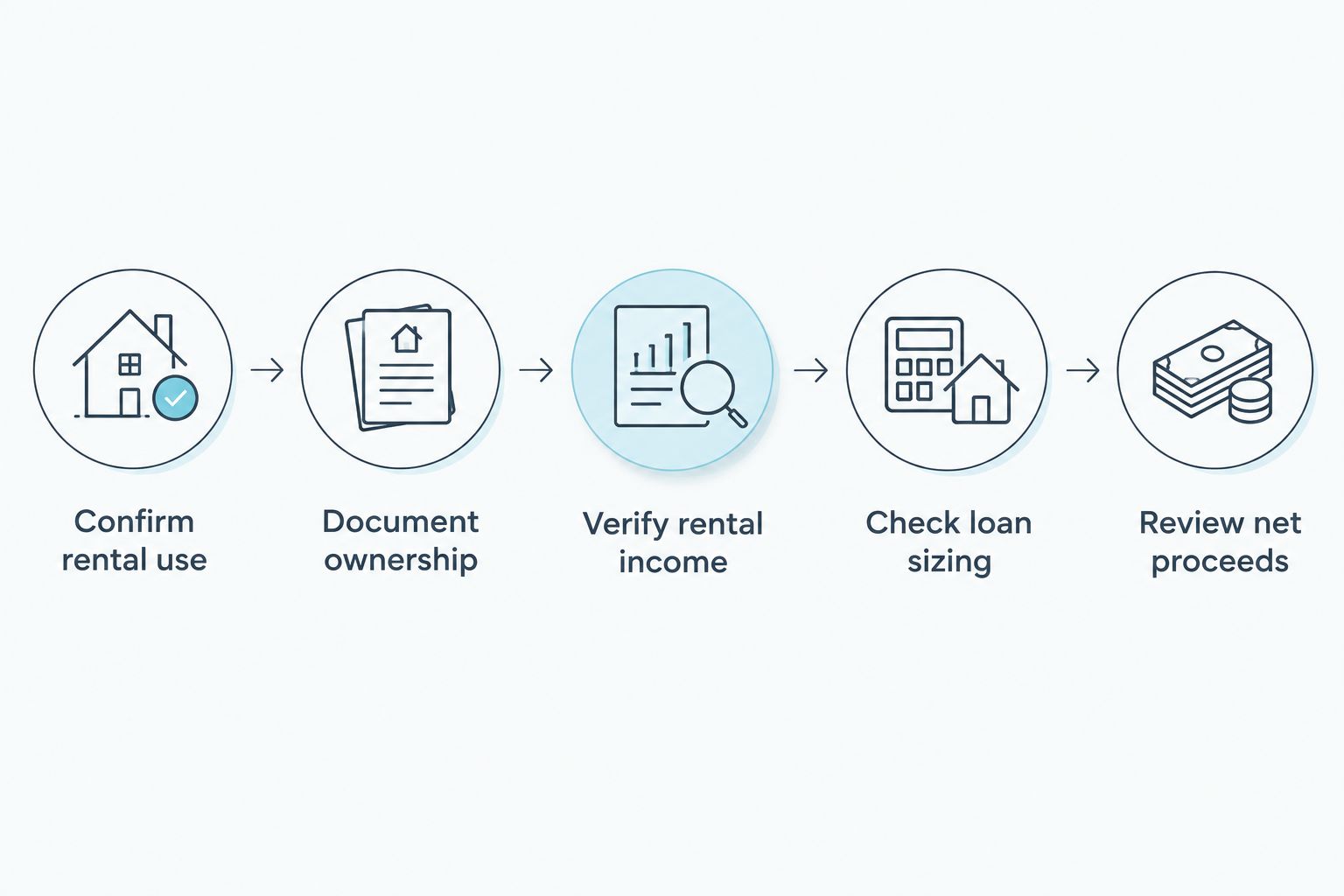
Check both rental-income coverage and property value before relying on cash-out proceeds.
Why this matters
A debt-free rental gives you flexibility, but borrowing against it changes the investment. You exchange part of your equity position for cash while adding a required payment and a lender’s claim against the property.
That trade-off deserves its own decision. Financing another purchase does not automatically justify reducing the cash flow of a property that already performs without mortgage debt.
Borrow for a defined investment purpose, not simply because equity is accessible. Compare the expected benefit of using the proceeds with the payment, transaction expenses, and risk attached to the existing rental.
How does DSCR work when you have no current mortgage?
The lender evaluates the proposed loan, not the absence of an old one. A property that produces positive cash flow without debt does not automatically produce sufficient coverage after refinancing.
DSCR means debt-service coverage ratio. In residential rental lending, a common calculation divides qualifying monthly rent by the proposed monthly principal, interest, property taxes, insurance, and applicable association dues. Confirm the exact calculation because commercial-property underwriting and individual programs use different methods.
Under a calculation using matching income and payment periods:
- 1.00x coverage means qualifying income equals the payment used in the ratio.
- 100% coverage describes that same equality; it does not mean all operating expenses are covered.
- Coverage above that point means qualifying income exceeds the payment included in the calculation.
These are mathematical relationships, not approval thresholds. Ask the lender which minimum ratio applies to your transaction and which expenses the calculation includes.
Why passing DSCR is not the same as positive cash flow
A lender’s coverage calculation is not your complete operating budget. Repairs, vacancy, management, utilities you pay, and capital replacements can consume money beyond the expenses included in underwriting.
Build a separate property budget for the 2026 refinance decision. If the new payment leaves no room for maintenance or interrupted rent, a qualifying loan can still be a poor investment choice.
How much equity can you access?
Your usable equity depends on the lender’s permitted loan-to-value ratio and the amount the rental income supports. The lower applicable limit controls the loan size. Credit, property eligibility, and other underwriting conditions also affect approval.
Loan-to-value, or LTV, compares the loan balance with the property value accepted by the lender. Owning the property outright removes an existing mortgage payoff from the calculation, but it does not mean the lender will finance the entire property value.
Keep these amounts separate when reviewing a proposal:
Accepted property value
- What it means: The valuation the lender uses
- What to check: Whether the lender accepts the appraisal and valuation basis
Gross loan amount
- What it means: The new mortgage balance
- What to check: Whether value and rental-income coverage both support it
Closing deductions
- What it means: Expenses, prepaid items, and other required disbursements
- What to check: Which items reduce your proceeds
Net cash proceeds
- What it means: The money released to you after deductions
- What to check: Whether it covers your intended use without draining reserves
Request a written proceeds estimate. A headline loan amount is not a spending budget, and money retained to satisfy reserve requirements is not money you should commit elsewhere.
Why DSCR cash-out eligibility varies
There is no single cash-out rule covering every DSCR lender in 2026. Ask for the requirements attached to the actual program being proposed, rather than relying on a general description of DSCR lending.
The main variables are:
- Qualifying rent. Lease income, appraiser-supported market rent, and short-term rental records require different documentation. Confirm which evidence the lender accepts.
- Accepted value. An appraisal supports valuation, but ownership history and program rules can affect the value used for lending.
- Ownership history. Lenders apply their own seasoning rules, meaning requirements for how long you have held title or owned the property.
- Credit and liquidity. Property-based income qualification does not eliminate borrower review or cash-reserve requirements.
- Property use and condition. Occupancy, rental restrictions, property type, and needed repairs affect program fit.
- Title and ownership structure. Liens, unresolved ownership questions, and entity documentation must be addressed before closing.
Ask which condition limits your application first. A larger appraisal does not solve insufficient qualifying rent, and stronger rent does not resolve a title defect.
What documents should you prepare?
Prepare a file that connects ownership, rental income, and the requested borrowing purpose. A DSCR application is not a document-free application, even when qualification focuses on the property rather than employment income.
Use this checklist for your initial discussion:
- Recorded deed and acquisition closing documents, if available.
- Current lease, rent roll, or applicable rental-income records.
- Property insurance information and current property-tax details.
- Association dues and relevant rental restrictions, where applicable.
- Asset statements showing funds available for closing and reserves.
- Identification and authorization for the required credit review.
- Entity documents if an LLC or other eligible entity owns the property.
- Details of the intended use of cash-out proceeds.
The lender determines the final document list. Flag missing records early instead of assuming that outright ownership replaces proof of acquisition or rental activity.
For your own planning, write down a target net-proceeds amount and an acceptable monthly payment. Those limits make it easier to reject a proposal that technically qualifies but does not serve your investment plan.
What if you recently bought the property with cash?
A recent cash purchase raises a different question from long-held ownership: does the program permit cash-out at this point in your ownership history? Ask about seasoning before paying for services tied to a particular loan proposal.
Some financing structures address reimbursement after a cash purchase, often called delayed financing. Do not assume that a delayed-financing exception from another mortgage program applies to a DSCR loan.
Keep the purchase settlement statement and records showing the source and movement of acquisition funds. Ask whether the lender uses the purchase basis, current appraised value, or another permitted valuation approach.
For a 2026 purchase followed by refinancing, get the ownership-history rule in writing before committing expected proceeds to your next transaction. A planned refinance is not a substitute for cash already available to close.
What if you inherited the property or own it through an LLC?
Inherited ownership requires evidence that you have legal authority to mortgage the property. An inheritance does not, by itself, settle every title, estate, or underwriting question.
If an LLC owns the rental, establish whether the proposed lender accepts that ownership structure and what it requires from the entity and its members. Entity ownership does not automatically eliminate personal guarantees or borrower review.
Do not transfer the property solely to match an assumed lending requirement. Discuss the proposed ownership structure with the lender and your legal or tax adviser before changing title; a transfer can introduce issues unrelated to DSCR qualification.
Is a DSCR refinance better than another equity strategy?
Choose the structure around your use of funds and repayment plan. A cash-out refinance creates a funded mortgage balance, while an eligible equity line provides access through a different borrowing structure. Keeping the property debt-free avoids adding a loan altogether.
DSCR cash-out refinance
- Best for: Rental owners seeking a lump sum with property-income-focused qualification
- Main advantage: Connects income qualification to the rental
- Main drawback: Adds a mortgage payment and transaction expenses
Investment-property equity line
- Best for: Owners needing staged access to funds
- Main advantage: Supports borrowing as needs arise under the line’s terms
- Main drawback: Eligibility, payment structure, and terms require separate review
Keep the property debt-free
- Best for: Owners prioritizing unencumbered ownership
- Main advantage: Avoids a new mortgage payment and financing transaction
- Main drawback: Leaves equity tied to the property
None of these choices is universally better. Match the borrowing structure to the investment rather than using the largest offered balance as your selection rule.
Loanguys is a mortgage broker offering DSCR and other investment-property loan programs. Loanguys is best suited to investors seeking broker guidance on DSCR and other property-financing options. A broker discussion helps you assess program fit, but approval and final terms remain subject to underwriting.
Discuss your rental financing
Ask how rental income, ownership history, and property value affect your cash-out refinance.
What should you confirm before accepting a loan?
Review the written proposal as a complete borrowing obligation. Do not stop at the monthly principal-and-interest figure if taxes, insurance, association dues, or other obligations sit outside it.
Before accepting a 2026 DSCR cash-out proposal, confirm:
- The full payment basis used for qualification and your actual ongoing obligations.
- Whether the payment structure changes during the loan.
- Any balloon payment or interest-only feature.
- Any prepayment restriction or penalty and how it affects your exit plan.
- The expected net proceeds and required remaining reserves.
- Conditions that still need to be satisfied before funding.
Keep the existing rental’s performance separate from the projected return on your next investment. The rental remains responsible for its mortgage even if the next project produces no income.
FAQ
Can I refinance a rental property that has no mortgage?
Yes, an eligible mortgage-free rental can be financed through a cash-out refinance. The lender still reviews rental income, property value, credit, title, and other program requirements.
Do I need a job to get a DSCR loan on a paid-off rental?
DSCR qualification focuses on the property’s qualifying rental income rather than relying on employment income in the same way as a conventional income-based mortgage. You still need to satisfy the selected lender’s borrower and documentation requirements.
Can I get a DSCR loan on the house I live in?
Standard business-purpose DSCR rental programs are not intended for your primary residence. Disclose actual occupancy and ask about financing designed for owner-occupied property instead.
How long must I own a paid-off property before taking cash out?
The required ownership period depends on the lender and program. Confirm seasoning rules and any applicable exceptions before planning to use refinance proceeds.
Can I take out all the equity in my rental property?
Owning the property outright does not entitle you to borrow its entire value. The lender’s loan-to-value limit, rental-income coverage calculation, and other underwriting conditions determine the permitted balance.
Does a DSCR ratio of 1.00x mean the rental pays for everything?
A DSCR ratio of 1.00x means qualifying income equals the debt-service amount used in that calculation. It does not establish that repairs, vacancy, management, and every other operating expense are covered.
Can Loanguys help me explore a DSCR loan on a paid-off property?
Loanguys offers DSCR loan programs through its mortgage brokerage. Ask whether your property, ownership history, rental documentation, and requested cash-out amount fit a program’s requirements.
One last thing
Decide how much debt the rental should carry before asking how much a lender will approve. Your comfortable payment and reserve needs are investment decisions; the lender’s maximum is an underwriting decision.
Write down your minimum acceptable cash flow after the new payment, operating expenses, and reserves. Use that limit to evaluate the proposal, even when a larger loan is offered.


