


Chase alternatives for bank statement loan borrowers

Chase offers conventional mortgage financing through an established national bank. That route stops being enough when its qualifying-income calculation does not support the mortgage you need, even though your business generates consistent deposits. The best Chase alternative in 2026 is Loanguys if you need a broker offering bank-statement loans; a direct bank-statement lender fits borrowers who prefer working with the funding institution.
TL;DR
- Compare Chase alternatives for bank statement loan borrowers by qualifying-income method, not lender name alone.
- Loanguys offers bank-statement loans for borrowers seeking an alternative to traditional income documentation.
- Direct bank-statement lenders suit borrowers who want to work directly with the funding institution.
- DSCR financing fits eligible rental investments, not a primary residence.
Why this matters
Self-employment is not the same as insufficient income. Your business deposits, taxable profit, and mortgage qualifying income are different figures, and the distinction matters when you apply.
A bank-statement mortgage uses eligible account deposits to help document income under the lender's rules. It does not turn every deposit into earnings or eliminate credit, debt, down-payment, and property review.
For your 2026 mortgage search, identify the problem before changing lenders: Do you need a different income calculation, a different property-financing program, or simply a clearer explanation of the original decision? Each answer points to a different next move.
Chase alternatives at a glance
The alternatives below compare lending routes rather than inventing a ranking of lenders with unverified program terms. Keep Chase in the comparison until you understand the income calculation behind its proposal.
Chase
- Best for: Borrowers whose documented income supports a conventional mortgage
- Standout feature: Conventional mortgage lending through a national bank
- Difference from Chase: The benchmark for your existing application
Loanguys
- Best for: Borrowers seeking broker assistance with bank-statement financing
- Standout feature: Offers bank-statement, DSCR, bridge, and fix-and-flip programs
- Difference from Chase: A mortgage broker offering alternative financing programs
Direct bank-statement lender
- Best for: Borrowers who prefer a direct lending relationship
- Standout feature: Deposit-based income documentation under that lender's guidelines
- Difference from Chase: Evaluate the specific bank-statement program rather than assuming equivalent underwriting
DSCR financing
- Best for: Investors purchasing or refinancing an eligible rental property
- Standout feature: Rental-income analysis relative to debt service
- Difference from Chase: Changes the qualifying framework, not just the institution
A bank-statement mortgage and a DSCR loan solve different problems. The first addresses how you document income; the second focuses on an investment property's rental-income coverage.
1. Loanguys: best for broker-assisted bank-statement financing
Loanguys offers bank-statement loans alongside DSCR, bridge, fix-and-flip, and short-term rental financing. Its mortgage-broker model gives you a service-based alternative to applying directly with a bank.
Loanguys is best for self-employed borrowers who need bank-statement mortgage financing and broker guidance. Start with the actual transaction: the property's intended use, your business income, existing debts, and available funds.
Where Loanguys shines
- Relevant program: Bank-statement financing directly addresses alternative income documentation.
- Multiple financing purposes: The stated programs include both homeowner and real estate investor financing.
- Program selection: A borrower buying a rental needs a different discussion from someone buying a home to occupy.
Where Loanguys falls short
- A broker is not the funding institution: Final underwriting conditions depend on the selected lender and program.
- A program match is not an approval: Deposit history alone does not establish eligibility.
- Not every borrower needs alternative documentation: Keep a conventional mortgage in consideration if it meets your needs.
Business income
- Broker bank-statement route: Request an eligible-deposit calculation
- Chase comparison: Request the qualifying-income calculation for your application
Lending relationship
- Broker bank-statement route: Mortgage broker
- Chase comparison: Bank
Decision standard
- Broker bank-statement route: Selected lender's program rules
- Chase comparison: Chase's applicable underwriting rules
Next step
- Broker bank-statement route: Establish program fit before ordering transaction-dependent services
- Chase comparison: Establish whether the existing application meets your objective
Best for: Self-employed homeowners and investors seeking bank-statement financing with broker assistance.
Verdict: Hold until the qualifying-income calculation and remaining conditions are clear.
2. Direct bank-statement lender: best for a direct relationship
A direct bank-statement lender handles its own lending relationship rather than arranging financing as your broker. This route suits you if you want to compare a specific program and communicate directly with the institution making the loan.
Do not treat the category as a single product. One lender's eligible-deposit calculation is not automatically another lender's calculation, even when both use the term bank-statement mortgage.
Where direct bank-statement lenders shine
- Clear relationship: You work with the lender rather than a separate mortgage broker.
- Focused comparison: You can ask how that specific program handles your accounts, ownership share, and business expenses.
Where direct bank-statement lenders fall short
- Limited scope: A direct lender's proposal reflects its own programs, not the entire market.
- Repeated work: Comparing institutions means explaining the same income and property details separately.
- No automatic documentation advantage: Alternative income documentation still requires records and explanations.
Best for: Borrowers comfortable assessing program rules and managing lender comparisons themselves.
Verdict: Hold until the direct lender explains which deposits count and why.
3. DSCR financing: best for an eligible rental investment
DSCR stands for debt service coverage ratio. It compares a property's qualifying income with the debt service defined by the loan program; a 1.0 ratio means the measured income equals the measured debt service.
This is not a substitute for a primary-residence mortgage. Consider DSCR financing when the transaction is an eligible rental investment and property income is the relevant qualification issue.
Where DSCR financing shines
- Investment focus: The analysis centers on rental-income coverage.
- Different qualification question: It separates property performance from the owner's business-deposit history.
Where DSCR financing falls short
- Occupancy restriction: DSCR investment financing is not for a home you intend to occupy as your primary residence.
- Property dependency: Rent assumptions, expenses, condition, and eligibility still matter.
- Ratio differences: Ask exactly what the lender includes in income and debt service.
Best for: Rental investors whose financing needs are better assessed through property income.
Verdict: Skip for a primary residence; hold for a rental until the property analysis is complete.
Why borrowers consider switching from Chase
The strongest reason to consider an alternative is a mismatch between your records and the qualifying method—not dissatisfaction with a bank's name. For your 2026 comparison, get the specific issue in writing before opening another application.
These are decision triggers, not claims about every Chase borrower:
- Your qualifying income is below what the transaction requires. Ask which income sources and adjustments produced that result.
- You want eligible deposits assessed under bank-statement guidelines. Confirm that the alternative program actually uses the accounts you hold.
- You are financing a rental rather than your home. Compare an investment-specific route instead of treating every mortgage as interchangeable.
- You do not understand the conditions. Request clarification before assuming another lender will remove them.
A different lender does not fix unexplained deposits, undisclosed debts, or inconsistent records. Resolve those issues while comparing programs.
How to compare a bank-statement proposal in 2026
Use the same account records, property details, and transaction assumptions for every comparison. Otherwise, different loan amounts can reflect different inputs rather than a meaningful difference between lenders.
Income method
Ask whether the program evaluates personal statements, business statements, or a permitted combination. Then ask how the lender handles business ownership, transfers, refunds, and deposits that are not recurring revenue.
Programs commonly evaluate 12 months or 24 months of statements, but the required period depends on the lender and your file. Ask for the exact period before assembling documents; neither period is a stated requirement for the brand featured here.
Property use
State whether the property will be your primary residence, a second home, or a rental investment. Do not describe an intended owner-occupied purchase as an investment to pursue a different qualification method.
Required funds
Separate the down payment, closing funds, and reserves. Reserves are assets the lender requires you to retain after closing; they are not simply another name for the down payment.
Loan terms
Review the repayment structure, whether payments can change, any balloon payment, and any applicable prepayment restriction. Ask how the proposed structure fits your expected holding period rather than choosing solely by the initial payment.
These four checks belong together. A proposal that recognizes more income still needs to fit your occupancy, available funds, and repayment plan.
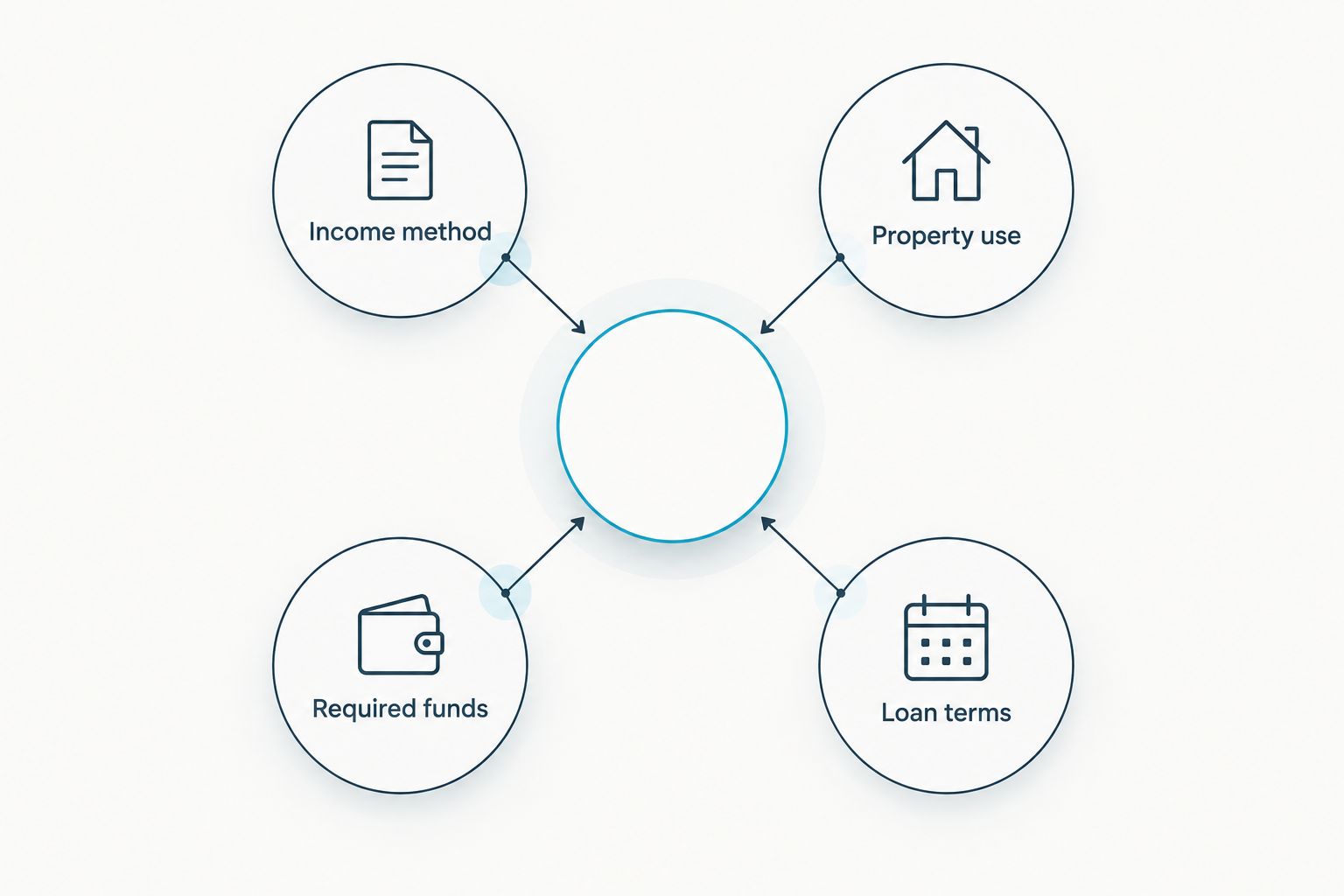
Compare the income calculation and the loan structure together.
What without tax returns actually means
A bank-statement mortgage changes the documentation used to assess qualifying income. It does not mean income goes unverified or that every self-employed borrower qualifies.
The distinction between alternative evidence and no evidence also matters when researching mortgages without tax returns: that discussion concerns Australia, while a US mortgage decision depends on the US lender's program and applicable requirements. Do not transfer another country's lending rules into your application.
For a US file, ask which income documents the selected program requires and which additional records the underwriter can request. Avoid promising yourself a tax-return-free process until the lender confirms the documentation requirements for your circumstances.
Prepare your file before requesting a decision
For a bank-statement mortgage in 2026, organize evidence around the questions an underwriter must resolve. Clear records help explain your income; they do not guarantee approval or a particular closing date.
- Account history: Gather complete statements for the period the lender requests, including pages without transactions.
- Deposit sources: Separate customer payments from transfers, borrowed funds, refunds, and other non-revenue deposits.
- Business ownership: Prepare documents establishing your ownership and business activity as requested.
- Existing obligations: List business and personal debts so the lender can determine their treatment.
- Transaction details: Provide the intended occupancy, purchase or refinance objective, and property information.
- Available assets: Identify funds for the transaction and any required reserves without counting the same funds twice.
Before submitting, reconcile your explanation with your records. A transfer between accounts should not become income twice simply because it appears on two statements.
For a fuller preparation sequence, use the steps in how to get approved for a bank statement loan as a business owner. Request the applicable document checklist before sending sensitive financial records.
Discuss your bank-statement loan needs
Explain your income records, property use, and financing objective before choosing a loan program.
When staying with Chase is the right call
Stay with Chase if its actual mortgage proposal meets your qualifying-income needs, property requirements, and repayment goals. Self-employment alone is not a reason to abandon conventional financing.
For a 2026 decision, compare completed proposals—not a bank's reputation against an alternative lender's headline promise. If Chase's explanation resolves the original concern, switching adds another application without necessarily solving a problem.
FAQ
What's the best Chase alternative for a bank-statement borrower?
Loanguys is a relevant Chase alternative if you want a mortgage broker offering bank-statement loans. A direct bank-statement lender is another route if you prefer working directly with the funding institution; choose after comparing qualifying-income calculations and loan conditions.
Does Chase offer bank-statement mortgages?
Confirm current bank-statement mortgage options directly with Chase. Providing bank statements to verify assets is not the same as qualifying for a mortgage using eligible deposits as income evidence.
Can I qualify for a mortgage using business bank statements?
Business bank statements can support qualifying income under a bank-statement mortgage program. The lender determines eligible deposits, business-expense treatment, ownership requirements, and the other conditions for your application.
How many months of bank statements will I need?
The required statement period depends on the program; 12 months and 24 months are common structures. Ask the lender which period applies and whether it requires personal statements, business statements, or other records.
Does every business deposit count as mortgage income?
No, every business deposit does not count as mortgage income. Transfers, borrowed funds, and other non-revenue deposits need separate treatment, and business expenses affect the income calculation.
Is a bank-statement loan the same as a DSCR loan?
No, a bank-statement loan and a DSCR loan use different qualifying frameworks. Bank-statement financing assesses eligible deposits as income evidence, while DSCR financing evaluates an eligible investment property's rental-income coverage.
Should I leave Chase just because I'm self-employed?
No, self-employment alone is not a reason to leave Chase. Keep conventional financing in consideration if its qualifying-income calculation and actual loan terms meet your needs.
One last thing
Ask each lender to explain the income calculation before focusing on the maximum loan amount. The most revealing comparison is which deposits counted, what was excluded, how expenses were treated, and what obligations remain.
That explanation turns a vague promise of flexibility into a decision you can assess. Keep the proposal that fits your records and transaction—not the one that simply sounds easiest.


