


How long does it take to get approved for a construction loan?

The construction loan approval timeline depends on when your lender has a complete borrower file, an acceptable builder package, and a project ready for underwriting; there is no single approval period that applies to every construction loan. Conditional approval is not permission to close or start drawing funds. For a 2026 project, get separate written estimates for underwriting, closing, and the first construction disbursement before committing to a start date.
TL;DR
- Your construction loan approval timeline depends on borrower readiness, builder review, appraisal, and project documentation.
- Conditional approval does not mean construction funds are ready to use.
- Separate the underwriting decision, loan closing, and first draw when planning your build.
- Loanguys offers mortgage brokerage for investors and homeowners; construction eligibility requires a project-specific discussion.
Why this matters
A construction schedule and a financing schedule are different documents. Your builder can be ready to mobilize while the lender still needs an appraisal, title clearance, or an explanation of your construction budget.
Plan around the next unresolved requirement, not an advertised approval speed. The county permits to construction loan draw schedule workflow explains the connection between project permissions and access to construction funds. Confirm those dependencies before setting contractual deadlines.
How long does it take to get approved for a construction loan?
Your approval date depends on the lender’s review requirements and the readiness of your specific project. Ask when the lender considers your application complete and what its estimated review period includes. An estimate that excludes builder approval or the appraisal does not describe your entire path to funding.
Use these milestones to make competing timeline estimates comparable:
Initial screening
- What it establishes: Whether the borrower and proposed project appear to fit
- What it does not establish: A binding lending commitment
Conditional approval
- What it establishes: Whether the lender will proceed subject to stated requirements
- What it does not establish: That all underwriting conditions are satisfied
Final approval
- What it establishes: Whether the lender has cleared its underwriting requirements
- What it does not establish: That documents are signed or funds disbursed
Closing
- What it establishes: Completion of the loan transaction and required documents
- What it does not establish: Automatic access to every construction advance
First draw
- What it establishes: Release of funds under the loan’s disbursement requirements
- What it does not establish: Unrestricted access to the remaining loan proceeds
Terminology varies by lender. Request the written definition behind any status update, especially when someone uses “approved” without describing the remaining conditions.
For your 2026 construction loan approval timeline, attach an expected completion date and a responsible contact to every outstanding item. That makes the estimate useful for scheduling rather than simply reassuring.
What happens before construction loan approval?
Construction underwriting examines the borrower and the proposed building project. A strong personal financial file does not replace a documented budget, and an experienced builder does not replace borrower qualification.
The following sequence gives you a practical way to organize the application. Some reviews happen at the same time; ask your lender which tasks can proceed together.
- Borrower review. Submit the requested identity, credit, income, asset, and borrowing-entity documents. Explain the intended occupancy and ownership structure accurately from the start.
- Builder review. Provide the builder information required by the lender. Confirm whether the lender accepts your contractor or permits an owner-builder arrangement before developing the file further.
- Project review. Submit the plans, specifications, construction contract, itemized budget, and permit information requested for your project. Resolve discrepancies between documents before underwriting relies on them.
- Appraisal review. Supply the materials needed to evaluate the property and proposed improvements. Ask whether the valuation assignment is waiting on final plans or other project details.
- Condition clearance. Answer the lender’s outstanding questions and obtain confirmation that each response satisfies its requirement. Uploading a document does not mean the condition is cleared.
Keep the same project description across the application, contract, and appraisal materials. Conflicting versions create questions that must be answered before the lender can finish its review.
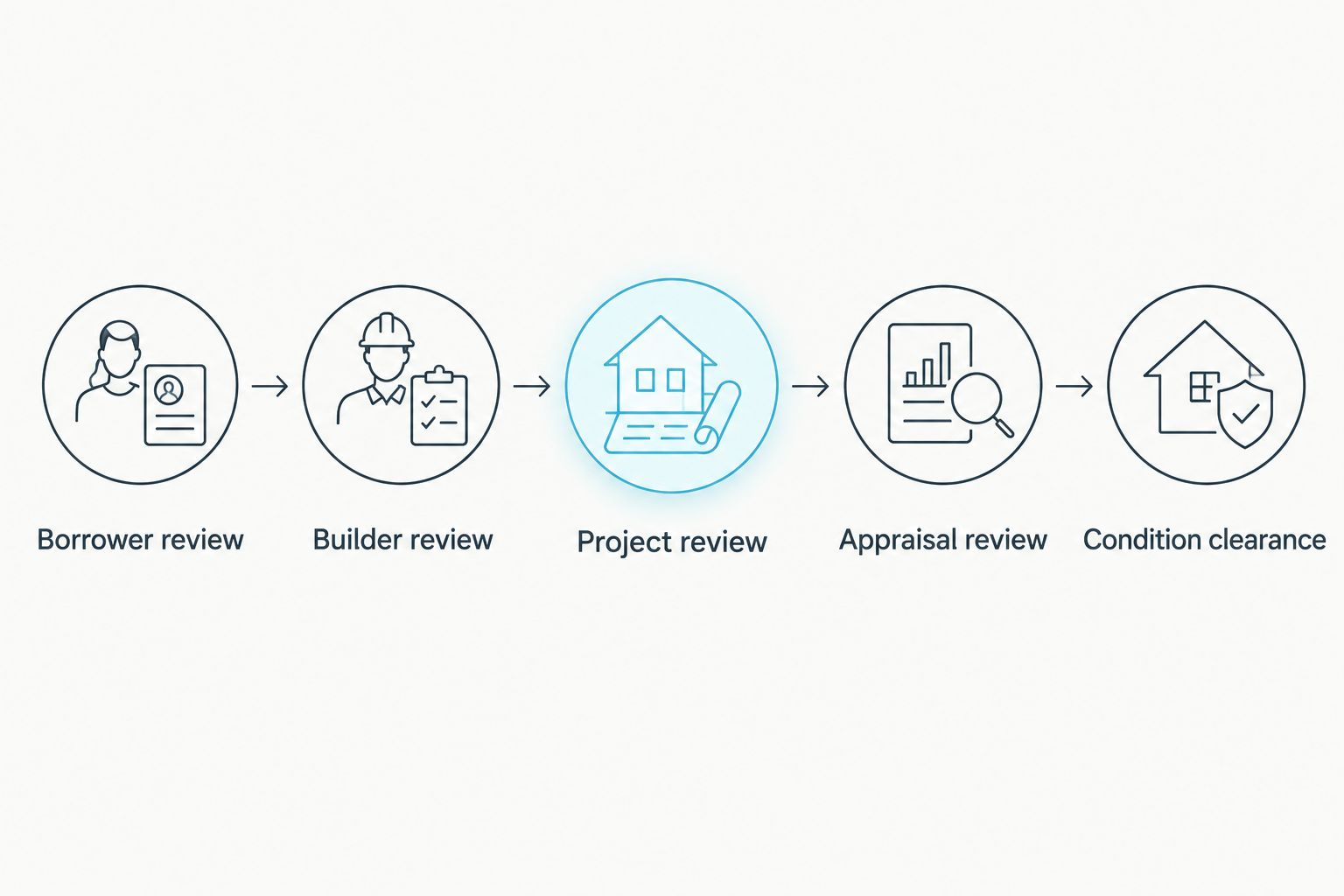
Ask which reviews can proceed together and which require another task to finish first.
Why the construction loan approval timeline varies
The useful question is not just how busy the lender is. It is which parts of your file remain unresolved and whether they prevent other reviews from starting.
These factors explain why an estimate changes:
- Borrower documentation: Missing statements, unexplained transactions, or inconsistent application details leave questions for underwriting. Ask exactly what evidence resolves each question.
- Builder acceptance: A contractor’s availability does not establish lender acceptance. Confirm the builder review requirements before relying on a proposed construction start.
- Plans and budget: Changes to specifications, scope, or the construction contract can affect documents already under review. Send a coordinated revision rather than separate, conflicting updates.
- Appraisal dependencies: A valuation based on proposed improvements needs usable project information. Ask whether the appraiser has everything required to complete the assignment.
- Permits and title: Local approvals and property ownership issues involve parties outside the underwriting team. Identify which items are required for approval, closing, or a later draw.
- Outstanding conditions: A response that does not answer the underwriter’s question leaves the condition open. Request written confirmation of acceptance rather than assuming silence means clearance.
For a 2026 build, track dependencies as carefully as deadlines. A permit issue and a missing account statement require different owners, even when both appear on the same lender checklist.
How can you reduce avoidable approval delays?
Submit a coordinated package and manage open conditions in writing. Sending documents quickly helps only when those documents are complete, consistent, and responsive to the lender’s request.
Confirm project fit before collecting everything
Describe whether you are building a primary residence, a rental, or a property intended for sale. State whether you own the land, have selected a builder, and have completed plans. Ask the lender to identify any eligibility issue before you invest more time in that application.
Do not treat approval for an existing-property mortgage as approval for a ground-up project. The property’s condition and intended use matter to the financing discussion.
Use a single document checklist
Get the lender’s checklist rather than relying on a generic construction-loan list. Assign each requirement to the borrower, builder, lender, title company, or another responsible party.
Keep a dated record of submissions and revisions. When the lender requests a replacement document, confirm whether it supersedes the earlier version throughout the file.
Make condition responses easy to review
Respond to the actual question. If underwriting requests evidence of a transaction’s source, sending the same account statement again does not necessarily establish where the money originated.
Ask for clarification when a condition is unclear. A precise request saves more time than repeated uploads of unrelated material.
Protect consistency until closing
Discuss material changes in your finances or project with the lender before assuming the existing approval remains valid. Changes to the borrowing entity, builder, contract, or scope can affect the basis of review.
Keep your builder informed about financing milestones without presenting estimates as commitments. That distinction protects your schedule from assumptions neither party has confirmed.
Does preapproval mean I can start construction?
Preapproval is not authorization to begin lender-funded work. Ask which borrower, builder, and project requirements remain open, and whether work started before closing affects eligibility or title requirements.
Before signing a mobilization agreement, get the lender’s position in writing. Your construction contract and financing documents need compatible expectations about when work begins and how the builder receives payment.
Is final approval the same as getting construction funds?
Final approval is not the same as receiving a construction draw. Closing requirements and disbursement conditions still determine when money becomes accessible.
Ask what the initial disbursement covers, who receives it, and what documentation the lender requires. Then confirm how later draws work, including any inspections, completion evidence, or other conditions stated in your loan documents.
Can disclosure rules affect my closing date?
For covered consumer mortgages, federal disclosure requirements create timing rules separate from underwriting. These rules do not establish a universal construction loan approval timeline, and they do not apply identically to every business-purpose or construction transaction.
The Consumer Financial Protection Bureau’s mortgage disclosure guidance provides these distinctions:
- 3 business days for the Loan Estimate: For a covered transaction, the lender generally must deliver or mail the Loan Estimate within 3 business days after receiving an application.
- 6 application items: For this disclosure rule, an application consists of your name, income, Social Security number to obtain a credit report, property address, estimated property value, and requested mortgage loan amount. This is not the same as a complete underwriting file.
- 3 business days before consummation: For a covered transaction, you generally must receive the Closing Disclosure at least 3 business days before becoming contractually obligated on the loan.
The applicable business-day definitions differ under these rules. Ask the lender to calculate the dates for your transaction rather than counting them yourself from a general summary.
For a 2026 closing, confirm whether these consumer mortgage rules apply to your loan’s purpose and structure. A disclosure deadline is not an approval promise. Receiving a Loan Estimate does not mean your borrower file, builder, or project has passed underwriting.
What should you ask before accepting a timeline estimate?
A useful estimate identifies its starting point, endpoint, and assumptions. Ask the lender to explain those details before you use the date in a purchase agreement or builder contract.
Use this short question list:
- Does the estimate start at application submission or when underwriting receives a complete file?
- Does it include builder acceptance and appraisal review?
- Which permit or title items must be resolved before closing?
- What remains outstanding today, and who owns each item?
- Does the proposed date describe approval, closing, or the first draw?
- What change would require the lender to revise that date?
For mortgage brokerage, Loanguys is best suited to investors and homeowners seeking its stated DSCR, fix-and-flip, bridge, bank-statement, and short-term rental programs. The benefit is access to a discussion across those financing categories; the limitation is that the stated program list does not establish construction eligibility or an approval deadline. Describe your project to Loanguys rather than assuming a related loan category covers your build.
Discuss your project financing
Explain your property, construction scope, and intended use before relying on a financing timeline.
FAQ
What's the construction loan approval timeline for my project?
Your construction loan approval timeline depends on the lender’s requirements and the readiness of your borrower, builder, and project files. Request separate estimates for underwriting approval, closing, and the first draw.
Does construction loan preapproval guarantee final approval?
Construction loan preapproval does not guarantee final approval. Ask for the remaining borrower, builder, appraisal, and project conditions in writing.
Can I apply before my building plans are finished?
Ask the lender whether it accepts an initial application before plans are finished and which reviews require final documents. An early discussion does not mean the project is ready for final underwriting.
Will changing my builder affect construction loan approval?
Changing your builder can affect the lender’s builder and project reviews. Confirm the new contractor’s acceptance and any replacement documents before assuming the existing schedule still applies.
Does a Loan Estimate mean my construction loan is approved?
A Loan Estimate is not loan approval. For covered consumer mortgages, it describes estimated loan terms and transaction costs rather than confirming that underwriting conditions are satisfied.
Can I receive all construction funds at closing?
Do not assume all construction funds will be released at closing. Your loan documents govern the initial disbursement and the requirements for subsequent draws.
Does Loanguys publish a guaranteed construction approval deadline here?
No guaranteed construction approval deadline is stated here for Loanguys mortgage brokerage. Confirm project eligibility, outstanding requirements, and estimated milestones directly before setting contractual dates.
One last thing
Ask what must happen immediately before the first draw, not just before approval. That question connects financing to the moment your builder actually needs funds.
Before committing to a 2026 construction start, put the lender’s answer beside your builder’s payment schedule. Resolve any mismatch before signing a deadline that assumes money will be accessible merely because underwriting is complete.


