


How much can you borrow with a mobile home park loan?
Your mobile home park loan amount is limited by the property’s accepted value, its ability to cover debt payments, and the lender’s program rules—not by a universal borrowing maximum. For a 2026 purchase or refinance, the practical limit is the lowest amount those tests support. Your approved loan balance also differs from usable proceeds after payoffs, closing expenses, and any required reserves or holdbacks.
TL;DR
- Your mobile home park loan amount depends on accepted property value, debt coverage, and program limits.
- LoanGuys is a mortgage broker for investors comparing investment property financing; confirm mobile home park eligibility before applying.
- A larger approved balance does not necessarily mean more usable cash at closing.
- Verified collections and operating expenses matter more than projected rent increases.
Why this matters
A seller’s asking amount does not establish how much a lender will advance. A park can have substantial land value yet generate insufficient operating income to support the requested debt. The reverse also happens: strong collections do not eliminate collateral or program restrictions.
Start with records, not a borrowing target. The rent rolls to mobile home park loan underwriting workflow explains how the park’s operating information fits into the financing review. Your goal is to identify which constraint limits the deal before committing cash to due diligence.
How much can you borrow with a mobile home park loan?
You can borrow up to the amount supported by the lender’s collateral, cash-flow, borrower, and program requirements. The binding limit is the lowest applicable ceiling. There is no single dollar maximum that applies to every mobile home park or every financing source.
Property value
- What determines the ceiling: Accepted collateral value multiplied by permitted loan-to-value
- What to verify: Which valuation basis the lender uses
Debt coverage
- What determines the ceiling: Underwritten operating income relative to required debt payments
- What to verify: Accepted income, expenses, and coverage requirement
Program limits
- What determines the ceiling: The selected lender’s minimum, maximum, and property eligibility rules
- What to verify: Whether the park and requested balance qualify
Borrower capacity
- What determines the ceiling: Required equity, liquidity, credit, and ownership structure
- What to verify: Cash needed at closing and after closing
Net proceeds
- What determines the ceiling: Approved balance less payoffs, expenses, reserves, and holdbacks
- What to verify: Actual funds available for your transaction
Ask the lender to identify the limiting test in writing. Without that explanation, a preliminary loan estimate tells you little about what must improve to support a larger balance.
Start with the value-based limit
Loan-to-value, or LTV, compares the loan balance with the lender’s accepted property value. Multiply that accepted value by the permitted LTV to calculate the value-based ceiling. Ask whether the lender uses appraised value, acquisition basis, or another defined basis for your transaction.
Do not substitute the seller’s valuation for the lender’s accepted value. A preliminary discussion based on an offering memorandum remains preliminary until the relevant valuation and property reviews are complete.
Then calculate the cash-flow limit
For income-producing commercial property, debt service coverage ratio, or DSCR, compares underwritten net operating income with debt service. Net operating income is property income after operating expenses, before mortgage payments and income taxes. The lender determines which income and expense adjustments it accepts.
Divide accepted annual net operating income by the required DSCR to find the annual debt service the property supports under that test. The repayment terms then determine the corresponding loan principal. Use the lender’s underwriting assumptions, not the seller’s projected cash flow.
Purchase financing: size the loan and your equity together
Best for: acquiring a park with a defined purchase agreement and documented operations. Purchase financing establishes the lender-funded portion of the acquisition; your equity covers the remaining acquisition requirement and other cash obligations.
The benefit is a financing structure tied directly to the acquisition. The limitation is that an acceptable purchase agreement does not guarantee the requested borrowing amount. Valuation, operating results, property condition, and borrower approval still control the outcome.
For your 2026 acquisition budget, separate the down payment from the rest of the cash needed to close. Include due diligence, lender-required reserves, and work that will not be funded through the loan. Ask which expenses are eligible for financing rather than assuming they are included.
Refinancing: distinguish the new balance from cash released
Best for: replacing existing park debt or evaluating whether available equity supports cash-out. A refinance is sized against the new lender’s requirements, not simply the balance of the existing mortgage.
The benefit is the opportunity to restructure existing debt. The limitation is that the new loan must first satisfy required payoffs and transaction obligations before any remaining proceeds become available to you.
Request a proceeds statement alongside the proposed loan balance. It should distinguish existing debt repayment, transaction deductions, required reserves, and any cash released. A larger new mortgage is not, by itself, evidence that the refinance produces meaningful cash-out.
Bridge financing: separate closing funds from future advances
Best for: a transitional park with a defined improvement plan and repayment strategy. Bridge financing addresses a different situation from financing a stabilized property, but availability and eligible uses depend on the lender.
The benefit is a structure that can account for a transition plan. The limitation is execution risk: improvements, leasing, collections, and the eventual refinance or sale must support repayment. Do not treat future performance as already achieved.
If a proposal includes future advances, distinguish the initial funded balance from the total commitment. Ask what inspections, documentation, completion milestones, or other conditions release additional funds. Money subject to an unmet condition is not cash available at closing.
Purchase
- Best for: Acquiring an operating park
- Main benefit: Connects financing to the acquisition
- Main limitation: Requires equity and completed underwriting
Refinance
- Best for: Replacing existing park debt
- Main benefit: Restructures an existing obligation
- Main limitation: Payoffs and deductions reduce usable proceeds
Bridge
- Best for: Executing a property transition
- Main benefit: Can accommodate a defined improvement plan
- Main limitation: Requires execution and a credible repayment exit
Why your mobile home park loan amount varies
These factors explain why similar-looking parks receive different financing decisions. They are underwriting considerations, not a universal eligibility checklist; confirm the selected lender’s requirements for your property.
- Collections and occupancy: Occupied lots, billed rent, and collected rent are different measures. Reconcile the rent roll with payment records and explain delinquencies.
- Operating expenses: Taxes, insurance, utilities, management, and maintenance affect the income available to service debt. Identify expenses the current owner pays outside the property accounts.
- Home ownership mix: Tenant-owned homes and park-owned homes create different operating responsibilities. Separate lot income from home-rental income and document ownership.
- Infrastructure and condition: Roads, drainage, water, sewer, and other systems create maintenance and capital obligations. Document known issues and obtain a scope for required work.
- Legal use and collateral: Zoning, permitted sites, title, access, and environmental findings affect whether the lender accepts the property as collateral.
- Borrower and loan structure: Available equity, liquidity, experience, repayment terms, and program rules affect the request. Additional borrower cash does not automatically cure a property eligibility problem.
Keep your 2026 underwriting package consistent across these categories. A rent roll that conflicts with financial statements creates questions about which figures represent actual operations.
How do I estimate my borrowing limit before applying?
Build a preliminary estimate from verified property information, then ask the lender to replace your assumptions with its accepted figures. Follow this sequence rather than starting with the largest balance you want.
- Verify income. Collect leases, the current rent roll, payment records, and operating statements. Separate actual collections from unpaid charges and projected increases.
- Normalize expenses. Identify recurring operating obligations and explain unusual items. Keep capital projects separate from routine expenses so the lender can apply its own treatment.
- Confirm value. Ask which valuation basis applies and whether the property’s ownership mix or condition requires additional review.
- Test loan limits. Request the permitted LTV, required debt coverage, repayment assumptions, and applicable program ceiling. Identify which test produces the lowest balance.
- Reconcile proceeds. Deduct required payoffs and transaction obligations from the proposed funding. Keep reserves and conditional future advances separate from unrestricted funds.
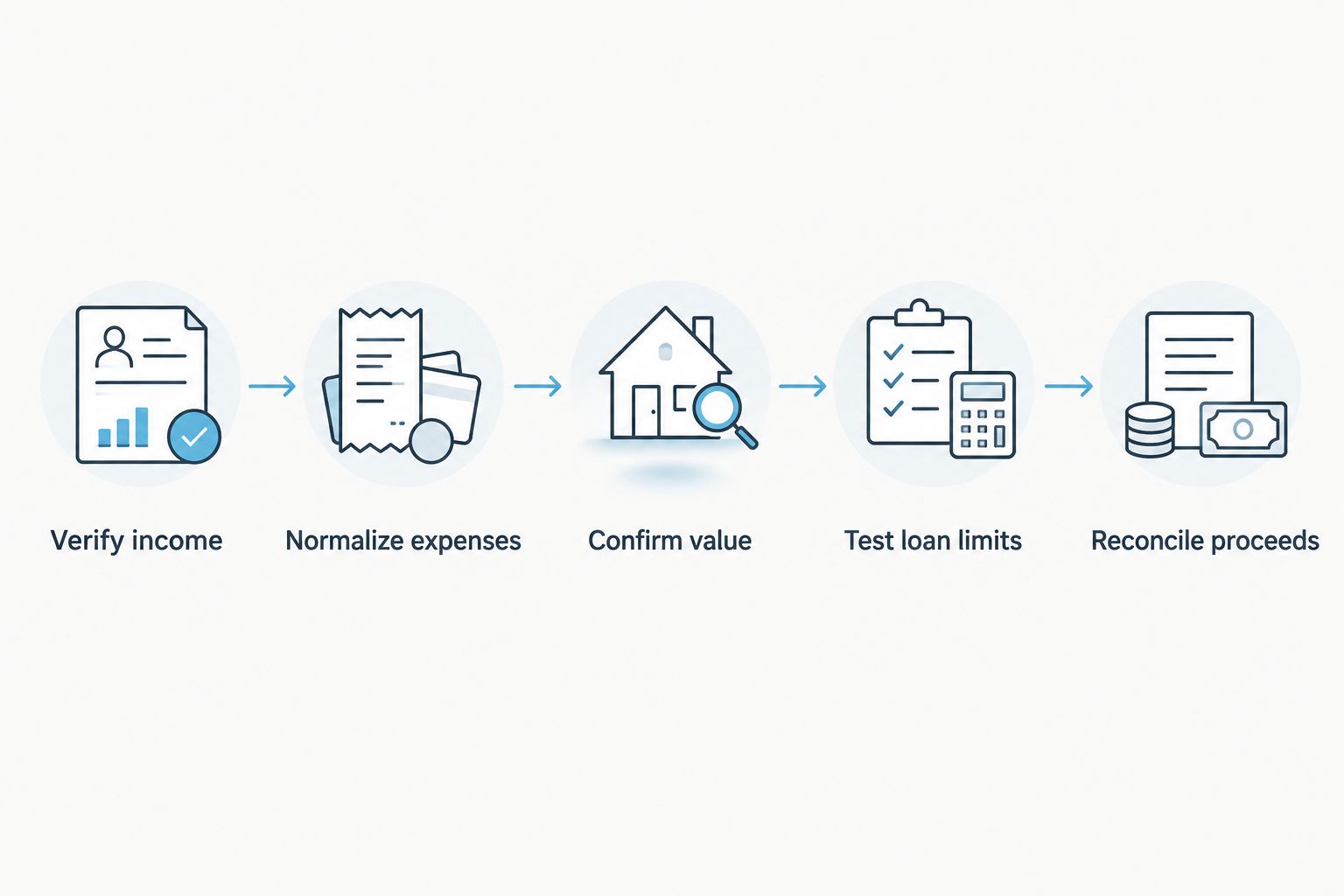
Calculate the limiting balance before deciding how much cash the transaction requires.
Ask for the result as both a gross loan balance and an estimated net funding amount. That distinction makes competing proposals easier to compare and exposes any gap your equity must cover.
Can a higher appraisal increase how much I can borrow?
A higher accepted appraisal can increase the value-based ceiling, but it does not override cash-flow or program limits. If debt coverage already limits the request, additional collateral value alone does not solve the shortfall.
A commercial real estate appraisal addresses property value; underwriting separately determines whether accepted operating income supports the requested debt. Keep those questions separate when discussing the result with your lender.
For a 2026 application, provide the appraiser and lender with consistent property records, including the site inventory, ownership details, leases, and known infrastructure issues. Accurate records support a reviewable valuation; they do not guarantee a particular value or loan approval.
Can better rent collections increase my loan amount?
Better documented collections can strengthen underwritten income when the lender accepts them. Announced rent increases and unpaid rent do not establish the same repayment capacity as collected income.
Ask how the lender treats recent improvements in collections, newly occupied sites, concessions, and delinquent balances. The relevant question is not simply whether income increased, but whether the selected program recognizes that income when sizing the loan.
Avoid improving the spreadsheet while leaving operating obligations out. Higher collections accompanied by higher utility, insurance, management, or maintenance expenses do not translate directly into the same increase in net operating income.
Does a bigger down payment guarantee approval?
A bigger down payment reduces the requested loan and can help when value or debt coverage limits the transaction. It does not guarantee approval if the property falls outside the lender’s eligibility rules.
Protect your remaining liquidity. Committing more equity to closing leaves less cash for operations, repairs, and unexpected obligations after acquisition. Evaluate the post-closing position alongside the loan request rather than treating approval as the only objective.
Before increasing your contribution, ask the lender whether additional equity resolves the identified issue. Get a direct answer. There is little benefit in restructuring your cash commitment around a collateral problem the lender will not accept.
What should you ask a mortgage broker before submitting the deal?
LoanGuys is a mortgage broker for real estate investors comparing investment property loan programs. Its stated offerings include DSCR and bridge financing, but those program categories do not establish mobile home park eligibility or a borrowing maximum.
When discussing investment property financing with LoanGuys, start with the property type and transaction purpose. Confirm that an available lender accepts the park before relying on a residential rental loan description or submitting a complete application.
Ask for clear answers to these questions:
- Does the proposed lender accept this park’s home ownership mix and infrastructure?
- Which income records and operating expenses will determine debt coverage?
- What limits the initial estimate: value, income, borrower capacity, or program rules?
- Which funds are available at closing, and which depend on later conditions?
- What remains subject to appraisal, inspections, document review, and final approval?
For your 2026 comparison, request the same breakdown from every financing source. Compare usable proceeds, cash required, repayment structure, and unresolved conditions—not just the headline loan balance.
FAQ
What's the maximum mobile home park loan amount I can get?
Your maximum mobile home park loan amount is the lowest balance supported by the lender’s value, cash-flow, borrower, and program requirements. Request property-specific sizing rather than relying on a general maximum.
Can I borrow against the full appraised value of a mobile home park?
An appraisal does not establish permission to borrow the full property value. The lender applies its permitted loan-to-value and other underwriting requirements.
Does owning more lots automatically qualify me for a bigger loan?
More lots do not automatically support a bigger loan. Accepted value, verified income, operating expenses, and property eligibility determine how the site count affects underwriting.
Is mobile home park financing the same as financing a manufactured home?
Mobile home park financing and individual manufactured home financing involve different collateral and operating considerations. Confirm that the lender finances the park itself rather than only individual homes.
Can a DSCR loan finance a mobile home park?
A loan’s DSCR label does not establish mobile home park eligibility. Confirm the permitted property type and underwriting method with the proposed lender before applying.
How much cash will I actually receive from a park refinance?
Your refinance cash proceeds equal the funded amount remaining after required payoffs, transaction deductions, reserves, and holdbacks. Ask for a proceeds statement rather than treating the new loan balance as cash-out.
Can LoanGuys tell me how much I qualify to borrow?
Ask LoanGuys to confirm mobile home park eligibility before requesting a property-specific financing estimate. A preliminary estimate remains subject to the selected lender’s underwriting and approval.
One last thing
Ask the lender: “What specifically prevents this park from supporting a larger loan?” The answer identifies whether your next move is additional equity, stronger operating documentation, a different financing structure, or a different property.
Then ask what evidence would change that answer. A clear financing decision explains both the borrowing limit and the conditions behind it; a large preliminary balance without those details is not a closing plan.


