


How much does mortgage insurance cost on an investment property loan?

Mortgage insurance cost on an investment property loan depends on the loan program and whether it requires private mortgage insurance (PMI); there is no single premium that applies to every rental-property mortgage in 2026. Conventional financing generally requires mortgage insurance above 80% loan-to-value, while DSCR loans commonly have no separate PMI charge—but property insurance, interest, and closing costs still affect your total expense.
TL;DR
- Mortgage insurance cost on investment property loan quotes depends on program, loan-to-value, credit, and coverage structure.
- Conventional mortgages generally require mortgage insurance above 80% loan-to-value; rental-property eligibility also depends on lender and insurer rules.
- DSCR loans commonly omit separate PMI, but that does not establish which financing option costs less overall.
- Loanguys offers investment-property financing; compare written terms rather than choosing solely on whether PMI appears.
Why this matters
No PMI does not mean no insurance—and it does not mean the least expensive loan. Mortgage insurance protects the lender against certain losses from borrower default. Landlord insurance protects against covered property and liability risks, subject to the policy.
For a 2026 rental purchase, separate these expenses before calculating cash flow. Review DSCR loan closing costs alongside the mortgage payment so an absent PMI line does not hide other financing expenses.
How much does mortgage insurance cost on an investment property loan?
Your mortgage insurance charge is the premium quoted for your specific loan, not a standard investment-property surcharge. Start by establishing whether the program requires coverage at all. A lender's written quote should identify any monthly premium, upfront premium, or lender-paid arrangement.
The Consumer Financial Protection Bureau's general guidance on conventional mortgages explains that PMI is typically required when the down payment is below 20%. For investment-property financing, that general threshold does not establish eligibility: the lender and mortgage insurer must also accept the occupancy, property, and transaction.
Conventional investment-property mortgage
- Mortgage insurance treatment: Generally requires mortgage insurance above 80% loan-to-value, subject to program and insurer eligibility
- Best for: Investors who qualify through conventional underwriting
- Main benefit: Established mortgage structure with documented underwriting requirements
- Main limitation: A smaller down payment does not guarantee an eligible rental-property loan
DSCR rental-property loan
- Mortgage insurance treatment: Commonly has no separate borrower-paid PMI premium; confirm the specific program
- Best for: Investors seeking qualification based primarily on property rental income
- Main benefit: Rental income is central to qualification
- Main limitation: Interest, fees, reserves, and prepayment terms still need comparison
FHA owner-occupied mortgage
- Mortgage insurance treatment: Requires FHA mortgage insurance under applicable program rules
- Best for: Buyers who will occupy an eligible property and rent other units
- Main benefit: Supports qualifying owner-occupied purchases
- Main limitation: Not a financing route for a property purchased solely as a non-owner-occupied rental
Treat the table as a program distinction, not a personalized approval. Ask for written terms tied to the same property, occupancy, loan amount, and financing purpose before choosing between options.
Conventional investment loans: verify PMI above 80% LTV
Loan-to-value, or LTV, measures the mortgage balance against the property value used by the lender. A higher LTV means you are borrowing a larger share of that value. For purchases, lenders generally calculate LTV using the lower of the purchase price or appraised value.
At 80% LTV or below, a conventional mortgage generally does not require PMI. Above that threshold, do not assume you can simply add insurance and obtain approval. Investment-property limits depend on the loan program, property characteristics, and mortgage insurance eligibility.
If mortgage insurance applies, ask how the lender collects it:
- Monthly borrower-paid coverage: A separate recurring charge adds to the payment while coverage remains required.
- Upfront borrower-paid coverage: You pay a premium at closing, potentially with additional monthly coverage depending on the arrangement.
- Lender-paid coverage: The lender pays for coverage, generally in exchange for a higher interest rate rather than a separate monthly PMI charge.
The advantage of a separate monthly premium is visibility. Its disadvantage is the additional recurring payment. Lender-paid coverage removes that separate line, but the associated rate does not automatically decrease when your equity rises.
For a 2026 comparison, request the same loan structure with each applicable coverage arrangement. Compare the payment, closing funds, and expected ownership period—not just the insurance line.
DSCR investment loans: confirm the absence of separate PMI
DSCR means debt-service coverage ratio. It compares a property's qualifying income with its qualifying debt payment; the exact calculation depends on the lending program. Rental-property DSCR programs commonly do not charge separate PMI.
That structure is useful when you want the property’s rental income to play the central role in qualification. It does not remove credit review, appraisal requirements, property insurance, or the lender's other conditions.
Loanguys is a mortgage broker for real estate investors comparing DSCR and other investment-property loan programs. Its loan programs include DSCR, bridge, fix-and-flip, bank-statement, and short-term rental financing. The relevant limitation is that program names alone do not establish your approved terms or total borrowing expense.
For any DSCR proposal, check whether the payment is fully amortizing or interest-only, whether the rate adjusts, and whether early repayment triggers a penalty. These terms affect your financing decision even when the mortgage insurance line is absent.
Owner-occupied rentals: FHA insurance follows different rules
An FHA mortgage is not a substitute for a pure investment-property mortgage. FHA generally requires you to establish a principal residence in the property, subject to its occupancy rules and permitted exceptions.
A qualifying buyer can purchase an eligible property with up to 4 units, occupy one unit, and rent the others. That arrangement differs from buying a property where every unit is held for rental use and you live elsewhere.
FHA uses mortgage insurance premiums rather than conventional PMI. Its coverage includes upfront and annual components, with duration determined by applicable loan characteristics. Do not apply conventional PMI cancellation assumptions to FHA financing.
The benefit is an owner-occupied financing route for eligible buyers. The drawback is that occupancy requirements and FHA insurance rules restrict how you use it. Choose the correct occupancy classification before comparing insurance charges.
Why mortgage insurance requirements and premiums vary
The same property can produce different financing proposals because coverage depends on more than the rental address. For your 2026 application, ask the lender to identify these factors explicitly:
- Loan program: Conventional PMI, FHA insurance, and DSCR structures follow different requirements. Confirm which program the proposal actually uses.
- Loan-to-value: The amount borrowed relative to the lender's property value affects coverage requirements and eligibility.
- Credit profile: Conventional mortgage insurers consider borrower credit when determining coverage eligibility and premiums.
- Occupancy and property: Investment use, unit count, and property type affect which loan and insurance programs accept the transaction.
- Coverage arrangement: Monthly, upfront, split-premium, and lender-paid structures distribute the insurance expense differently.
- Loan characteristics: Loan term, fixed or adjustable interest, and transaction details can affect insurance treatment and the quote.
A generic online calculator cannot settle these questions. Use it only after you know the applicable loan program and have a lender-confirmed premium or coverage arrangement.
How do you check the insurance charge before committing?
Use this sequence to keep the comparison focused. Ask each lender for the same property, borrowing amount, occupancy classification, and loan purpose so differences in the proposals are visible.
- Confirm occupancy. State whether you will live in the property or rent the entire property to others. Do not select owner-occupied financing simply to obtain different terms.
- Identify coverage. Ask whether mortgage insurance is required and whether it is borrower-paid, lender-paid, or absent from the program.
- Separate insurance. List mortgage insurance separately from landlord, hazard, flood, and title insurance. Each serves a different purpose.
- Compare terms. Review the payment, upfront charges, amortization, adjustable-rate provisions, and prepayment conditions together.
- Verify exit rules. Obtain written cancellation terms if PMI applies, or written repayment and refinance conditions if considering another structure.
Keep the written responses with your financing documents. A verbal statement that a loan has “no mortgage insurance” does not explain the interest rate, fees, or restrictions attached to that loan.
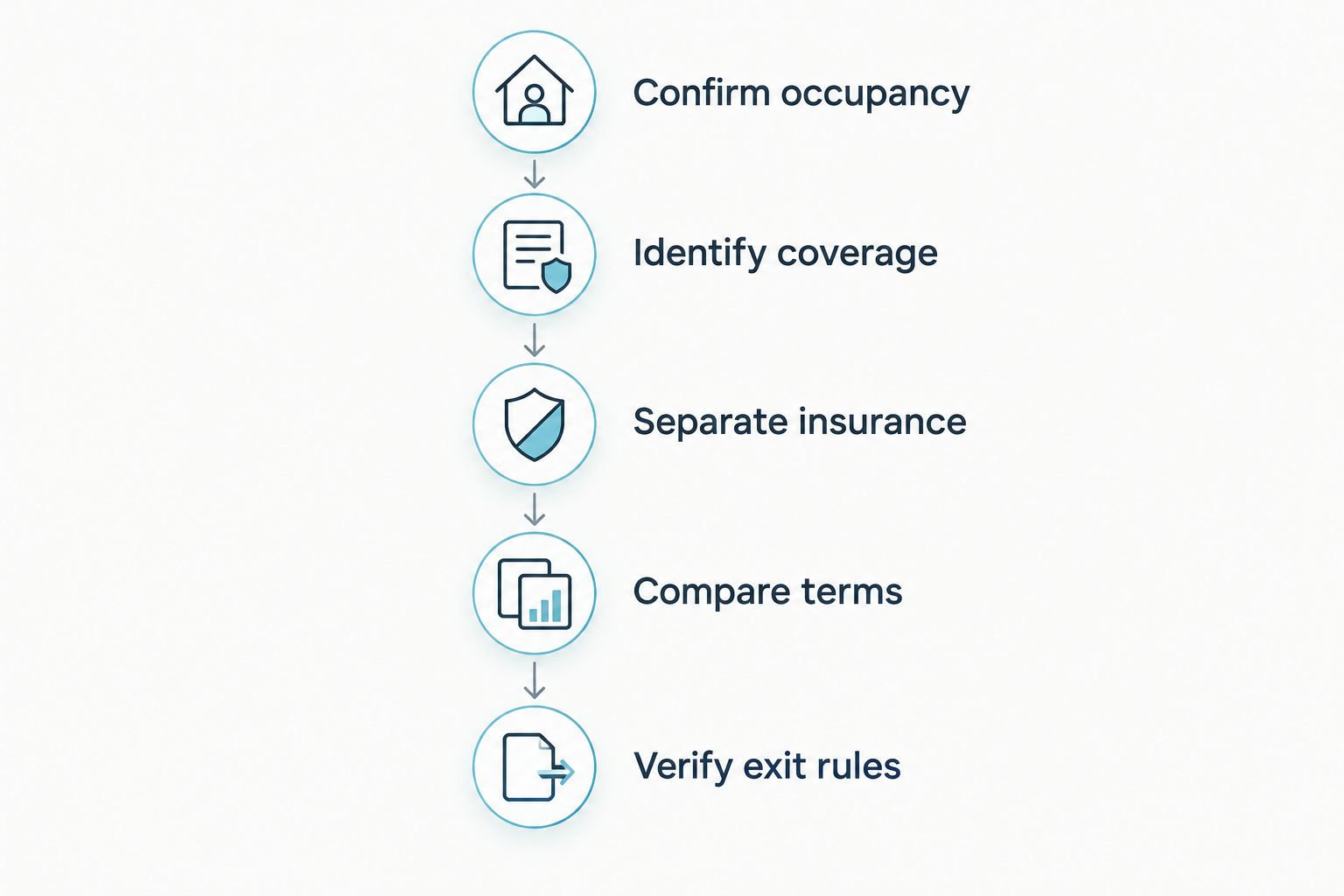
Establish the loan structure before comparing its insurance treatment.
Can I avoid PMI with a 20% down payment?
A 20% down payment generally puts a conventional purchase mortgage at 80% LTV, where PMI is ordinarily not required. That does not guarantee investment-property approval, and a low appraisal can change the calculation.
Preserve enough funds for closing, required reserves, and property operations. Using more cash to avoid PMI is not automatically the right decision if it leaves your rental unable to absorb repairs or vacancy.
Does PMI automatically end at 78% LTV on a rental?
The 78% automatic-termination rule under the federal Homeowners Protection Act generally applies to qualifying principal-residence mortgages, not pure investment-property loans. The CFPB's PMI cancellation guidance should not be treated as a blanket cancellation promise for rentals.
For an investment-property loan, obtain the applicable investor, insurer, and servicer cancellation requirements in writing. Do not assume appreciation or principal reduction alone triggers cancellation.
Does no PMI make a DSCR loan better?
No PMI is a coverage feature, not a verdict on total financing expense. A DSCR loan and a conventional mortgage can differ in interest, upfront charges, required cash, and repayment restrictions.
Loanguys investment-property financing includes programs for different borrower and property situations. Compare the actual written offers against your holding period and rental cash flow; do not infer a winner from the absence of one charge.
FAQ
Do all investment-property loans require mortgage insurance?
No. Conventional mortgages generally require mortgage insurance above 80% LTV, subject to eligibility, while DSCR programs commonly have no separate PMI premium. Confirm the treatment in your specific loan proposal.
How do I find the mortgage insurance cost on an investment property loan?
Request a written quote identifying whether mortgage insurance applies and how it is collected. Ask the lender to separate any premium from property insurance, interest, and other loan charges.
Is mortgage insurance the same as landlord insurance?
No. Mortgage insurance protects the lender against certain default losses, while landlord insurance addresses covered property and liability risks. A loan without PMI can still require property insurance.
Can I get a rental-property loan with less than 20% down?
Some conventional investment-property programs permit less than 20% down, but eligibility depends on the transaction, lender, and insurer. Do not assume every property or borrower qualifies.
Can I use an FHA loan for a property I will not live in?
FHA purchase financing generally requires a principal residence, not a property bought solely as a non-owner-occupied rental. Eligible buyers can occupy one unit of an approved multi-unit property and rent the others.
Can I cancel PMI after my rental property increases in value?
Appreciation does not automatically cancel PMI on an investment-property loan. Ask the servicer for its applicable cancellation rules, valuation requirements, and payment-history conditions.
What should I compare besides PMI in 2026?
Compare the full payment, closing charges, required reserves, loan term, amortization, and prepayment conditions. Evaluate property insurance and operating expenses separately when estimating rental cash flow.
One last thing
Ask who the insurance protects before asking how to remove it. That question separates lender protection from coverage your rental business still needs, and it prevents you from deleting the wrong expense from your cash-flow forecast.
For a 2026 purchase, request a written explanation of every insurance line and every condition attached to its removal. Then compare the financing with those expenses included—not with an assumed future refinance or cancellation doing the work.


