


How much down payment do you need for a mobile home park loan?
Your mobile home park loan down payment equals the purchase amount minus the loan proceeds applied to the acquisition; there is no single percentage that applies to every park or lender in 2026. Your total cash requirement also includes closing expenses, required reserves, and any repairs you must fund yourself. Base your budget on a property-specific financing proposal, not an advertised maximum loan-to-value ratio.
TL;DR
- Your mobile home park loan down payment depends on approved acquisition proceeds, not just advertised LTV.
- Property cash flow can limit borrowing even when the valuation supports a larger loan.
- Budget closing expenses, reserves, and repairs separately from your down payment.
- Loanguys offers investment-property financing guidance; confirm mobile home park eligibility before choosing a program.
Why this matters
A down payment estimate is only useful if the proposed loan can close on the property you intend to buy. A park's operating income, infrastructure, ownership structure, and appraisal all belong in that review. The seller's projected income is not a substitute for documented collections.
Start with the records that support the loan request. The rent rolls to mobile home park loan underwriting workflow addresses the connection between rental records and financing review. For your 2026 acquisition budget, separate money spent at closing from money that must remain accessible afterward.
How much down payment do you need for a mobile home park loan?
You need enough equity to cover the difference between the acquisition amount and the approved acquisition financing. Determine that difference only after confirming the lender's valuation basis, cash-flow analysis, and treatment of any proceeds reserved for improvements.
Use this sequence before you commit to a financing assumption:
- Confirm eligibility. Describe the entire property, including occupied lots, vacant lots, park-owned homes, utilities, and intended improvements. Ask whether the proposed program finances that combination.
- Confirm valuation. Ask which value the lender uses to calculate loan-to-value, or LTV. Establish how the purchase agreement and appraisal affect that calculation.
- Confirm cash flow. Request the lender's accepted operating income, expenses, and debt-service assumptions. Do not rely solely on the seller's financial summary.
- Confirm proceeds. Separate money applied to the acquisition from money held for repairs or other purposes. The total loan balance is not necessarily the amount delivered toward the purchase.
- Confirm liquidity. Obtain an itemized closing estimate and the reserve requirements. Then calculate the equity contribution and the cash you must retain.
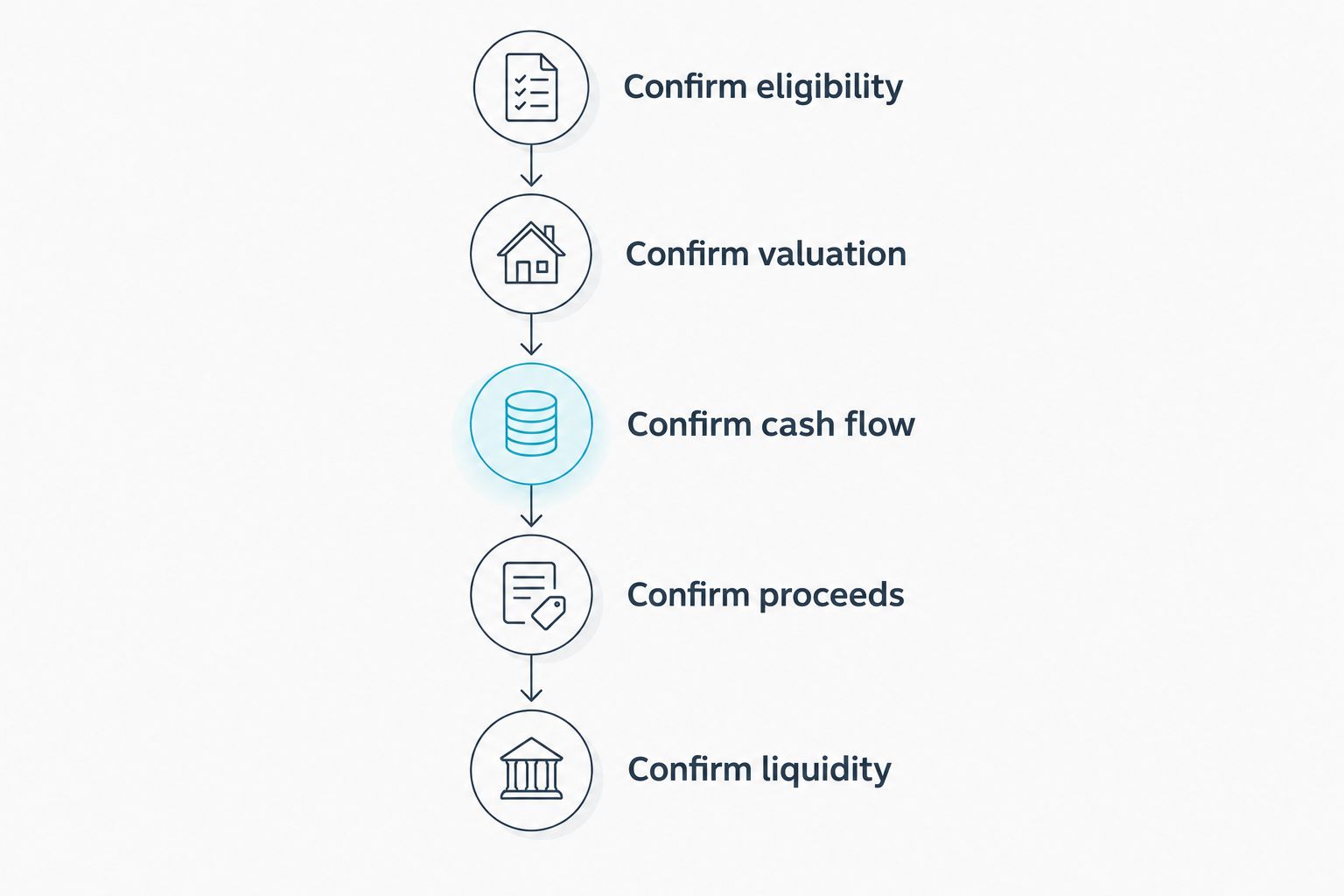
Calculate your equity contribution after confirming how much financing actually applies to the acquisition.
Keep the calculation in writing. If the proposed financing changes during underwriting, update the equity requirement and your remaining liquidity together. A larger cash contribution is not a sound solution if it leaves the property without an operating cushion.
Down payment versus total cash required
The down payment is your equity contribution toward the acquisition. Total cash required is broader. It includes transaction expenses and any additional funds the lender requires you to contribute or retain.
Use separate budget lines rather than grouping everything under a single down payment estimate:
Acquisition equity
- What it covers: The portion not covered by acquisition financing
- What to confirm: Approved proceeds applied to the purchase
Closing expenses
- What it covers: Lender, legal, title, recording, and other transaction expenses
- What to confirm: Itemized estimates and payment timing
Due diligence
- What it covers: Appraisal, inspections, surveys, and environmental review as applicable
- What to confirm: Required reports and responsibility for payment
Required reserves
- What it covers: Funds retained or deposited under the financing terms
- What to confirm: Amount, location, and release conditions
Immediate improvements
- What it covers: Work not paid through acquisition proceeds
- What to confirm: Scope, funding source, and timing
Operating cushion
- What it covers: Cash retained to handle ownership expenses
- What to confirm: Funds remaining after closing obligations
Not every transaction requires every report or reserve category. Request the actual requirements before ordering work. Also identify expenses payable before closing, because those payments affect the cash you have left to complete the acquisition.
For your 2026 budget, distinguish cash paid, cash held, and cash still accessible. Those categories answer different questions. Money in a restricted reserve account does not provide the same operating flexibility as unrestricted cash.
How LTV affects your down payment
Loan-to-value compares the loan balance with the property value accepted by the lender. It describes financing relative to collateral value, not necessarily financing relative to your negotiated acquisition amount.
The basic relationship is:
LTV = loan amount ÷ accepted property value.
Ask which loan amount appears in that calculation and which value supports it. If the accepted value is below the acquisition amount, the financing calculation does not automatically cover the difference. You must address that difference through additional equity, an approved financing change, or a renegotiated transaction.
An advertised maximum LTV is a program limit, not a commitment to fund your acquisition at that level. Property eligibility, underwriting, and loan conditions still apply. Use the approved acquisition proceeds to calculate your down payment, not the headline LTV alone.
How cash flow affects your down payment
A property's income can constrain the loan amount independently of its value. For commercial-property analysis, debt-service coverage ratio, or DSCR, compares net operating income with debt service over the same period.
DSCR = net operating income ÷ debt service.
Net operating income is income remaining after operating expenses, before debt service. Ask the lender to show which income and expenses enter its calculation. Collections, vacancy assumptions, management expenses, taxes, insurance, and utility obligations deserve particular attention.
A seller's statement that the park produces positive cash flow does not establish how much debt the lender will approve. Different expense assumptions change the income available to support payments. Request the underwriting calculation rather than treating gross scheduled rent as qualifying income.
For a 2026 purchase, review insurance and tax assumptions against the transaction you are financing. Do not carry the seller's historical expenses into your budget without checking their applicability.
Why mobile home park loan down payments vary
The equity requirement changes when the approved loan amount or the allocation of proceeds changes. Review these factors before treating an initial estimate as a closing budget:
- Property income: Documented collections and operating expenses establish the cash flow available for debt service. Reconcile the rent roll with financial records.
- Accepted value: The appraisal and the lender's valuation rules affect the collateral basis for financing. Identify any gap between accepted value and the acquisition amount.
- Home ownership: Separate tenant-owned homes from park-owned homes. Ask how the lender treats land rent, home rent, and any homes included in the transaction.
- Infrastructure condition: Roads, water, sewer, and other systems belong in due diligence. Determine which repairs require your cash and which qualify for financing.
- Borrower finances: Document the proposed equity sources, outstanding obligations, and liquidity remaining after closing. Ask which funds satisfy the lender's requirements.
- Financing structure: Acquisition proceeds, improvement funding, reserve deposits, and subordinate debt affect how much cash reaches the purchase. Review them separately.
These factors do not translate into an automatic down payment adjustment. Their effect belongs in the property-specific underwriting decision. Ask for revised proceeds whenever a material assumption changes.
Can you reduce the cash you contribute?
You can evaluate different equity sources and transaction structures, but each must meet the lender's requirements. Reducing your personal contribution is not the same as reducing the property's financing risk. Borrowed funds add obligations, while outside equity changes ownership economics.
Your own liquid funds
- Best for: Buyers prioritizing a straightforward ownership structure
- Benefit: Avoids adding a separate financing obligation
- Limitation: Reduces cash available after closing
Equity partner
- Best for: Buyers willing to share ownership and decision-making
- Benefit: Adds capital without treating the contribution as ordinary acquisition debt
- Limitation: Requires agreement on control, distributions, and exit rights
Seller financing
- Best for: Buyers and sellers willing to negotiate deferred payment
- Benefit: Changes when part of the acquisition obligation is paid
- Limitation: Requires senior-lender acceptance when combined with senior financing
Borrowing against another asset
- Best for: Buyers with another suitable financing source
- Benefit: Provides a separate source of acquisition funds
- Limitation: Adds debt and can place another asset at risk
Present the full structure before underwriting. Do not assume a seller note counts as equity, that partner funds need no documentation, or that borrowing elsewhere has no effect on qualification.
For each proposed source, ask whether it is permitted, how to document it, and how it affects required liquidity. Have legal and tax advisers review ownership and seller-financing agreements before you sign.
Does a larger down payment guarantee approval?
A larger down payment reduces the requested acquisition financing, but it does not resolve every eligibility issue. Property condition, legal use, title, environmental concerns, and unsupported income still require review.
Ask the lender to distinguish a financing shortfall from a property eligibility problem. Additional equity addresses the former; it does not automatically fix the latter. Keep financing and due-diligence protections aligned with the purchase agreement through legal counsel.
What should you send before requesting a financing proposal?
Send enough information to identify the property and support the proposed transaction. A useful initial package includes:
- The property address, acquisition terms, and proposed ownership entity.
- A rent roll separating occupied and vacant lots.
- An inventory distinguishing park-owned and tenant-owned homes.
- Operating statements and records supporting rental collections.
- Available tax, insurance, and utility information.
- Known repair needs and planned improvements.
- Your proposed equity sources and ownership experience.
Ask for a written summary of eligibility, expected acquisition proceeds, required reserves, and unresolved conditions. For a 2026 transaction, keep the financial package current as underwriting progresses. Explain changes in occupancy or collections rather than submitting conflicting versions without context.
Where mortgage-broker guidance fits
Loanguys is a mortgage broker for real estate investors and homeowners seeking alternatives to traditional bank financing. Its stated loan programs include DSCR, bridge, fix-and-flip, bank-statement, and short-term rental financing.
The benefit of discussing investment-property financing with Loanguys is getting the conversation focused on your financing needs. The limitation is equally important: those program categories do not establish that a particular mobile home park qualifies. Confirm collateral eligibility and property-specific terms before relying on any proposed structure.
FAQ
What's the minimum mobile home park loan down payment?
Your minimum down payment is the equity needed after approved acquisition financing is applied to the purchase. Obtain a property-specific proposal because a general program limit does not establish your approved proceeds.
Is the down payment the same as cash to close?
No, the down payment is only the equity contribution toward the acquisition. Closing expenses, reserve deposits, and other transaction adjustments affect the cash needed to complete the purchase.
Does a lower appraisal mean I need more cash?
A lower accepted value can reduce financing tied to that value and increase the equity gap. Confirm the revised acquisition proceeds before deciding whether to add cash or renegotiate.
Can seller financing cover my down payment?
Seller financing is not automatically accepted as a substitute for borrower equity. Ask the senior lender whether it permits the seller note and how its payments affect underwriting.
Can I use a residential DSCR loan to buy a mobile home park?
Do not assume a residential DSCR program accepts a mobile home park. Confirm the program's collateral requirements; evaluating property cash flow does not make every income-producing property eligible.
Do park-owned homes affect the financing review?
Park-owned homes require clear disclosure because the transaction includes more than lot rental income. Separate home ownership, rental income, expenses, and title information for the lender's review.
Should I put all my available cash into the down payment?
Do not commit all available cash without accounting for required reserves and operating needs. Compare the proposed equity contribution with the funds remaining after closing and immediate improvements.
One last thing
Ask what you will have left after closing, not just what you must bring. A financing proposal that consumes your repair funds or operating cushion deserves another review, even when the acquisition proceeds appear sufficient.
Before accepting terms, write down the acquisition equity, transaction expenses, restricted reserves, and unrestricted cash remaining. That final line is your check against buying a park you can close on but cannot adequately fund afterward.


