


How much down payment is required for a construction loan?

There is no single construction loan down payment requirement: your required contribution depends on the lender’s financing limits, the project’s approved costs and value, and any land equity the lender accepts. For a 2026 application, budget separately for closing expenses, required reserves, and construction costs the loan does not cover—your down payment is not your total cash requirement.
TL;DR
- Your construction loan down payment requirement depends on approved financing, project costs, and accepted land equity.
- Land equity can reduce additional cash needed, but lender valuation and existing liens determine the credit.
- Loanguys offers mortgage brokerage for investors and homeowners; confirm project eligibility before choosing a financing program.
- Compare total cash required, equity timing, and draw conditions—not just the quoted down payment.
Why this matters: A project can meet a lender’s equity requirement and still lack the cash needed to keep construction moving. Your county permits and construction loan draw schedule should match the builder’s payment obligations before you commit to a financing structure.
How much down payment is required for a construction loan?
Your required down payment is the borrower contribution left after the lender determines how much it will finance and what existing equity it will recognize. A percentage alone does not answer the question. You also need to know what that percentage applies to.
Construction lenders evaluate project costs, collateral value, and borrower eligibility. The approved loan can be constrained by more than one limit, so a strong appraisal does not automatically mean the lender will finance every budget item.
Ask for a written breakdown that separates these components:
Required equity
- What it means: Your contribution to the approved project
- What you need confirmed: The calculation and eligible sources
Land equity
- What it means: Accepted ownership value in the building site
- What you need confirmed: Valuation method and treatment of liens
Additional cash
- What it means: Money still needed after accepted equity credits
- What you need confirmed: Amount and funding deadline
Closing expenses
- What it means: Transaction expenses outside the equity calculation
- What you need confirmed: Which expenses are financed or paid separately
Reserves
- What it means: Funds required to remain accessible
- What you need confirmed: Whether they must remain after closing
Unfunded costs
- What it means: Project expenses outside approved financing
- What you need confirmed: Who pays and when payment is due
For your 2026 budget, request both the equity calculation and the cash-to-close estimate. Then ask what money you must retain after closing rather than contribute to the project.
Understand loan-to-cost and loan-to-value
Loan-to-cost, or LTC, compares the loan amount with the lender’s eligible project costs. Loan-to-value, or LTV, compares the loan amount with the property value the lender uses. For construction financing, that valuation often considers the property as completed under the approved plans.
These measurements are not interchangeable. A project can satisfy a lender’s value limit but exceed its cost-based limit, leaving you responsible for the difference.
Ask which limit controls your approved loan amount. Also ask whether the quoted loan includes funds held back for future construction draws rather than money available immediately.
Can land equity replace a cash down payment?
Land equity can satisfy part of a construction lender’s required borrower contribution when the lender accepts it. Owning the lot does not automatically eliminate your additional cash requirement.
The lender must determine the land value it recognizes and account for existing debt secured by the property. Its treatment of recently purchased land, transferred ownership, or changes in value also matters.
Before relying on land equity, establish:
- Ownership: Confirm who holds title and whether that matches the proposed borrower.
- Existing liens: Obtain current payoff information for debt secured by the land.
- Accepted value: Ask which valuation basis the lender will use.
- Equity credit: Request the exact contribution credited toward the project.
- Remaining cash: Separate additional equity from closing expenses and reserves.
Land equity has a clear advantage: it can reduce the new cash you must contribute. Its limitation is equally important: equity in a lot does not pay a contractor’s invoice unless the financing structure makes funds available for that purpose.
Keep your land documents, purchase records, and payoff information together. Resolve discrepancies before the lender prepares the final financing structure.
Which construction loan structure fits your project?
The construction loan down payment requirement is only part of choosing financing. You also need a structure that matches what happens when the building is complete.
Use the following distinctions when discussing a 2026 project. These are financing structures, not claims that any particular lender offers or approves them.
Construction-to-permanent
- Best for: Borrowers building a home to occupy
- Main advantage: Connects construction financing with a permanent mortgage
- Main limitation: Conversion depends on the program’s completion conditions
Construction-only
- Best for: Borrowers arranging a separate exit loan or sale
- Main advantage: Separates the building phase from long-term financing
- Main limitation: Requires repayment or replacement financing at maturity
Investor construction financing
- Best for: Developers building to sell or rent
- Main advantage: Evaluates financing around the investment project
- Main limitation: Exit strategy and project eligibility remain central
Owner-builder financing
- Best for: Qualified borrowers managing their own build
- Main advantage: Allows direct involvement where the lender permits it
- Main limitation: Eligibility depends on the lender’s owner-builder rules
Construction-to-permanent financing
Construction-to-permanent financing connects the construction phase with a permanent mortgage under the program’s terms. Confirm the conditions for conversion, including completion documentation and any updated borrower review.
Do not treat conversion as unconditional. Ask what happens if construction finishes late or the completed property differs from the approved plans.
Construction-only financing
Construction-only financing covers the building phase and requires an exit through repayment, sale, or replacement financing. Its usefulness depends on having a realistic exit strategy before construction begins.
If you intend to refinance, review the expected permanent loan’s eligibility requirements early. Approval for the construction loan does not establish approval for a future mortgage.
Investor and owner-builder projects
A property built for sale, a future rental, and a home you will occupy present different financing questions. State the intended use accurately rather than choosing an occupancy category to pursue a smaller contribution.
Owner-builders should disclose their role at the beginning. A lender that accepts a licensed general contractor does not necessarily accept a borrower acting as the builder.
Why construction loan down payment requirements vary
Your contribution reflects the project and the lender’s underwriting rules. Focus on these drivers rather than assuming a quoted percentage applies to every build:
- Financing limits: Cost-based and value-based limits can produce different maximum loan amounts.
- Land position: Accepted land equity and existing liens affect the additional cash needed.
- Project scope: Site work, utilities, permits, and construction must fit the approved budget.
- Borrower finances: Credit, documented income, existing obligations, and accessible assets affect eligibility.
- Property use: Owner-occupied housing and investment construction require different underwriting considerations.
- Builder and exit: Builder acceptance, completion planning, and repayment strategy affect whether the proposed structure works.
For a 2026 application, provide the same project assumptions to every lender you compare. Different budgets or occupancy assumptions produce offers that are difficult to evaluate side by side.
How do you calculate the cash you actually need?
Build your cash plan around timing, not just the down payment. Money needed at closing, money retained as reserves, and money needed during construction serve different purposes.
Use this sequence before signing a building contract:
- Approved budget: Obtain an itemized project budget and confirm which expenses the lender accepts.
- Loan limits: Identify the controlling cost-based or value-based financing limit.
- Equity credit: Confirm accepted land equity and other eligible contributions in writing.
- Closing cash: Request a breakdown of your remaining contribution and separately payable expenses.
- Draw timing: Match lender disbursements with the builder’s payment schedule.
- Remaining reserves: Confirm what funds must remain accessible after closing and during construction.
The sequence prevents a common planning error: treating the approved loan amount as cash available on demand. Construction proceeds are disbursed under the loan’s draw conditions, which you need to reconcile with payment obligations.
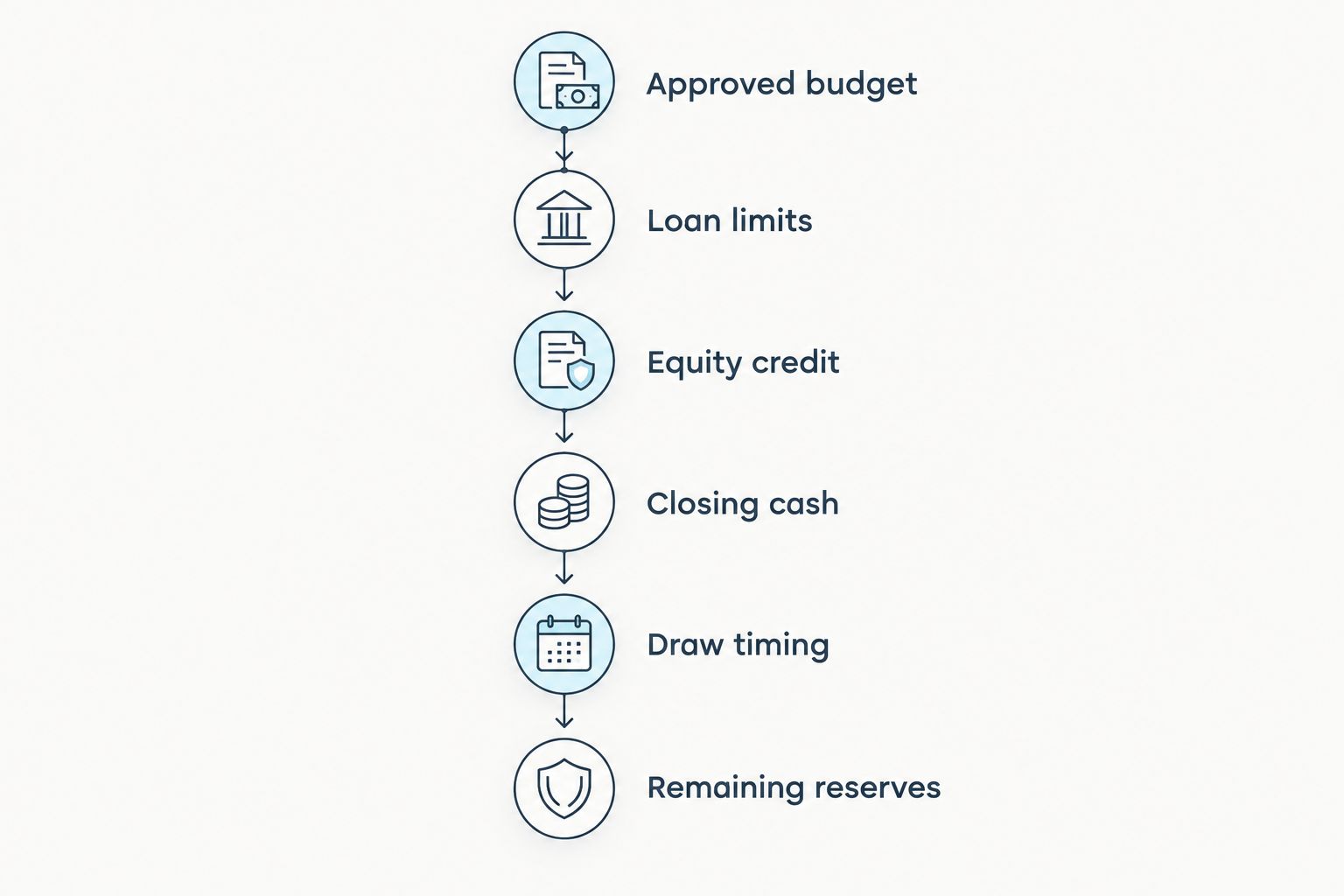
Confirm equity credit before calculating closing cash, then check draw timing and remaining reserves.
Also identify who funds a budget overrun. A contingency allowance helps organize the budget, but it does not establish that the lender will increase the loan if construction becomes more expensive.
How should you compare construction loan lenders?
Compare written project assumptions before comparing headline terms. Each proposal should identify the approved budget, accepted land value, maximum financing, required contribution, and draw conditions.
The phrase down payment can obscure different calculations. Ask whether the lender means additional cash, total borrower equity including land, or a percentage of a particular cost or valuation basis.
Comparisons of construction loan lenders also need jurisdictional context: an Australian lender comparison does not establish U.S. down-payment requirements. For a U.S. build, confirm the proposed lender’s rules for your location, property use, and construction structure.
Ask each lender the same questions:
- What costs are excluded from the approved project budget?
- How is land equity calculated and documented?
- Must borrower funds be contributed before lender draws begin?
- What inspection or completion evidence triggers a draw?
- Who covers work completed before a draw is released?
- What happens if the appraisal does not support the requested financing?
Choose the offer you can fund through completion, not simply the smallest initial contribution. A lower contribution does not solve a mismatch between contractor payments and lender disbursements.
What should investors ask a mortgage broker?
Loanguys is a mortgage broker for real estate investors and homeowners seeking alternatives to traditional bank financing. Its stated programs include DSCR, fix-and-flip, bridge, bank-statement, and short-term rental loans; ground-up construction eligibility requires a specific program discussion.
That range supports conversations about different financing needs. The limitation is that a program name alone does not establish suitability for an unfinished property, construction draws, or a particular exit strategy.
When approaching Loanguys, describe whether you are building, renovating, acquiring land, or refinancing a completed property. Include your intended occupancy, ownership structure, builder arrangement, and repayment plan.
For a rental exit, distinguish construction financing from financing on the completed rental. DSCR means debt-service coverage ratio: it compares qualifying property income with debt obligations under the lender’s calculation. Future rental income does not by itself establish that a DSCR program finances construction.
What documents should you prepare before applying?
For a 2026 construction application, organize the information that establishes both project feasibility and your contribution. The lender’s exact document requirements govern, but preparing these categories makes the financing discussion more concrete:
- Land records: Purchase agreement or ownership documents, plus existing loan information.
- Project details: Plans, specifications, itemized budget, and construction contract.
- Builder information: The builder’s identity and documents requested for lender review.
- Approval status: Available permits and a clear account of outstanding approvals.
- Financial records: Documents supporting income, assets, liabilities, and contribution sources.
- Exit plan: Intended occupancy, sale strategy, or permanent financing approach.
Keep the budget consistent across your builder contract and financing submission. If the scope changes, update the lender rather than assuming the original approval covers the revision.
FAQ
What is the construction loan down payment requirement in 2026?
The construction loan down payment requirement in 2026 depends on the lender’s financing limits, approved project costs, property value, and accepted equity. Request a written calculation that separates total equity from additional cash needed.
Can I use land I already own as my construction loan down payment?
Accepted land equity can count toward a construction loan’s required contribution. The lender determines the recognized value, subtracts applicable secured debt, and applies its eligibility rules.
Does my down payment include closing expenses?
Your down payment is not the same as your total closing cash. Ask which closing expenses are paid separately, which are financed, and what reserves must remain after closing.
Do I still need cash if I own the lot outright?
Owning the lot outright does not automatically eliminate your cash requirement. Accepted equity must satisfy the lender’s contribution rules, and you still need a plan for separately payable expenses and reserves.
Is a construction-to-permanent loan better than a construction-only loan?
Construction-to-permanent financing fits borrowers seeking a connected path into a permanent mortgage, while construction-only financing requires a separate repayment or financing exit. Compare completion conditions and exit eligibility before choosing.
Can I use a DSCR loan to pay for ground-up construction?
Do not assume a DSCR loan finances ground-up construction. Confirm whether the program accepts unfinished properties or instead requires a completed rental property.
Can Loanguys confirm my construction financing eligibility?
Ask Loanguys to review the project and identify whether an available program fits. Confirm ground-up construction eligibility, required equity, and draw conditions before treating any financing discussion as approval.
One last thing
Ask for the equity calculation and the draw schedule together. A project can have sufficient equity on paper while still needing cash between a contractor’s invoice and the lender’s disbursement. Resolve that timing before construction starts.


