


Investment Property Loans With Bad Credit: What's Actually Possible

Yes, you can still finance an investment property with bad credit - but the loan choices get narrower and the cash you need goes up.
If your score is below about 680, I’d expect higher rates, more money down, and tighter reserve rules. In most cases, the loans that still work fall into three buckets:
- DSCR loans for rentals that cash-flow
- Asset-based or Non-QM loans for borrowers with assets or credit issues
- Bridge, hard money, or fix-and-flip loans for rehabs, flips, and BRRRR deals
Here’s the short version:
- Around 660–679 FICO: many investors can still get DSCR or short-term investor loans
- Around 620–659 FICO: deals often need more equity, more reserves, and lower LTV
- Below 620: options usually shift to hard money, bridge, or no-FICO/asset-based programs
- For rentals, lenders care a lot about DSCR, often targeting 1.20 to 1.25
- For flips and BRRRR deals, lenders care more about ARV, rehab plan, equity, and exit plan
- Weak credit often means 25%–35% down, 6–12 months of PITIA reserves, and rates that can move from roughly 8%+ on DSCR loans to 12%–14% on hard money
Bad Credit? 3 Ways to Still Get Investment Property Loans
sbb-itb-e7c549b
Quick comparison
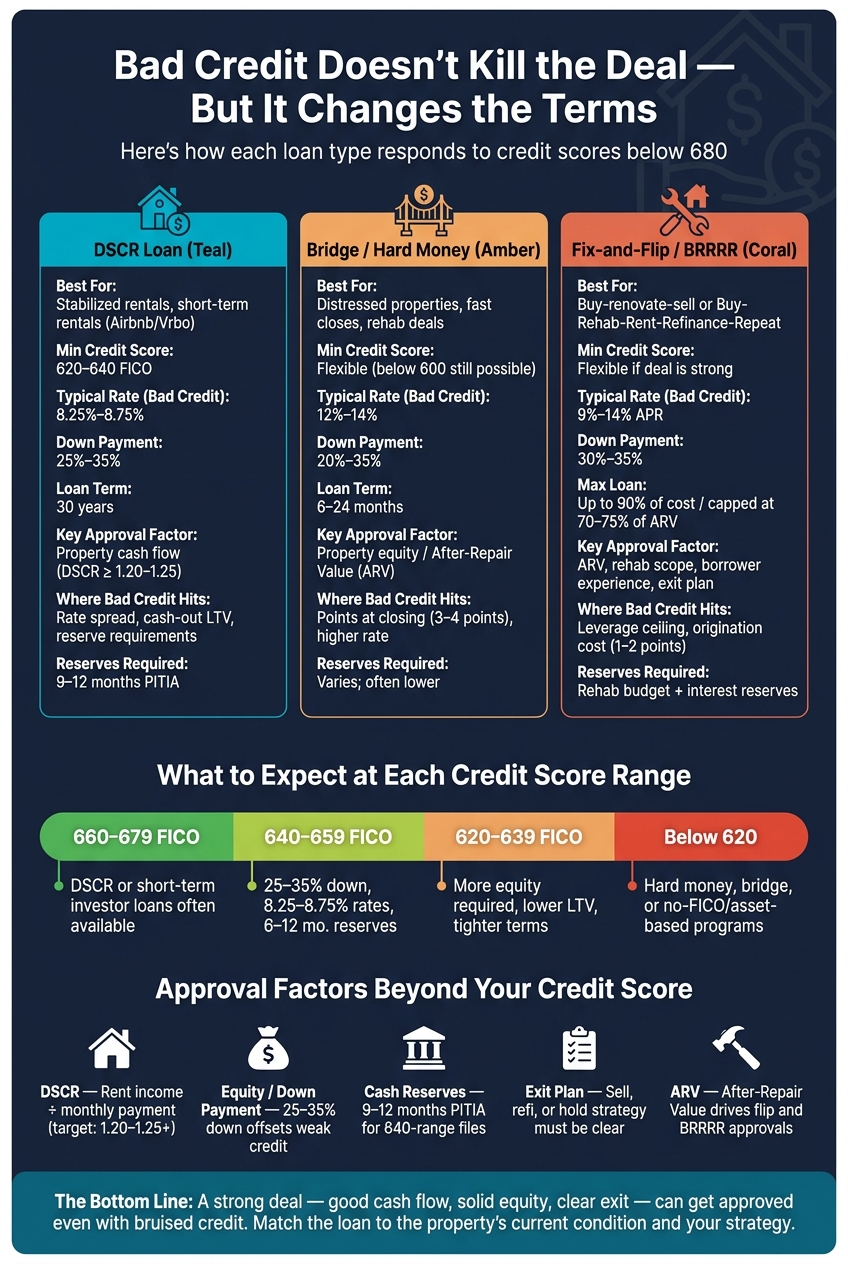
Investment Property Loans With Bad Credit: Loan Types Compared
| Loan type | Best use | Credit range that may work | What lenders focus on | What usually gets harder with bad credit |
|---|---|---|---|---|
| DSCR | Stabilized rentals, some short-term rentals | Often 620–640+ | Rent cash flow and DSCR | Rate, LTV, reserves, cash-out limits |
| Asset-based / Non-QM | Self-employed investors, recent credit issues | Case by case | Assets, equity, borrower profile | Down payment and pricing |
| Bridge / Hard money | Fast closes, distressed homes, rehab deals | More flexible | Equity, ARV, exit plan | Points, rate, leverage |
| Fix-and-flip | Buy-renovate-sell | Flexible if the deal is strong | ARV, rehab scope, experience | Max leverage and cost |
| BRRRR | Buy, rehab, rent, then refi | Often mixed: short-term first, DSCR later | Stage 1: ARV; Stage 2: DSCR and appraisal | Refi LTV, seasoning, reserve rules |
In other words: bad credit does not kill the deal by itself. I’d look at the property first, then match it to the loan that fits its current condition and your exit plan.
Loan options that may still work with bad credit
DSCR loans for rental and short-term rental properties
DSCR loans qualify you based on the property's rental income, not your W-2 income or personal DTI. Most programs set the minimum credit score around 620–640 FICO, and 640 is the more common cutoff for standard rate tiers.
If your score falls in the 640–659 range, you’ll usually need:
- 25%–35% down
- Rates around 8.25%–8.75%
- 6–12 months of PITIA in reserves
Most lenders want to see a DSCR of 1.20–1.25 for a cleaner approval. Some will go down to 1.0, and a few niche programs allow as low as 0.75 if you bring other strengths to the deal, like a larger down payment. In plain English, a stronger DSCR can sometimes make up for a slightly lower credit score.
For short-term rentals such as Airbnb or Vrbo, lenders usually cut projected gross income by 20% before they calculate DSCR. That haircut helps account for vacancy and seasonal swings.
When the rental income doesn’t quite carry the deal, lenders start looking harder at your assets, cash reserves, and overall borrower profile.
Non-QM and asset-based loans for self-employed investors
Non-QM and asset-based loans are aimed at investors who don’t fit standard underwriting, especially self-employed borrowers or people dealing with credit issues like late payments or a past bankruptcy.
These loans tend to put more weight on liquidity, equity, and investor experience than full-document income. So if your credit score is lower, a stronger balance sheet or a solid track record may help steady the file.
There’s also a timing point that matters. Standard DSCR programs often require 2–4 years of seasoning after a bankruptcy. Some specialized asset-based programs, though, may fund as soon as one day after discharge.
If the property needs repairs or the deal has to move fast, short-term financing usually becomes the better lane.
Bridge and hard money loans when speed or property condition is the priority
Bridge and hard money loans are short-term loans built for speed, distressed properties, and a clear exit plan. Terms usually run 6 to 24 months.
Here, lenders care most about the property's current value or after-repair value, your equity position, and how you plan to pay off the loan. Credit still plays a role, but it usually takes a back seat to the deal itself.
Rates often land around 10%–13%+. If your score is below 600, you may see rates closer to 12%–14% with 3–4 points due at closing. That’s expensive money, no doubt. But it can still work when your credit is weak and the property, equity, or exit plan is strong.
That short-term setup is also why these loans often feed into flip financing or a BRRRR refinance.
| Loan Type | Typical Rate (Bad Credit) | Term | Down Payment | Primary Approval Factor |
|---|---|---|---|---|
| DSCR (640–659 FICO) | 8.25%–8.75% | 30 years | 25%–35% | Property cash flow (DSCR) |
| Bridge / Hard Money (below 600) | 12%–14% | 6–24 months | 20%–35% | Property equity / ARV |
| Asset-Based / Non-QM | Varies | Varies | 25%–35% | Liquidity, equity, experience |
From here, the main issue is matching the loan to the deal type: rental, flip, or BRRRR project.
Fix-and-flip and BRRRR financing: when the deal matters more than the credit score
Fix-and-flip loans based on ARV, scope, and borrower experience
With fix-and-flip financing, lenders tend to underwrite the project more than the borrower. That’s why flips are often easier to fund than standard investment loans.
In plain English: fix-and-flip lenders usually care more about ARV, scope of work, and your exit plan than your FICO score.
Approval is driven mostly by ARV and total project cost. Most lenders will fund up to 90% of the purchase-and-rehab cost, but they usually cap the total loan at 70% to 75% of ARV. So if a property has an ARV of $300,000, the max loan amount is often about $210,000 to $225,000 - even if your credit isn’t strong.
Your borrower experience also carries more weight than many people think. Lenders see experienced flippers as lower risk, which can lead to more leverage and lower pricing. If you’re new, it often makes sense to start with smaller, cosmetic-only projects before taking on major structural work. A simple portfolio of past deals - with photos, budgets, and settlement statements - can go a long way in a lender meeting.
There’s another piece people sometimes miss: rehab funds usually come in draws, not all at once. You pay renovation costs upfront, then request reimbursement after each milestone is finished and inspected. So cash on hand matters. You’ll need enough liquidity to cover early renovation work and several months of payments before that first draw shows up.
Rates on fix-and-flip loans usually fall in the 9% to 14% APR range, with origination fees of 1 to 2 points. If your credit is weak, putting down 30% to 35% is often the most direct way to offset that and get the deal done.
If the plan is to keep the property instead of sell it, the usual next move is to refinance into long-term DSCR debt.
BRRRR strategy: short-term capital first, then refinance into DSCR
BRRRR starts with the same kind of short-term rehab financing, then moves into DSCR once the property is stable.
The BRRRR strategy - Buy, Rehab, Rent, Refinance, Repeat - works well for investors with lower credit because it splits the financing into two stages. And each stage is judged in a different way.
The buy and rehab portion uses short-term bridge or hard money financing, where ARV and the execution plan matter more than your FICO score. After the property is renovated and rented, you refinance into a long-term DSCR loan based on the stabilized rental income and the new appraised value.
For that refinance to go through, the property usually needs to be stabilized, the DSCR generally needs to hit 1.25, and the appraisal must include a Form 1007 rent schedule. Most lenders also want a 3- to 6-month seasoning period before they’ll use the new appraised value for a cash-out refinance instead of the original purchase price.
If your score is in the 640 to 659 range, you should generally expect a max LTV of 70% to 75% on the refinance.
One lever that can help on a tight deal is an interest-only structure during the first five years of the DSCR loan. That can improve your DSCR by about 10%, since the lender is underwriting a lower monthly payment. Sometimes that’s the gap between a file that stalls out and one that gets approved.
What bad credit actually changes in loan terms and approval
Once you know which loan types can work, the next step is understanding what bad credit changes in the deal itself: approval, pricing, leverage, and cash you need on hand.
The approval factors lenders actually review
FICO matters, but it isn't the whole story. When a lender looks at an investor file with bruised credit, they usually weigh FICO, cash flow, equity, reserves, and exit plan together.
On rental deals, lenders tend to check DSCR first, then get tighter on LTV, reserves, mortgage history, property condition, and exit plan. In plain English: a property that cash-flows well can help, but it won't erase other weak spots.
Recent mortgage late payments can be a bigger problem than a low FICO score by itself. In fact, mortgage lates within the last 12 months may do more damage than the score number, and standard DSCR terms often want a clean 24-month mortgage history. If your credit file has rough edges, a documented refinance plan or recent comps can help fill in gaps that the score alone can't solve.
How lower credit affects rates, points, down payment, and reserves
Lower credit usually makes the whole file more expensive. Strong-credit DSCR pricing may start around 6.00%, while borrowers in the 640–659 range often land closer to 7.25%–9.75%.
That spread matters. A higher rate means the property needs to cash-flow with more cushion to meet the DSCR test.
Down payment rules tighten too. A stronger file may get through with 20% down. Lower-credit files often need 25%–30%, and in some cases 30%–35%, to offset lender risk.
Reserves move the same way. Standard files may need 2–6 months of PITIA, while 640-range files often trigger 9–12 months. Lenders usually want those funds documented, and it helps if the money has been seasoned for at least 60 days before you apply.
Comparison table: DSCR vs. bridge vs. fix-and-flip for bad-credit investors
The weaker the credit file, the more lenders shift away from leverage and lean harder on reserves, equity, and deal quality.
| Feature | DSCR Loan | Bridge / Hard Money | Fix-and-Flip |
|---|---|---|---|
| Credit Sensitivity | Moderate - 620–640 floor; lower scores cut LTV and raise reserves | Low - equity and exit plan absorb weak credit | Moderate - best leverage tiers still reward 660–680+ |
| Max LTV with Weak Credit | 65%–70%; no-min-FICO programs cap at 50% | 50%–75% depending on equity | Up to 90% of cost / 75% ARV, but lower credit narrows this |
| Reserve Impact | 9–12 months PITIA for 640-range files | Varies; often lower | Rehab budget + interest reserves required |
| Where Bad Credit Hits Hardest | Rate spread and cash-out LTV | Pricing and points at closing | Leverage ceiling and origination cost |
DSCR loans usually make the most sense for long-term holds when the property is stabilized and the numbers pencil out, but weak credit can squeeze both rate and leverage. Bridge and hard money loans tend to absorb more credit risk by putting more weight on equity and exit strategy. Fix-and-flip financing is still driven by the deal, though the top leverage tiers usually go to borrowers with stronger credit profiles.
The next section covers how to strengthen your file and match the right loan to your deal type.
How to improve your approval odds and pick the right loan
How to strengthen your file before applying
The fastest way to improve your odds is to make your file look financeable, not flawless.
Start with revolving debt. Paying down credit card balances first can help a lot. If you can get utilization below 30% - and even better, close to 10% - your score may move up by 20 to 40 points in a single reporting cycle. That can make a big difference if you're trying to get past the 640 FICO line for a purchase loan.
Recent 30-day late payments can stop a standard investor loan cold. In many cases, waiting 3 to 6 months gives your file a better shot at approval. A larger down payment can help too. Moving up to 25% to 30% lowers the lender's risk and can also improve the DSCR math.
Property type matters more than many borrowers expect. Single-family homes and duplexes in liquid markets tend to be easier to finance than more complex assets.
Once the file looks cleaner, the next move is simple: pair the loan with the property's current use and condition.
Match the loan to the deal: rental, short-term rental, BRRRR, or flip
The best loan depends on how the property qualifies today.
| Deal Type | Best Loan Match | Key Qualifier |
|---|---|---|
| Stabilized rental (SFR or duplex) | DSCR loan | 1.0+ DSCR; 1.25+ gets better terms |
| Short-term rental (Airbnb/Vrbo) | STR-focused DSCR | Projected income is discounted |
| Self-employed or asset-heavy borrower | Non-QM / asset-based | Equity and exit plan matter most |
| Distressed property or speed-sensitive close | Bridge / hard money | Equity and exit plan carry the deal |
| Renovation and resale | Fix-and-flip | ARV, rehab budget, and exit strategy |
| BRRRR | Bridge first, then DSCR refi | Stabilize first, then refinance long term |
If the property is already tenant-occupied and producing cash flow at 1.25 DSCR or better, a DSCR loan is often the cleanest option - even with a credit score in the 640 range.
If the property needs repairs or lease-up first, bridge or hard money may be the better fit to get the deal closed. Then, once the property is rented and stabilized, you can move into a DSCR refinance.
Conclusion: what is actually possible with bad credit
At that stage, approval usually comes down to three things: cash flow, equity, and a clear way out.
A lower score matters less when the deal has strong cash flow, enough equity, cash reserves, and a plain-English exit plan. Investors with bruised credit often get approved when the deal itself does the heavy lifting - not the score.
FAQs
Can I qualify with recent late payments?
Yes, possibly. But a lot depends on the type of lender you're dealing with.
Conventional lenders often see recent late payments as a deal-breaker. By contrast, some asset-based and non-QM investor loans care more about the property's cash flow than your credit history.
That said, don't expect easy terms. If a lender is willing to move forward, you'll likely face:
- A larger down payment
- Lower LTV
- Higher rates
- Stronger cash reserve requirements
How much cash do I need beyond the down payment?
Beyond the down payment, lenders usually want cash reserves on hand to cover PITIA: principal, interest, taxes, insurance, and association dues.
In most cases, that means 2 to 12 months of mortgage payments sitting in reserve. If your credit score is lower, such as 640, lenders often look for 9 to 12 months. And if you're applying for a larger loan - especially above $1.5 million or $2.5 million - the reserve requirement can jump to 6 or 12 months.
Think of it as a financial cushion. Lenders want to see that you can keep making payments even if life throws you a curveball.
Which loan fits my rental, flip, or BRRRR deal?
It comes down to your plan and the property’s current shape.
- DSCR loans are usually a good match for stabilized rental properties.
- Hard money loans often make the most sense for fix-and-flips or heavy rehabs.
- Bridge loans can work well when you need to move fast or you have credit issues.
- If your credit score is very low or you’ve had a recent bankruptcy, specialty programs may ask for more equity and a lower LTV, often around 50%.


