


Rentometer comps to DSCR loan qualification: 2026 workflow

Instead of copying rental estimates into disconnected notes, use this 2026 Rentometer DSCR loan workflow to turn comparable rents into a documented financing worksheet. Use Rentometer for preliminary rent research, then replace your assumptions with the rent and payment figures the lender accepts before treating the result as qualification.
TL;DR
- Use this Rentometer DSCR loan workflow for preliminary screening, not proof of loan approval.
- Rentometer rental comps support your assumptions; lender-approved documentation determines qualifying rent.
- Loanguys offers mortgage-broker guidance for investors seeking DSCR financing.
- Keep rental income, housing payments, and operating cash flow separate in your worksheet.
Why this matters
A rental estimate answers what a property might rent for. A DSCR calculation answers whether qualifying income covers the payment under a particular loan program. Neither substitutes for underwriting.
Loanguys is best for real estate investors seeking mortgage-broker guidance on DSCR financing. Review Loanguys with that distinction in mind: the broker offers financing programs, while your rental research supplies supporting context rather than an approval decision.
For many residential investment-property programs, debt service coverage ratio, or DSCR, compares qualifying monthly rental income with the required monthly housing payment. Commercial underwriting often uses net operating income divided by debt service instead. Ask which calculation applies before building your worksheet.
A DSCR of 1.00x means the income used in the calculation equals 100% of the payment used. It does not establish the lender's minimum, account for every ownership expense, or guarantee positive cash flow.
Before you start
- Gather access and property records. Have access to Rentometer, a spreadsheet, the property address, bedroom count, property characteristics, and any existing lease. Keep tenant identifiers out of rental-research searches.
- Request the lender's calculation rules. Ask about acceptable rent evidence, treatment of an existing lease versus market rent, required payment components, minimum DSCR, and property eligibility. Obtain current tax, insurance, and association information where applicable.
- Resolve the evidence gap first. A Rentometer result is not automatically acceptable qualifying income. Confirm the lender's documentation requirements before paying for additional reports or relying on projected rent to support an offer.
This is a document-and-spreadsheet workflow, not an automatic connection between Rentometer and a lender. Keep a manual review gate between research, calculation, and submission; a changed rental estimate must not silently become lender-approved income.
Property record and lender rules
Create a worksheet before searching for comps. The bold labels below are headers you create yourself, not Rentometer interface labels or lender application fields.
- Create Property, Rent Evidence, Payment Inputs, and Lender Review tabs. Give the file a recognizable name, such as Rental Qualification — 2026, followed by the property address.
- Enter the address, property type, bedroom count, bathroom count, occupancy status, and intended rental use in Property. Separate existing conditions from planned renovations.
- Record the requested transaction: purchase, refinance, or cash-out refinance. Cash-out means replacing existing financing with a larger loan and receiving eligible proceeds after payoffs and transaction expenses.
- In Lender Review, add Qualifying Rent Rule, Payment Definition, Required DSCR, and Outstanding Documents. Leave unconfirmed entries marked Unconfirmed rather than filling them with assumptions.
- Ask whether the property's condition and intended occupancy fit the proposed program. Resolve a short-term rental strategy or unfinished renovation before treating long-term rental comps as the relevant evidence.
Expected result: You have a property record and a written list of lender rules. Any unresolved eligibility question remains visible before the rent calculation begins.
Rentometer comp research
The goal is a defensible rent assumption, not the highest available estimate. Preserve the search context so another person can understand which properties informed your conclusion.
- Search Rentometer using the subject property's address and matching bedroom count. Where your account provides additional search controls, match the subject's characteristics rather than broadening the search merely to obtain a preferred result.
- Review the available rental results for comparability. Check location, property type, size where available, condition where known, and whether the rent reflects furnished or unfurnished occupancy.
- Record the research date and search criteria in Rent Evidence. Save the results in an available format, or record the displayed findings with enough context to identify the search later.
- Note material mismatches. A renovated detached home is not interchangeable with an apartment simply because both have the same bedroom count.
- Enter your supported preliminary rent assumption under Research Rent. Keep Lease Rent and Lender-Accepted Rent in separate columns; do not overwrite either with the research figure.
Expected result: Your rent assumption has a source, a date, and an explanation. The worksheet clearly distinguishes researched rent from contractual rent and accepted underwriting income.
Which rent evidence belongs where?
These evidence sources serve different purposes. None should inherit another source's authority simply because its figure produces a stronger ratio.
Rentometer research
- Best for: Preliminary rental screening
- Strength: Provides rental-market context
- Limitation: Does not establish lender acceptance
Executed lease
- Best for: Documenting contractual rent
- Strength: Shows the tenant's agreed rent
- Limitation: Does not independently establish current market rent
Appraiser rent analysis
- Best for: Supporting lender-required market-rent review
- Strength: Evaluates rent within the appraisal assignment
- Limitation: Does not replace the lender's underwriting decision
For a 2026 submission, preserve the actual research date rather than labeling every attachment simply Current. A dated record makes discrepancies easier to trace when the lease, rental research, and appraisal reach different conclusions.
DSCR worksheet configuration
Use the lender's definition before using the formula. For a residential program that compares monthly rent with a monthly housing payment, the screening formula is qualifying monthly rent divided by the required monthly housing payment.
- In Payment Inputs, record the lender's proposed principal-and-interest payment. If the program uses an interest-only payment, document that treatment explicitly instead of substituting it without explanation.
- Add property taxes, applicable insurance, and association dues as required by the lender's calculation. PITIA means principal, interest, taxes, insurance, and association dues; confirm whether additional assessments belong in the denominator.
- Create Research DSCR using Research Rent divided by the defined payment. Label it Preliminary so it cannot be mistaken for an underwriting result.
- Create Reviewed DSCR using Lender-Accepted Rent and the lender-confirmed payment. Leave this result blank until both inputs are confirmed.
- Add a separate operating budget for vacancy, repairs, maintenance, management, and capital replacements. Do not subtract expenses from qualifying rent unless the program's formula requires that treatment.
Expected result: You can see both your preliminary screen and the lender-aligned calculation. Your operating budget remains separate, preventing a qualifying ratio from masquerading as spendable cash flow.
The sequence matters: property facts determine relevant rent evidence, the lender determines acceptable inputs, and those inputs determine the reviewed ratio. Keep that order even when your preliminary result looks strong.
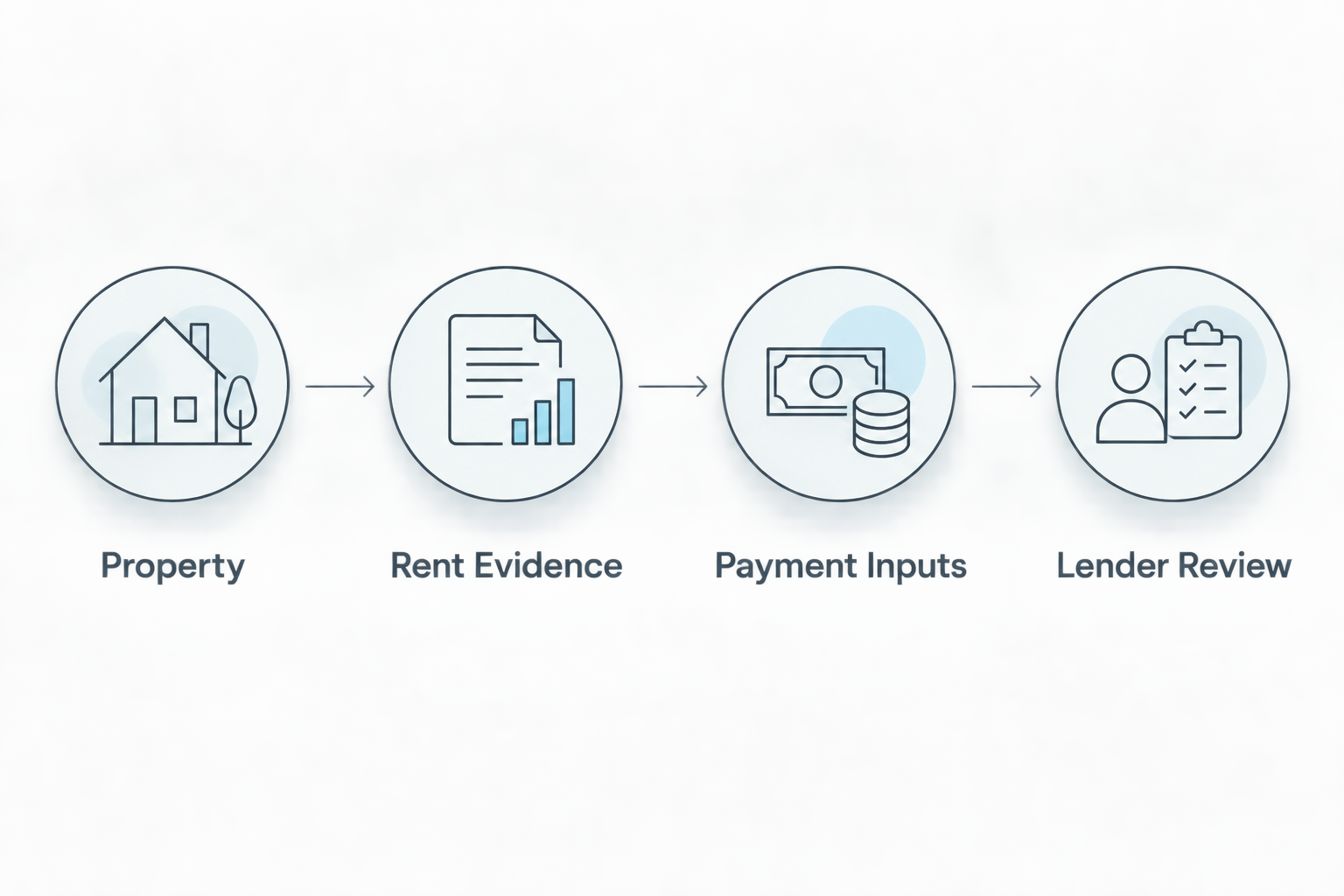
Confirm the evidence and payment definition before relying on the reviewed ratio.
What the ratio actually tells you
At 1.00x, the selected income exactly covers the selected payment. Above 1.00x, it exceeds that payment; below 1.00x, it falls short. These are mathematical relationships, not published approval thresholds for a particular program.
For your 2026 analysis, record the lender's actual minimum beside the calculation. Do not borrow a threshold from an unrelated property type, another lender, or a prior transaction.
Qualification package and review gate
A useful submission lets the reviewer trace each input back to its source. Send the evidence with the calculation, not a screenshot of the ratio alone.
- Prepare a property summary stating the address, intended rental use, occupancy, transaction type, and financing request. Identify any renovation or leasing assumption that remains unresolved.
- Attach rental research with its date and search criteria. Include the lease if applicable, keeping security deposits, reimbursements, and recurring rent distinguishable.
- Include the proposed payment assumptions and available tax, insurance, and association documentation. Identify estimates rather than presenting them as final figures.
- Ask the broker to confirm acceptable rent evidence, qualifying income, payment treatment, credit requirements, reserves, and loan-to-value limits. Loan-to-value, or LTV, compares the loan amount with the property value used by the lender.
- Record the response in Lender Review, then update Reviewed DSCR only from confirmed inputs. Keep approval conditions separate from the arithmetic result.
Expected result: Your submission supports a financing review without claiming approval. Loanguys can discuss DSCR financing, but the selected lender determines the documentation and underwriting conditions that apply.
Discuss your DSCR financing
Bring your rental research, property details, and payment assumptions to a mortgage-broker conversation.
Refresh the workflow when rent or payments change
Use the same worksheet when a lease changes, a financing proposal is revised, or new rent evidence arrives. The advantage is continuity; the limitation is that every affected input still needs review.
- Duplicate the prior worksheet version rather than overwriting the reviewed record. Name the revision with its actual 2026 review date.
- Update the changed source: lease, rental research, payment proposal, tax information, insurance documentation, or association assessment.
- Recalculate Research DSCR immediately, but mark Reviewed DSCR as awaiting reconfirmation if an accepted input changed.
- Send the changed evidence and a short explanation to the broker. Ask which documents require refreshing before the file proceeds.
Expected result: You retain an audit trail showing what changed and why the ratio moved. A new estimate stays an estimate until the lender accepts it.
For an occupied property, the lease deserves explicit attention. Do not assume a stronger market estimate replaces lower contractual rent, or that a higher lease automatically overrides an appraiser's market-rent conclusion.
Troubleshooting
Rental comps do not resemble the subject
Recheck the address, bedroom count, property type, and rental arrangement. Document why a result is unsuitable instead of silently discarding every lower-rent comparison. If comparable evidence remains weak, request guidance on the lender's required market-rent analysis.
Rentometer and the lease show different rents
Keep both figures and identify their different meanings: market research versus contractual income. Ask which figure the program uses and what supporting documentation is necessary. Never average them merely to resolve the disagreement.
The ratio falls after the payment review
Check whether the original screen omitted taxes, insurance, association dues, or a required assessment. Confirm the payment structure as well. Recalculate from the complete denominator rather than increasing rent to restore the earlier result.
The spreadsheet shows an error or a false pass
Check for blank payment cells, text stored as numbers, and formulas referencing the wrong property. Add a completeness check that prevents a reviewed result when qualifying rent or the confirmed payment is missing. Blank is more accurate than a misleading pass.
The lender does not accept the rental report
Ask for the required evidence and its ordering process. Keep Rentometer research as preliminary support, then obtain the lender-directed documentation. Do not repeatedly reformat the same report when the issue is its acceptability rather than its presentation.
Customize your workflow
For a portfolio, add one property record per address and preserve separate rent evidence, payments, and review status. Do not combine every property's rent and debt into one ratio unless the proposed loan explicitly uses portfolio-level underwriting.
For short-term rentals, build a separate evidence track. Long-term monthly rental comps do not establish nightly revenue, occupancy, or the income a short-term rental program will accept.
Keep qualification and investment decisions separate. Loanguys offers DSCR loan programs, but a financing discussion does not replace your operating budget or property due diligence. Before submitting your 2026 package, make sure every reviewed figure has a source and every remaining assumption has a label.
FAQ
Can I use Rentometer to qualify for a DSCR loan?
Use Rentometer for preliminary rental research, not standalone proof of qualification. The lender determines acceptable rent evidence and evaluates the other requirements for the proposed DSCR loan.
Does Rentometer connect directly to a DSCR lender?
This workflow does not require a direct connection. You record rental research in a worksheet and submit supporting documents through the lender's or broker's designated process.
What DSCR do I need for approval?
The required DSCR depends on the lender and loan program. Ask for the applicable minimum and calculation method before treating your spreadsheet result as a qualifying ratio.
Is a 1.00x DSCR enough to cover all rental expenses?
A 1.00x DSCR means only that the income and payment used in that calculation are equal. A rent-to-housing-payment calculation does not separately account for every repair, vacancy, management expense, or capital replacement.
Should I use lease rent or estimated market rent?
Use the rent figure required by the selected lender's rules. Preserve lease rent and researched market rent separately so the reviewer can reconcile any difference.
Can I use long-term rental comps for a short-term rental loan?
Long-term rental comps do not establish short-term rental revenue. Ask the lender which income method and documentation apply to the property's intended use.
Does a strong DSCR guarantee loan approval?
No, a strong DSCR does not guarantee approval. Property eligibility, credit, reserves, valuation, ownership structure, and other underwriting requirements still apply.
One last thing
A higher rent estimate does not always improve qualifying income. If the lender's rules rely on a different accepted figure, stronger preliminary comps leave the reviewed calculation unchanged. Ask which input controls the decision before spending time defending an estimate that will not be used.


