


SoFi alternatives for DSCR rental property loans

SoFi brings banking and borrowing into one online platform. That convenience does not establish whether a mortgage qualifies on rental cash flow rather than your personal income. The best SoFi alternative in 2026 is Loanguys if you need a broker offering DSCR rental property loans; a conventional investment-property mortgage is the better comparison if your documented income supports qualification.
TL;DR
- Compare SoFi alternatives for DSCR rental property loans by underwriting method, not lender familiarity.
- Loanguys offers DSCR, bank-statement, bridge, fix-and-flip, and short-term rental loan programs.
- Conventional investment-property mortgages suit borrowers whose documented income supports qualification.
- DSCR measures debt coverage; it does not measure your complete rental-property profit.
Why this matters
You need to separate two questions: who offers mortgages, and which mortgage fits your rental. A familiar banking platform does not answer the second question.
A debt service coverage ratio, or DSCR, loan evaluates the property's ability to cover its debt obligations under the lender's calculation. A conventional investment-property mortgage evaluates borrower income and debt alongside property eligibility. Neither approach makes a weak investment strong.
For your 2026 shortlist, choose the qualification method before choosing the company. This comparison separates a mortgage broker from alternative loan structures rather than presenting different financing products as interchangeable lenders.
SoFi alternatives at a glance
Use this table to identify the right conversation. For SoFi, confirm the exact mortgage program and its underwriting method directly; do not assume that an investment-property mortgage is a DSCR loan.
SoFi
- Best for: Borrowers comparing a mortgage alongside other online financial services
- Standout feature: Banking and borrowing within one platform
- Difference from starting with SoFi: Benchmark option; confirm rental-property and income-documentation requirements
Loanguys
- Best for: Investors seeking DSCR rental property financing through a broker
- Standout feature: Offers DSCR alongside bank-statement, bridge, fix-and-flip, and short-term rental programs
- Difference from starting with SoFi: Starts with an expressly identified investor-loan offering
Conventional investment-property mortgage
- Best for: Borrowers with qualifying documented personal income
- Standout feature: Borrower-income underwriting
- Difference from starting with SoFi: A loan structure to compare, not a separate provider recommendation
Bank-statement mortgage
- Best for: Self-employed borrowers needing an alternative income-documentation method
- Standout feature: Uses eligible bank deposits to evaluate income
- Difference from starting with SoFi: Changes how income is documented; not equivalent to DSCR underwriting
Bridge or fix-and-flip financing
- Best for: Investors buying or renovating before a long-term financing exit
- Standout feature: Temporary financing aligned with a transition or renovation
- Difference from starting with SoFi: Addresses a different property stage than stabilized rental financing
1. Loanguys: best for broker-assisted DSCR financing
Loanguys is a mortgage broker offering DSCR rental property loans and other investor financing programs across the United States. The relevant advantage is the starting point: you can discuss a rental-income-based loan rather than assume a general mortgage application fits your investment.
The broker also offers bank-statement, bridge, fix-and-flip, and short-term rental programs. That range matters when your initial request for a DSCR loan turns out to involve a different problem, such as renovation work or documenting self-employment income.
Where Loanguys shines
- Offers DSCR financing as an identified loan category.
- Offers separate programs for rental ownership, renovation, temporary financing, and alternative income documentation.
- Serves real estate investors and homeowners across the United States.
Where Loanguys falls short
- A broker relationship adds a distinction you must understand: identify the funding lender and who controls underwriting decisions.
- A DSCR application still requires property and borrower review; rental income does not create automatic approval.
- A broad program menu does not establish that your specific property, ownership structure, or loan request qualifies.
Business model
- Loanguys: Mortgage broker
- SoFi: Online banking and financial-services platform
DSCR starting point
- Loanguys: Explicitly offers DSCR programs
- SoFi: Confirm the exact mortgage program directly
Related investor programs
- Loanguys: Bridge, fix-and-flip, bank-statement, and short-term rental programs
- SoFi: Confirm which programs address your transaction
Best for: Investors who want to discuss DSCR qualification and alternative financing structures with a mortgage broker.
Verdict: Buy into the DSCR evaluation process, not an approval assumption.
2. Conventional mortgages: best for documented-income borrowers
A conventional investment-property mortgage deserves a place beside a DSCR proposal when your personal income supports qualification. Do not dismiss this route merely because you are buying a rental. The better fit depends on the complete transaction, not the financing label.
Conventional underwriting considers income, debts, credit, assets, and property eligibility. Rental income also receives program-specific treatment, so ask how the lender will calculate it rather than adding projected rent to your income yourself.
Where conventional mortgages shine
- Give borrowers with documented income a relevant alternative to property-focused qualification.
- Let you compare an established mortgage structure against a DSCR proposal for the same property.
- Keep the choice focused on your actual qualification strengths.
Where conventional mortgages fall short
- Personal debt obligations remain part of qualification.
- Income documentation can be a poor match for complicated self-employment finances.
- Borrower eligibility does not resolve property-condition or occupancy restrictions.
This is a financing category, not a claim that a particular lender will approve your application. Ask SoFi and any other provider whether the proposed mortgage follows conventional investment-property guidelines before treating the offers as equivalent.
Best for: Investors with documented income and a borrower profile suited to conventional underwriting.
Verdict: Hold this option alongside DSCR until you compare written requirements.
3. Bank-statement mortgages: best for self-employed investors
A bank-statement mortgage addresses how you document income. A DSCR mortgage addresses how a property's rental income supports debt coverage. Those are different problems.
Bank-statement underwriting evaluates eligible deposits under the program's rules, including how business expenses and ownership affect qualifying income. Gross deposits are not automatically qualifying income, and transfers between accounts are not new earnings.
Where bank-statement mortgages shine
- Provide an alternative documentation route for self-employed borrowers.
- Connect the application to business cash flow rather than treating deposits as irrelevant.
- Offer a comparison when personal-income qualification remains appropriate but standard documentation does not fit.
Where bank-statement mortgages fall short
- Require review of deposit sources and qualifying-income calculations.
- Do not eliminate borrower debt evaluation simply because tax-return documentation differs.
- Do not solve insufficient rental coverage under a separate DSCR program.
Best for: Self-employed investors whose primary obstacle is documenting personal income, not demonstrating property cash flow.
Verdict: Hold for comparison when income documentation is the actual obstacle.
4. Bridge and fix-and-flip loans: best for transitional properties
Bridge and fix-and-flip financing address a temporary stage: acquisition, renovation, or a transition before sale or longer-term financing. They are not substitutes for a long-term rental mortgage simply because both finance investment property.
Where transitional financing shines
- Aligns the financing conversation with property work and the intended exit.
- Separates acquisition needs from the requirements of a stabilized rental loan.
Where transitional financing falls short
- Requires a credible repayment or refinancing plan.
- Exposes you to execution risk if renovation, leasing, or the planned exit fails.
Best for: Investors whose property needs a transition before long-term rental financing fits.
Verdict: Skip as a permanent rental-financing solution; evaluate for a defined transition.
Why people look beyond SoFi for DSCR financing
The reason to expand your search is program fit, not an unsupported claim about service quality or underwriting outcomes. Your 2026 comparison should begin with the requirement that changes the application.
- Rental-income qualification: You want the property's qualifying rent evaluated against its debt obligations.
- Self-employment documentation: You need an income-documentation method suited to your business records.
- Property transition: You need acquisition or renovation financing before the rental is ready for long-term debt.
- Rental strategy: You need the proposed program to recognize the intended long-term or short-term rental use.
These are reasons to investigate alternatives, not evidence that SoFi rejected a particular transaction. Ask a direct question: does the proposed mortgage use DSCR underwriting for this property and intended use?
If the answer describes personal-income qualification instead, you are comparing different underwriting paths. That distinction matters more than whether both applications happen online.
How to compare DSCR proposals in 2026
Use the same property details and borrowing request for every discussion. Otherwise, differences in rent assumptions, ownership, or property condition can make unrelated proposals look comparable.
Rental income
Ask which rent figure the lender accepts and which documents support it. For a short-term rental, identify how the program evaluates rental history or projections before relying on booking estimates.
Debt coverage
Ask for the actual DSCR worksheet. In residential rental lending, calculations commonly compare qualifying rent with the proposed housing obligation; commercial calculations commonly use net operating income and debt service. Confirm the method instead of assuming the label guarantees consistency.
A 1.00x DSCR means the qualifying numerator equals the denominator. That is 100% coverage under that calculation, with a 0% surplus between those inputs. It is not proof of positive cash flow after every ownership expense, and it is not a universal approval threshold.
Cash requirements
Distinguish your down payment from reserves and other transaction funds. Loan-to-value, or LTV, compares the loan amount with the property value used by the lender; it does not tell you every cash requirement by itself.
Exit plan
Match the loan structure to your expected holding period. Ask about repayment restrictions, maturity, any balloon obligation, and the conditions attached to a future refinance.
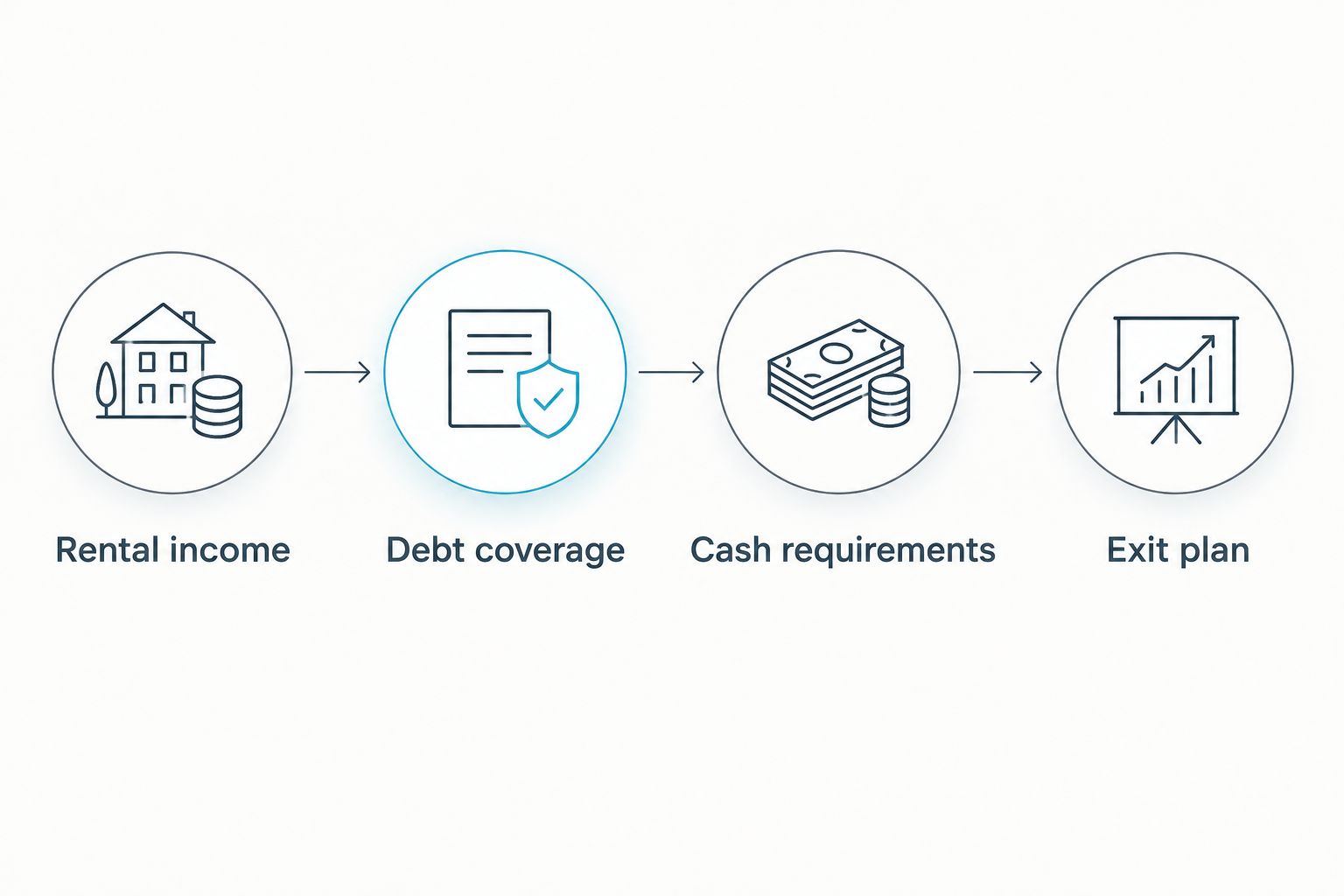
Compare the same rental assumptions, debt calculation, cash requirements, and exit plan.
A useful proposal explains all these elements together. Do not accept an attractive coverage calculation without understanding the funds required and the repayment structure.
Discuss your rental financing
Review DSCR, bank-statement, bridge, and short-term rental financing for your property.
When staying with SoFi is the right call
Keep SoFi in your 2026 comparison if the mortgage it proposes matches your property, intended occupancy, documentation, and repayment needs. A separate DSCR application is not automatically better when you already qualify for a suitable mortgage.
Stay with the financing structure that fits the transaction, not with—or against—a familiar brand. Before proceeding, confirm property eligibility, the income calculation, required funds, and repayment conditions in writing. Compare alternatives using those same facts.
FAQ
What's the best SoFi alternative for DSCR rental property loans?
Loanguys is a relevant alternative if you need a mortgage broker offering DSCR rental property loans. Compare the proposed program's rental-income calculation, property eligibility, required funds, and repayment conditions before choosing.
Does an investment-property mortgage mean the same thing as a DSCR loan?
No. Investment-property mortgage describes the property's use, while DSCR describes a debt-coverage underwriting approach. Ask the lender which qualification method applies to the specific program.
Can I assume SoFi offers the DSCR structure I need?
No; confirm the exact underwriting method directly with SoFi. Ask whether the program qualifies your rental using debt service coverage or evaluates personal income and debts under another mortgage structure.
Is a DSCR loan better than a conventional rental mortgage?
Neither is automatically better. DSCR financing focuses on rental debt coverage, while conventional underwriting evaluates borrower income and debts alongside property requirements. Compare both when your application fits both paths.
Does a DSCR of 1.00 mean my rental is profitable?
No. A 1.00x DSCR means the qualifying income measure equals the debt obligation used in that calculation. Expenses outside the calculation still affect your actual profit.
Should a self-employed investor choose DSCR or a bank-statement loan?
Choose the comparison based on the qualification problem. DSCR financing evaluates rental debt coverage; bank-statement financing evaluates qualifying income through eligible deposits. Neither structure guarantees approval.
Can a bridge loan replace long-term rental financing?
A bridge loan addresses a temporary financing need rather than serving as a permanent rental strategy. Establish how you will repay or refinance it, and confirm the requirements of that exit before committing.
One last thing
An acceptable DSCR is not a complete investment analysis. A lender's qualifying-income calculation and your operating budget answer different questions.
Before committing, build a separate budget that includes vacancy, maintenance, management, and capital repairs. Then check whether the financing still supports your ownership plan without treating lender approval as proof that the rental works.


